



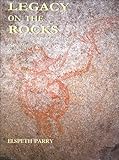
Elspeth Parry. Legacy on the Rocks. The Prehistoric Hunter-Gatherers of the Matopo Hills, Zimabwe. Oxford: Oxbow Books, 2000. x + 134 pp. $29.95 (cloth), ISBN 978-1-84217-010-6.
Reviewed by Terence Ranger (Visiting Professor, History, University of Zimbabwe )
Published on H-SAfrica (November, 2000)
'Written for Whom?'
'Written for Whom?'
It is puzzling to know for what audience this book is intended. Although its author and illustrator both live in Bulawayo, Zimbabwe, the price of the book makes it prohibitive for Zimbabwean readers and even for Zimbabwean libraries. It is abundantly illustrated with photographs and line drawings but it is in no sense a coffee-table or tourist book. Nor can it be aimed at an academic market. It offers laywoman's descriptions of techniques like carbon-dating. The author proudly describes herself as an amateur in the long line of amateurs who have loved the rock art of Matopo. This makes her perhaps excessively respectful to other scholars. 'As the whole arena of Bushman art is open to speculation and many assumptions', she writes, 'it is hoped that the author will open up new avenues of thought and not trigger any explosive reactions with controversial theories'. (p.80)
I could not detect any new avenues of thought and I don't suppose there will be many explosive reactions. Those who have already read Peter Garlake or Nick Walker will find nothing fresh here, unless it is the author's romantic evocation of the hills and her readiness to draw on poets and novelists. The genuinely novel feature of the book lies not in the text but in the illustrations which depict a number of hitherto unrecorded sites and are claimed by the publishers to be 'the most accurate drawings ever produced'. Maybe there is a special rock art market. Oxbow Books has published four other collections on rock art -- in the Americas, globally -- though nothing as focussed on one particular area.
At any rate, whoever reads this book will find that it exemplifies with particular clarity the dilemmas and paradoxes of rock art analysis. Like other authors, Elspeth Parry emphasises that the Matopo artists are long vanished. They are 'a race of extinct people'. (p.viii) Like authors she warns against making use of contemporary ethnographic material about the Kalahari Bushmen - and then proceeds to do so. I find it hard to understand why there should be this emphasis on extinction. Parry assumes that the painters were Bushmen - and comments on one drawing, for instance, that it shows a typical Bush female shape. But the Bushmen, if they can be called a race at all, are certainly not an extinct one. They are not extinct even in Zimbabwe. Certainly at the end of the nineteenth century there were Bushmen living a day or two's march from the Matopo. No historian has put together the abundant archival material available on the Bushmen of western Zimbabwe but it could and should be done.
Parry imputes various splendid qualities to her vanished race. Maybe, as 'a proud people' (p.19) they chose 'to remain isolated' and withdrew from the hills as the pastoralists arrived? But as she herself says, the sparseness of evidence of interaction between the Bushmen and the herders is due to the lack of archaeological work in western Zimbabwe. It seems likely that the descendants of the painters did not vanish at all but were assimilated, along with many other peoples, into the Iron Age population of the Matopo. Recent reinterpretations of the most prolific periods of South African rock art, indeed, suggest that they are evidence precisely for contact between hunters and herders. The emphasis on 'shamanism' in the paintings, it has been argued, arises out of the character of interaction between Bushmen and pastoralists, with the latter relying on Bushmen for rain-making and hunting magic and the former developing and emphasising these valuable skills. This certainly is a 'controversial' theory with which one might have 'explosive reactions'. But it seems worth exploring in Matopo. Parry allows herself to make reference to myths of Mwali, the High God of the hills, while at the same time emphasising that the rock painters vanished long before the Mwali shrines emerged. Yet continuities in rain-making (which is not mentioned in this book) seem very much worth exploring.
Although Parry's artists vanished so long ago, in another strand of her book they are present; they are us -- or at least they are us as we once were, when we were humble and natural and peaceful. Viewers of the paintings should seek to imagine themselves back in a lost Utopia. Here she draws upon the idealisations of Bush society by authors like Van der Post. Yet do the paintings bear out this Utopianism? They are certainly assertions of masculinity; they seem to be attempts to control nature rather than to reflect it. Were not the painters likely to have been a human society like all others --competitive, striving, violent? Should not the paintings be used for history rather than for Utopia?
The Matopo hills are certainly a magnificent landscape. Parry has enjoyed the 'enchantment of misty mornings', 'the glorious vistas of rolling hills', 'endless unmatched experiences and ... the uncanny feeling of the Bushman's presence'. (p.viii) One can well believe that her wanderings in the hills 'have been a wonderful adventure, full of thrilling experiences.' (p.ix) But the adventure has been an emotional one, rather than an intellectual one. Readers who want to 'relive' Parry's excitement and to 'appreciate, as I do, a lost race of great people', probably don't need the careful accuracy of the line drawings. Readers who want to now what to make of these images probably do not need the romantic enthusiasm. This is a book which falls between two rocks.
Copyright (c) 2000 by H-Net, all rights reserved. This work may be copied for non-profit educational use if proper credit is given to the author and the list. For other permission, please contact <H-Net@h-net.msu.edu>
If there is additional discussion of this review, you may access it through the network, at: https://networks.h-net.org/h-safrica.
Citation:
Terence Ranger. Review of Parry, Elspeth, Legacy on the Rocks. The Prehistoric Hunter-Gatherers of the Matopo Hills, Zimabwe.
H-SAfrica, H-Net Reviews.
November, 2000.
URL: http://www.h-net.org/reviews/showrev.php?id=4686
Copyright © 2000 by H-Net, all rights reserved. H-Net permits the redistribution and reprinting of this work for nonprofit, educational purposes, with full and accurate attribution to the author, web location, date of publication, originating list, and H-Net: Humanities & Social Sciences Online. For any other proposed use, contact the Reviews editorial staff at hbooks@mail.h-net.org.

