



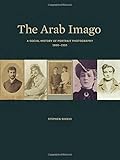
Stephen Sheehi. The Arab Imago: A Social History of Portrait Photography, 1860-1910. Princeton University Press, 2016. pages cm. $45.00 (cloth), ISBN 978-0-691-15132-8.
Reviewed by Tina Barouti (Boston University)
Published on H-AMCA (January, 2017)
Commissioned by Jessica Gerschultz (University of Kansas)
The Arab Imago: A Social History of Portrait Photography, 1860-1910, the title of Stephen Sheehi’s crucial book, urgently shifts the center of scholarship to consider the indigenista photograph, particularly its production, discourse, performance, exchange, circulation, and display in Ottoman Egypt, Lebanon, and Palestine from 1860 to 1910, thereby reversing historical narratives of Middle Eastern photography, which have focused on the production and perspective of the colonisateurs, largely overlooking the contribution of native photographers (p. xxii). Sheehi borrows the term “indigenista” from Latin American anthropologist Deborah Poole, whose examination of photography in turn-of-the-century Peru and the country’s processes of embourgeoisement parallels that of the Ottoman world, showing that the rise in portrait photography as a social practice and a growing middle class could be found in diverse regions of the global South. The time frame of Sheehi’s text is significant in that it marks the rise of the Tanzimat, a series of reforms and processes of modernization in the Ottoman Empire, and nahdah, or renaissance, in the Arab world in 1860 and the decline of the Osmanlilik project in 1910. Composed of two parts, “Histories and Practice” and “Case Studies and Theory,” The Arab Imago contains eight chapters that are oriented around two poles: the analytical and practical history of indigenista photography in the Ottoman Arab world and an abstruse theorization of the multifold levels of photography as a “social and ideological act” (p. xxxvii).
Sheehi’s The Arab Imago not only provides the field of Middle Eastern photography with an introduction to unexplored photographers, photographic practitioners, texts on photography, and photography studios, but also sets forth a new methodology wherein an analysis of the manifest and latent content of indigenista photography can elucidate the “nature of photography” in the Ottoman Arab world. He uncovers its particular history, ideology, and social relations, which have been overshadowed by those of the colonisateurs. Although the art-historical canon has a long way to go before the focus is shifted from the foreign to the native photographer, Sheehi’s text is a valuable contribution to the nascent stage of this developing scholarship.[1] Overall, The Arab Imago succeeds in its attempt to “deprovincialize” the history of Eastern photography, specifically of the Ottoman Arab world, from European master narratives. Sheehi explains that in a variety of disciplines Middle Eastern and European modernity are incorrectly enmeshed. Although the author acknowledges that Ottoman reformers looked to Western models for inspiration, they were both “self-aware” and had specific “ideological intent” (p. 6). It can be said, therefore, that Ottoman modernity is autonomous from that of the West and that Ottoman photography is purely an Ottoman phenomenon.
In his introduction, Sheehi addresses the conundrum of Arab photography by tackling a question commonly posed in art-historical and curatorial discourse: “How is Arab photography really different?”[2] According to Sheehi, if the so-called Eastern image is formally different from the “Western master-image,” it runs the risk of perpetuating unflattering narratives of “Otherness,” which maintain the traditional power dichotomy of “dominant West” vis-à-vis “submissive East.” If the Eastern image is formally similar, it is reduced to a mimicry of the Western image. Both cases sustain reductive East-West binaries and strip the Eastern image and its producers of any agency. The Arab Imago aims to solve this dilemma by stressing the role of the indigenous photographer as not a passive consumer but an innovator of photographic technology. Although many Arab portraits reproduce the “genetic patterns” found in the formalism of European images, they are imbued with Osmanlilik and nahdah ideology.[3] The formal similarities are not direct imitations nor are they the result of a lack of knowledge and skill on the part of the indigenista photographer; rather, the visual parallels are the result of the nature of the medium. Photography, according to Sheehi, was an “organically native social practice” in the Ottoman Arab world of the mid-nineteenth century to the early twentieth century (p. 32). The images Sheehi presents in The Arab Imago are loaded with ideological meaning particular to the Ottoman Arab world during a period of reform and modernization.
Sheehi cites three principles that make up the nature of photography in the late Ottoman Arab world, which he repeats consistently throughout the text: all photography expresses social relations; photography is an afterimage rather than a producer of political, economic, class, national, and subject formation transformations; and the portrait as a material object operates on both the manifest and the latent level (p. xxiii). Additionally, the The Arab Imago can be reduced to the following two themes or functions of photography: the portrait as ideological tool and the portrait as stabilizer of identity. The manifest is concerned with the formal qualities of the photograph; it is the surface of the image that contains visual cues or an index of recognizable physical and ideological signs that “enact” the ideas of nahdah ideology, thereby allowing the photograph to also be a performance of sorts. The manifest also stabilizes and homogenizes its subjects, satisfying the Osmanlilik ideology of inclusion and universality amongst all citizens of the Ottoman Empire. Interestingly, as in the case of the portrait of governor Midhat Pasha, who had a reputation for suppressing revolts in Iraq, the manifest level can be violent by “re-working” or erasing the latent content of an image (fig. 62, pp. 158-160). In the case of the Iraqi governor, his portrait conceals the “violence of modernity and the reform project” (p. 159). Because The Arab Imago is a social history of portrait photography in the Ottoman Arab world, Sheehi is more concerned with the latent level of the photograph, which contains hidden histories of how the manifest content became naturalized, how the signification system became intelligible, and how the imago of the portrait became recognizable and desirable.
The theme of photography as ideological tool is apparent in Sheehi’s discussion of the Ottoman sultans, particularly Sultan Abdülaziz, who used photography as a way to contain and regulate modernizing projects. Photography had the ability to “imprint” the “optical unconscious” of Osmanlilik ideology and reproduced a particular “perspective”—through genetic patterns, or the manifest level—of the photograph, that reflected the Ottoman Empire’s new efforts of reorganization, reform, and modernization. Sheehi’s second chapter, “The Arab Imago: Jurji Saboungi and the Nahdah Image-Screen,” provides examples of these genetic patterns and explores how photography “interpellated” Osmanlilik modernity as Arab subjectivity during the nineteenth-century “Arab Renaissance” (p. 28). Using an undated image of Shaykh Effendi al-Khuri and one of an anonymous sitter taken by the photographer Saboungi, Sheehi identifies orthodox visual iconography, such as a forward gaze, which stabilizes the body and posture; a slightly rigid stance; and an arm resting on a rococo chair (fig. 18, p. 34). These two images exude virtues associated with the nahdah-Tanzimat ideology, such as perseverance, temperance, ambition, knowledge, and patriotism. The iconography seen in these two images and others used in Sheehi’s text, which are often strategically banal, insignificant, and anonymous photographs, represents a visual standard for the “new men and women” and is repeated time after time. Questions of how the images of “new women” differed from those of “new men” on the manifest level need further fleshing out in future scholarship. The lack of identification of the anonymous sitter documented by Saboungi, despite his anonymity, has the same ideological effect as an image of the nahdah’s most prolific writer, Jurji Zaidan, taken by an unknown photographer (fig. 19, p. 35). An image of a prestigious writer is placed beside that of a common, unidentified man. Here, the Ottoman portraits’ use of similar visual codes ideologically flattens them, thereby challenging traditional art-historical methodologies and forcing the viewer to reach beyond the portraits’ composition and into their latent content (pp. 48-49). Saboungi’s images, according to Sheehi, are a “concrete afterimage” of social relations (p. 46).
Photography, as a stabilizer of identity, the second major theme, is evident in the carte de visite. This new format of portraiture aided in the process of flattening identity: posing was quick, standardized, and allowed for nearly every class of society, from the “prestigious” to the “commonplace,” to fall under the same formula. This standardization allowed Ottoman citizens, whether Armenian, Greek, or Arab, to appear formally alike, thereby satisfying the Osmanlilik ideological goals and resulting in a form of “ethnic erasure.” Sartorial codes, however, can locate a photograph’s sitter within a particular locale. For example, in a carte de visite image of a young couple taken by Saboungi and Krikorian around 1880-90, the garb worn by the sitters locates them in Ottoman Syria (fig. 32). According to Sheehi, they project their “own version of cosmopolitan Arab modernity” (p. 63). Moving away from the book’s general concentration on the middle- and upper-class population, Sheehi states that the carte de visite, despite being uneven, was a mass social practice. Aside from the peasant class, Ottoman Arab “cartomania” meant that every private citizen may have had at least one image taken in a lifetime (p. 60). A deeper examination of these non-effendiyah-class carte de visits would be a compelling future project.
In addition to exploring photography as a representative of ideology and a flattener of Ottoman identity, Sheehi also pays particular attention to the discourse surrounding photography. In the chapter “Writing Photography: Technomateriality and the Verum Factum,” Sheehi reviews public writing of al-nahdah al-‘arabiyah on photography in the Arab press. Unlike in Europe, photographic practitioners in the Arab world, according to Sheehi, were not “plagued” by questions of whether their craft was a “bastard child” of painting and science; rather they viewed photography as a tool for “progress and reform” (p. 75). Writing about photography resulted in a “coherent” Ottoman Arab discourse on the practice, which was rapidly changing social reality (p. 76). Sheehi explores the writing of several prominent figures, such as Dr. Yusuf al-Jalkh, who was part of Beirut’s new class of “organic intellectuals.” Although highly Eurocentric, recounting accomplishments of photography’s forerunners such as Joseph Nicéphore Niépce, Louis-Jacques-Mandé Daguerre, William Henry Fox Talbot, and Frederick Scott Archer, al-Jalkh’s 1869 “A Treatise on Physical Science and Photography,” which was the first public presentation in Arabic by an Arab intellectual on photography, perceived photography as a modern practice that was essential to Arab “progress.” The Arab press played an important role in the creation of this new public discourse. Authors such as Shahin Makarius, who published articles for the journal al-Muqtataf, supplied specific instructions in his articles on how to take a photograph. Journals such as al-Muqtataf, al-Fotograf, and al-Funun wal-tawsir al shamsi offered spaces for public intervention via question-and-answer sections. According to Sheehi, the lack of articles on “how to read” a photograph or what makes a “good photograph” indicates that the portrait was perhaps already legible, at least for the journals’ literate target audience (p. 92). Nahdah writing related to the field of photography proves that photographic practitioners in the Ottoman Arab world were aware of what Christopher Pinney calls the “technomateriality” of the practice and were not merely passive consumers of photography, but educated themselves in its origins, style, science, and participated in its innovation.
The second part of the The Arab Imago provides readers with case studies that put the theory set forth in the first half of the text into practice. Chapter 5, “Portrait Paths: The Sociability of the Photographic Portrait,” examines the portraits found in Wasif Jawhariyyeh’s albums in Ottoman and Mandate Palestinian society. Chapter 6, “Stabilizing Portraits, Stabilizing Modernity,” is a case study of Masis Bedrossian and Ahmad Amin and examines the idea of “manifest content” even further. In chapter 7, titled “The Latent and the Afterimage,” Sheehi dissects the ways the manifest level of the image can overpower its latent content, much like the earlier example of Midhat Pasha’s portrait. The final and most provocative chapter, “The Mirror of Two Sanctuaries and Three Photographers,” focuses on the ignored travels and images of Sadiq Bey, Ibrahim Rif’at Pasha, and Muhammad ‘Ali Sa’udi and the way new social relations resulting from nahdah and Osmanlilik ideology were received in nonmetropolitan locales and nonsecular practices of the Ottoman Empire, particularly during the Hajj (p. 165). As reiterated throughout the text, photography was used by the Ottoman state as an instrument of national progress, order, and organization and served as an afterimage of the social transformations resulting from Arab modernity. Superstition and aggression outside the metropole and within Hijazi space towards the camera was not a reaction against image making, particularly of figures, but a “rising fanaticism” that associated the camera and photography with violent transformations and a “mechanized” and “rationalized” world order that pushed against older, traditional regimes of social hierarchy (p. 186). These anxieties, according to Sheehi, indicate the power of the camera as a tool for modernization and reform and indicate the “materialist and ideological nature of photography” (p. 192).
Sheehi’s text is timely given the 2015 exhibition staged at Koç University in Istanbul titled “Camera Ottomana: Photography and Modernity in the Ottoman Empire, 1840-1914” curated by Zeynep Çelik, Edhem Eldem, and Bahattin Öztuncay.[4] Unlike The Arab Imago, “Camera Ottomana” focuses on more than just studio portraiture, including documentations of construction projects such as Istanbul’s Galata Bridge. Both the exhibition and Sheehi’s book examine native photographers and the display of modernity through photographic practice. The Arab Imago, which focuses primarily on the “new men” of the Ottoman Arab world, leaves room for future scholars to investigate complex issues of gender and class, particularly as related to women and the lower classes outside of the metropoles that Sheehi, with full awareness, only briefly mentions in his critical text.[5] For example, the ways that women and the abject classes fit within Osmanlilik and nahdah ideology and reform processes and how they were represented photographically have yet to be critically assessed. Overall, Sheehi’s text is a deep scholarly investigation of portrait photography in the late nineteenth and early twentieth centuries that lays out a new methodology for examining historical photographs from indigenous photographers of the Ottoman world and potentially other regions of the global South, thereby adding an important, missing element to the field of photo-history.
Notes
[1]. Although not exclusively focused on indigenous photographers, the following publications contain several essays on native photographic practices from the African continent: Elisabeth L. Cameron and John Peffer, eds., Portraiture and Photography in Africa (Bloomington and Indianapolis: Indiana University Press, 2013); and Erin Haney, ed., Photography on Africa (Chicago: University of Chicago Press, 2010). Other publications related to indigenous photographers from the Middle East include Badr El-Hage, “The Armenian Pioneers of Middle Eastern Photography,” Jerusalem Quarterly 31 (2007): 22-26, Saudia Arabia: Caught in Time 1861-1939 (London: Garnet, 1997), and “Khalil Raad- Jerusalem Photographer,” Jerusalem Quarterly (Winter 2001): 11-12, 39; Mona Khazindar, Djamila Chakour, and Hoda Makram-Ebedi, L’Orient des photographes arméniens (Paris: Institute du Monde Arabe, 2007); Issam Nassar, “Familial Snapshots: Representing Palestine in the Work of the First Local Photographers,” History & Memory 18, no. 2 (2006): 139-155, and “Early Local Photography in Palestine: The Legacy of Karimeh Abbud,” Jerusalem Quarterly 46 (Summer 2011): 23-31; Markus Ritter and Staci Scheiwiller, eds., The Inidgenous Lens: Early Photography in the Middle East (Zurich: University of Zurich Press, forthcoming). Photography’s Orientalism: New Essays on Colonial Representation, edited by Ali Behdad and Luke Gartlan and published by the Getty Research Institute in 2013, provides several essays that consider the role of native photographers as well as European ones working in the Middle East and India. Additionally, the Arab Image Foundation is a nonprofit organization founded in Beirut, Lebanon in 1997 with the mission to rescue and preserve indigenous Arab photography. For more information see their website at http://www.fai.org.lb/home.aspx.
[2]. It is important to clarify the use of the term “Arab” in Sheehi’s text: “Arab” is not presented as a strictly racial category; rather it is a term that can refer to non-Arab ethnicities and non-Muslim minorities that shared a common history and language in the Ottoman world (p. xxiv).
[3]. Sheehi borrows the term “genetic patterns” from literary theorist and literary critic Paul de Man. “Genetic patterns” or “generic qualities” standardize Ottoman Arab portrait photography and are repeated in the formalism of the portraits examined in The Arab Imago.
[4]. For more information on the “Camera Ottomana: Photography and Modernity in the Ottoman Empire, 1840-1914” exhibition, see the “Ottoman History Podcast,” http://www.ottomanhistorypodcast.com/2015/08/ottoman-empire-photography-edhem-eldem.html, and the exhibition website, http://cameraottomana.ku.edu.tr/.
[5]. For more information on women in early photography of the Middle East, see Sarah Graham-Brown, Images of Women: The Portrayal of Women in Photography of the Middle East, 1860-1950 (London: Quartet, 1988).
If there is additional discussion of this review, you may access it through the network, at: https://networks.h-net.org/h-amca.
Citation:
Tina Barouti. Review of Sheehi, Stephen, The Arab Imago: A Social History of Portrait Photography, 1860-1910.
H-AMCA, H-Net Reviews.
January, 2017.
URL: http://www.h-net.org/reviews/showrev.php?id=46828
 | This work is licensed under a Creative Commons Attribution-Noncommercial-No Derivative Works 3.0 United States License. |

