

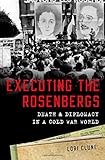
Lori Clune. Executing the Rosenbergs: Death and Diplomacy in a Cold War World. Oxford: Oxford University Press, 2016. 280 pp. $29.95 (cloth), ISBN 978-0-19-026588-5.
Reviewed by Mary Nolan (New York University)
Published on H-Diplo (August, 2016)
Commissioned by Seth Offenbach (Bronx Community College, The City University of New York)
In 1950, Communist Party members Julius and Ethel Rosenberg were tried and convicted for passing atomic secrets to the Soviet Union, and after numerous appeals, they were executed in June 1953. This most famous of US espionage cases received enormous and contentious attention in America at the time, and for decades was the subject of intensive historiographical and political disputation. Even after the 1994 publication of the Venona transcripts of Soviet documents on American spies and the 2008 admission by codefendant Morton Sobell that he and Julius had passed military secrets, American interest in the case continues. What exactly were the Rosenbergs’ motives? How valuable was the information passed to the development of the Soviet A-bomb? What exactly did Ethel know and should she be posthumously pardoned? Given how extensively these questions have been debated, do we need another book about the Rosenbergs?
Lori Clune, professor of history at the University of California, Fresno, argues that we do. Her book neither focuses on the intricacies of the trial and appeals, although she does present thorough overviews of them, nor does it debate the Rosenbergs’ motives and guilt. Rather, it is the reactions to the trial and execution in countries around the globe that concern her. While protests by Communists and non-Communists alike within the United States have been extensively studied, those outside have not. In large part, this is because State Department documents on international reactions could not be found in the National Archives; references to Julius and Ethel Rosenberg were not in the name card index, as Clune discovered. With the help of archivist David Pfeiffer, reports from embassies, consulates, and legations were recovered, providing Clune with a rich, unread collection of documents.
Covering the period from 1952 to 1954, these reports track expressions of concern and active protests in cities across forty-eight countries, ranging from New Zealand, Brazil, and India to Mexico, South Africa, and Iceland. The vast majority, however, come from Western Europe. China and much of Africa did not respond or responses were not recorded. Officials at embassies and consulates tried to assess the character and import of foreign responses, providing Washington with petitions as well as newspaper editorials and articles as supporting material. The responses, or more often, lack thereof, of State Department officials in Washington and of Presidents Harry Truman and Dwight Eisenhower are included as well. The collection shows that State Department officials abroad meticulously and anxiously tracked international concern about the fairness of the trial and the humanity and political consequences of the executions. It also shows that State Department officials in Washington, Truman and Eisenhower, and their advisers equally assiduously dismissed protests as uninformed, inappropriately interventionist, or Communist. Then, for reasons Clune has not been able to discover, the reports of pervasive negative foreign responses were buried in the archives for decades.
Executing the Rosenbergs is driven by and hews closely to the State Department documents, which Clune retrieved. That is the strength and contribution of this work, but it is, as we will see, also its weakness. The book moves chronologically through the sentencing, appeals, and execution, looking first at Communist responses, then more politically diverse ones. Although the reports are often repetitive, and rather superficial, they reveal a range of oppositional stances to the case and its conclusion.
The KGB attributed the trial and death penalty to an American spy mania, a growing danger of fascism, and a desire to blame Jews and Communists for the war in Korea—themes not widely picked up, even in the European and American Communist press. Communist papers focused on judicial irregularities, weaknesses in the evidence against Ethel, and the harshness of the sentence. Socialist and liberal papers across Europe soon picked up on these themes. Papers like the French mainstream Le Figaro argued that the death penalty would not deter spying but would create Communist martyrs and thus provide the Soviets with a propaganda tool. Members of the British Labour Party reiterated this view. Pope Pius XII, as staunch an anti-Communist as one could hope to find, opposed execution on humanitarian grounds; the death penalty was abhorrent and it would be tragic to orphan the couple’s two young sons. Catholics across Europe and Latin America joined in this anti-death penalty protest as did Protestants. Both argued that execution would be extreme, while clemency would show the humanity, restraint, and strength of the United States. The protests of Scandinavian trade unionists and women’s groups also featured opposition to the death penalty prominently. Many advocated clemency regardless of whether Julius and especially Ethel were guilty. The centrality of anti-death penalty views across diverse groups is intriguing and calls for more investigation, especially since all countries except West Germany and Italy still had the death penalty on the books. Was condemnation of the death penalty genuine or deployed instrumentally? Did this mark the beginning of a transatlantic divide around this issue?
As final appeals were exhausted and the execution date neared, protests mounted. The pope continued to urge clemency, the president of France wrote directly to Eisenhower with the same recommendations, and all Italian non-Communist papers recommended commuting the sentences. Latin American protests became rhetorically more extreme, labeling government actions imperialist and bullying. Ninety-five thousand people, mostly Europeans, sent letters pleading for clemency in the week prior to the execution.
Throughout the mounting protests, State Department officials on the ground begged Washington for more materials with which to counter criticism and persuade foreigners that the trial and sentence were legal, just, and necessary. Their reports and pleas were often simply marked “no action” and filed away unanswered. Pleas from personnel in Europe, however, sometimes got attention. Secretary of State Dean Acheson recommended arguing that death was the only possible sentence legally and was fair, given the systematic character of their espionage activities. Charges of anti-Semitism were outrageous and judge and jury were not biased. Those confronting protest directly, such as press attaché Ben Bradlee in Paris and the embassy personnel in Bonn found this of inadequate help as were United States Information Services bulletins that often contained factual mistakes. Bradlee wrote his own assessment of the case that defended the verdict and insisted on the high value of the evidence passed to Moscow. This was circulated to US embassies worldwide where protests were occurring, but it did not address what was the major concern in France and elsewhere, namely, clemency rather than guilt. As US ambassador to France C. Douglas Dillon wrote in an eyes-only memo to Washington in May 1953: “the great majority of French people of all political leanings feel that death sentence is completely unjustified from [a] moral standpoint and is due only to [a] political climate peculiar to [the] United States.... If [the] death sentence is carried out, this will have a most harmful long term effect on the opinion and attitudes of the French people towards the United States” (p. 96). Dillon insisted that other American diplomats in Europe shared his analysis.
Eisenhower and his advisers were unmoved. Although there had been some divisions within the government, with the Psychological Strategy Board briefly favoring clemency in early 1953, most Americans inside and outside the government took a hard line. Eisenhower’s motives were many. He was convinced that the Rosenbergs had not only materially aided the Soviets but also bolstered their confidence and aggressive tendencies and thus were responsible for the stalemated Korean War. Eisenhower saw clemency as weakness while those protesting the execution from abroad saw it as both a strong and humane gesture. While Europeans of many political and religious orientations argued that executing a mother of young children was inhumane, Eisenhower viewed Ethel as the older, stronger, and more manipulative member of the couple, one who was every bit as responsible for what happened as Julius, if not more so. US officials and foreign opponents of execution talked past one another; their understandings of the nature of clemency were mutually exclusive; and their judgments of Ethel as a wife and mother and of the importance of not creating orphans could not be reconciled. Eisenhower and his advisers listened to domestic opinion over foreign views, dismissing the latter as ignorant or Communist-inspired or too insignificant to be bothered with. They were confident that they could weather any adverse diplomatic consequences.
Were there any? What does the wave of protest Clune documents tell us about the longer arc of foreign attitudes toward the United States and about the shape of the early Cold War as an international, and not just an American, phenomenon? Executing the Rosenbergs is disappointing in regard to these larger questions. The book’s heavy reliance on the exchanges between diplomats abroad and the State Department at home limits its ability to analyze who actually protested abroad, why, and on behalf of what political and ethical visions. We learn a great deal about what American officials thought was happening and who they thought was behind various protests and concerns. But we get only decontextualized snapshots of protest rather than an understanding of the local and national contexts and political movements from which they came. One wishes Clune had delved deeply into a few foreign sites to read not just US materials but also a variety of other sources, as Moshik Temkin did in his book, The Sacco-Vanzetti Affair: America on Trial (2011). Then we would better understand the context in which they viewed the Rosenberg case. Some Europeans, for example, raised the Sacco and Vanzetti affair, while some Latin Americans referenced a long history of problematic hemispheric relations. But for many countries the particular historical and political context is unclear. Nor do we learn whether and how those who protested the trial and execution drew on and reshaped previous national attitudes toward the United States. Did responses spring from and reinforce anti-Americanism or reflect ongoing ambivalence, what Temkin calls “conflicted Americanism.”[1]
Once the executions occurred did the case continue to resonate abroad as it did in the United States, tainting views of America? The book stops when the initial files do so we are left in the dark. And what use did the US government make of the information about protesters that its diplomats had so carefully compiled? Clune notes that the Central Intelligence Agency decided to use the information gathered to target “countries not strongly aligned with either the United States or the Soviet Union” (p. 140). But we learn nothing about what such targeting entailed. Executing the Rosenbergs opens a fascinating window on foreign responses to the trial and execution, but it raises more questions than it answers.
Note
[1]. Moshik Temkin, The Sacco-Vanzetti Affair: America on Trial (New Haven, CT: Yale University Press, 2011), 111.
If there is additional discussion of this review, you may access it through the network, at: https://networks.h-net.org/h-diplo.
Citation:
Mary Nolan. Review of Clune, Lori, Executing the Rosenbergs: Death and Diplomacy in a Cold War World.
H-Diplo, H-Net Reviews.
August, 2016.
URL: http://www.h-net.org/reviews/showrev.php?id=46741
 | This work is licensed under a Creative Commons Attribution-Noncommercial-No Derivative Works 3.0 United States License. |

