



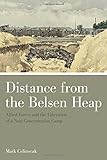
Mark Celinscak. Distance from the Belsen Heap: Allied Forces and the Liberation of a Nazi Concentration Camp. Toronto: University of Toronto Press, 2015. 328 pp. $32.95 (paper), ISBN 978-1-4426-1570-0; $75.00 (cloth), ISBN 978-1-4426-4762-6.
Reviewed by Melissa Young (University of Alabama)
Published on H-War (September, 2016)
Commissioned by Margaret Sankey (Air University)
When British and Canadian forces entered Bergen Belsen on April 15, 1945, Allied personnel were not prepared for the brutal conditions they encountered. Grappling with their emotions and the language they needed to process their experience, they struggled to appropriately respond to the camp’s starving, disease-ridden inmates. In Distance from the Belsen Heap: Allied Forces and the Liberation of a Nazi Concentration Camp, Mark Celinscak examines the words and actions of these soldiers, relief workers, artists, and chaplains. His book’s purpose is twofold: to reveal common patterns of behavior and collective reactions to the concentration camp and to reinsert Canada into the story of its liberation. Celinscak concludes that Allies who entered Bergen Belsen employed several defense mechanisms to create the distance they needed to manage the dead, offer aid to its survivors, and document Nazi war crimes. Their experiences were transformative; some later began to support Zionism while others reexamined their own lives or work.
Drawing his evidence from more than seventy archives in four countries, Celinscak structures his book into six chapters that use “historical, cultural, and narratological analysis” to evaluate the words and actions of British and Canadian military personnel and volunteers (p. 4). He begins by explaining his theoretical foundations, which he garners from many scholars, including Hayden White, David Carr, and Paul Ricoeur. Borrowing a term from Richard Kearney, Celinscak defends his use of firsthand accounts by stating his intention to create a “trans-narrative truth” through the comparison of several testimonials (p. 11). He believes that subjective narratives are powerful because they reveal details about historical events that are omitted from official records. Throughout the text, he focuses on how individuals frame their narratives in order to emphasize the impact of their experiences. For Celinscak, examining this becomes more important than substantiating the narratives with objective documentation.
Although the VIII Corp of the British army is given primary credit for liberating Bergen Belsen, Celinscak uses his second chapter to establish the significant role of Canadian forces in the camp’s liberation and occupation. Not only did the 1st Canadian Parachute Battalion arrive at Bergen Belsen the same day as the British, but Canadian photographers, doctors, volunteer nutrition groups, and “padres” also worked alongside their British counterparts in the weeks that followed. In chapter 3, Celinscak describes the shock all Allied personnel experienced within the first seventy-two hours of their arrival. Exploring how much both the public and the soldiers knew about the atrocities, he determines there was a significant gap between what was reported and what was believed. To emotionally distance themselves from the experience, Allies employed dark humor to particularly harrowing scenes or compared survivors to zoo animals or inanimate objects. They often likened SS guards to monsters, devils, or beasts and “punished” them through physical or psychological violence.
Celinscak uses the rest of his book to evaluate and depict the conflicts and internal tensions of various groups, who, he concludes, reacted to Bergen Belsen in different ways. Military men were motivated by the camp and believed it justified their sacrifices. While inspired to document the atrocities, many artists and photographers worried they were capitalizing on the inmates’ pain. Medical personnel and volunteers often failed to understand the inmates’ social distance or “irrational” behavior, which was caused by cruelty, pain, and starvation. Repulsed by the situation, doctors and nurses drank or smoked excessively or found solace in each other. Chaplains were torn between their spiritual obligations to the suffering and their duties to their units. Celinscak states some struggled with their moral and religious beliefs while others were strengthened by what they witnessed.
Although his text can often be a bit repetitive, Celinscak’s analysis seems genuinely effective. He clearly demonstrates the use of associative clusters and common metaphors in the diaries and letters of Allied personnel, yet he also includes the theories of many important scholars. Unfortunately, these discussions occasionally veer from his primary subject. For example, while interesting and nicely written, an explanation of the unwanted beauty in Holocaust art or the dangers of universalizing collective memory might only interest a select few readers. Other readers, however, could find these topics a bit disconnected from the rest of the text. Since Celinscak tends to focus on a few notable individuals to support his claims, the work might also have benefited from additional examples of his conclusions. These minor faults will not deter readers from enjoying the work, however. Distance from the Belsen Heap is a worthy addition to any scholar’s library, especially those who study the Holocaust, genocide, or World War II.
If there is additional discussion of this review, you may access it through the network, at: https://networks.h-net.org/h-war.
Citation:
Melissa Young. Review of Celinscak, Mark, Distance from the Belsen Heap: Allied Forces and the Liberation of a Nazi Concentration Camp.
H-War, H-Net Reviews.
September, 2016.
URL: http://www.h-net.org/reviews/showrev.php?id=46632
 | This work is licensed under a Creative Commons Attribution-Noncommercial-No Derivative Works 3.0 United States License. |

