



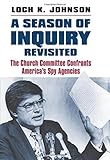
Loch K. Johnson. A Season of Inquiry Revisited: The Church Committee Confronts America's Spy Agencies. Lawrence: University Press of Kansas, 2015. 368 pp. $34.95 (cloth), ISBN 978-0-7006-2147-7.
Reviewed by Thomas Reinstein (Temple University)
Published on H-War (January, 2017)
Commissioned by Margaret Sankey (Air University)
1975 was a watershed year in the history of American intelligence. Up to that point, Congressional oversight of the US intelligence community (IC), particularly the CIA, had been inconsistent. While oversight existed, much of it was informal and not very rigorous, especially concerning covert action programs. The CIA developed hundreds of programs of dubious legality, most of which Congress knew nothing about, from the 1950s through the mid-1970s. These programs included schemes to assassinate foreign dictators and the opening of mail to and from the United States and the Soviet Union. The CIA had also conducted surveillance of domestic activist groups and investigative reporters, which violated the agency’s charter. In December 1974, reporter Seymour Hersh published a series of articles revealing these surveillance operations to the public. The Vietnam War, along with Watergate, had fomented a widespread distrust of government within the American citizenry. Further, many junior congressmen and -women had won election in 1974 by promising to rein in what they saw as an “imperial presidency.” Hersh’s disclosures gave fuel to these pro-intelligence reformers on Capitol Hill. On December 30, President Gerald Ford signed the Hughes-Ryan Amendment into law. This amendment to the Foreign Assistance Act of 1961 required the president to approve and report to Congress all CIA covert actions. It was the first successful example of legislators placing official controls on the CIA since the agency's creation. And in January 1975, Ford, the Senate, and the House of Representatives all established separate commissions to investigate IC activities. Thus began what many scholars refer to as “The Year of Intelligence.” The commissions’ proceedings became front-page news, and sweeping reforms of the IC followed.
The Senate investigative committee quickly became known as the Church Committee, due to its head, Frank Church (D-ID). One of Church’s staffers was Loch K. Johnson, who has since become a leading scholar of intelligence at the University of Georgia, where he is the Regents Professor of Public and International Affairs. In 1986 Johnson published A Season of Inquiry, a first-person account of his experiences on the Church Committee. It examined the committee’s inner workings from its inception through the acrimonious hearings with CIA officials such as Richard Helms, who served as DCI (director of central intelligence) for much of the Vietnam War, and William Colby, who succeeded Helms. The book concluded with the committee’s final recommendations and entrenchment as the permanent Senate Select Committee on Intelligence (SSCI). It stands as one of the definitive works on the Church Committee. Now, in response to such controversies as CIA torture of suspected terrorist operatives during the second Bush administration, Johnson has re-released his book.
A Season of Inquiry Revisited is a valuable study of how government oversight can operate in practice. Johnson’s detailed, day-by-day account of the commission’s proceedings provide an excellent behind-the-scenes look at the Church Committee’s operations. In the new postscript, Johnson borrows from political scientists Matthew D. McCubbins and Thomas Schwartz to argue that the Church Committee, along with later Capitol Hill investigations such as those that probed the CIA’s involvement in the Iran-contra scandal and torture of terrorism suspects, are less effective forms of oversight than committees which work to stop such abuses before they happen. Johnson contends that the SSCI and its House counterpart (the House Permanent Select Committee on Intelligence, or HSPCI) must act as “police-patrollers” by stopping bad behavior in the IC as soon as it starts, rather than as “firefighters” who only react after IC overreach has morphed into scandals that harm America’s reputation at home and abroad. Such dedicated investigation might also have uncovered the sorry state of CIA-FBI communication in the 1990s, which helped contribute to the failure to predict the 9/11 attacks. It might also have exposed lapses in CIA counterintelligence which allowed CIA agent Aldrich Ames to work as a Russian spy for years, compromising many American intelligence assets in the process.
Johnson allows that this kind of investigation, while valuable, will not be easy. Far too often, he contends, the CIA and other intelligence agencies treat Congress “as if it were a foreign country to be manipulated rather than a valued partner in the nation’s defense” (p. 292). Yet he argues that post-Church Committee scandals show that it is incumbent on Congress, the executive branch, and the public to demand rigorous intelligence oversight.
Johnson’s decision to re-release A Season of Inquiry is a welcome one. The book’s analysis has held up well, and Johnson’s writing is sharp, engaging, and insightful. To be sure, the book is identical to the first edition apart from a new preface, postscript, chronology, and appendix. But current debates over the scope of executive power, congressional oversight, and the balance between security and freedom make A Season of Inquiry’s re-release timely. The book’s accessibility make it a good match for anyone with an interest in congressional and intelligence history, not just those at the graduate level and above. If the public must be part of the solution in terms of proper intelligence oversight, then hopefully A Season of Inquiry Revisited will be widely read indeed.
If there is additional discussion of this review, you may access it through the network, at: https://networks.h-net.org/h-war.
Citation:
Thomas Reinstein. Review of Johnson, Loch K., A Season of Inquiry Revisited: The Church Committee Confronts America's Spy Agencies.
H-War, H-Net Reviews.
January, 2017.
URL: http://www.h-net.org/reviews/showrev.php?id=46629
 | This work is licensed under a Creative Commons Attribution-Noncommercial-No Derivative Works 3.0 United States License. |

