

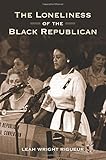
Leah Wright Rigueur. The Loneliness of the Black Republican: Pragmatic Politics and the Pursuit of Power. Princeton: Princeton University Press, 2015. 432 pp. $35.00 (cloth), ISBN 978-0-691-15901-0.
Reviewed by Joshua Farrington
Published on H-Afro-Am (December, 2016)
Commissioned by Jewell Debnam
In The Loneliness of the Black Republican: Pragmatic Politics and the Pursuit of Power, Leah Wright Rigueur offers the first substantive history of post-New Deal black Republicans. While there are a number of books on contemporary black Republicans written by political scientists and pundits, those from the decades prior to the 1980s have been routinely marginalized by historians. Indeed, as Rigueur notes, most of our assumptions about black Republicans of the mid-twentieth century “are teleological and ahistorical, informed by the Republican Party as it exists in the present” (p. 4). Moving away from this standard approach of viewing black Republicans since the 1940s through the lens of their twenty-first-century counterparts not only deepens our understanding of black politics, but challenges “all of our instincts” that “African Americans should not be Republicans, nor should they be conservatives” (p. 3).
Central to Rigueur’s analysis is a reevaluation of the definition of conservatism. This is particularly important, she suggests, since many black Republicans described their ideology in different terms than many of their white peers. To those conservatives who would deride the ideologies of black Republicans as not “authentic” conservatism, Rigueur argues that conservatism is not a “rigid ideology, fixed over time and space,” but rather something that is “far more complicated” and sometimes “contradictory” (p. 8). The conservatism embraced by most black Republicans of the twentieth century had various “manifestations,” according to Rigueur. One manifestation dates back to the nineteenth-century middle-class ideology embodied by Booker T. Washington, which emphasized pragmatism, self-help, personal responsibility, and faith in the Protestant work ethic. Another, overlapping, manifestation emphasized the historical connections between African Americans and the bedrock principles upon which the party was founded, including its faith in the private sector. However, even though some white Republicans abandoned the racial egalitarian beliefs of the party’s forefathers, many black Republicans still clung to these historic impulses. These African Americans sought not to “destroy” conservatism “but rather to expand the boundaries of the ideology in order to include black needs and interests” (p. 9). The final manifestation of black Republican ideology was “the most complicated to outline,” but included black reactionaries who opposed the civil rights legislation of the 1950s and 1960s. This faction was small during the mid-twentieth century, but as white opponents of civil rights began to embrace the “seemingly race-neutral ideology of individual rights, freedom of choice, and free market enterprise” by the late 1960s, “more and more” black Republicans joined the fray (p. 9). That those who embraced civil rights legislation and those who opposed it could both be self-described “conservatives” points Rigueur not only to the malleability of the term, but also to the fact that scholars of this understudied subject “do not have an adequate name for the black Republicans described in this book, nor do we differentiate between the types of black Republicans” (p. 11).
Though Rigueur’s narrative begins with the New Deal era, her primary focus is on the pivotal decades of the 1960s and 1970s. Well-known black Republicans like Senator Edward W. Brooke of Massachusetts and William T. Coleman Jr., Gerald Ford’s secretary of transportation, receive their fair share of attention, but what makes Rigueur’s work particularly compelling is her examination of behind-the-scenes activists like Grant Reynolds and Clarence Townes Jr. of the Republican National Committee’s Minorities Division. Rigueur’s discussion of black insiders within Richard Nixon’s administration is fascinating, as his staff represented the spectrum of black Republican thought. Nixon’s black staff included mainstream black leaders like James Farmer, proponents of affirmative action like Arthur Fletcher, and advocates of massive increases in federal funding for black colleges and businesses like Robert Brown. A virtual auxiliary of the Nixon White House, the National Black Silent Majority Committee, represented the far Right of black Republican thought.
Despite the immense value of The Loneliness of the Black Republican to reshaping widely held assumptions toward both black politics and the post-World War II Republican Party, it is not a work without flaws. By her own admission, Rigueur notes that her focus centers on the national stage, as she tasks future scholars to explore black Republican activism on the state and local levels. While it may be unfair to criticize her for not looking beyond national politics, had she attempted even a cursory examination of grassroots black Republican activism, she would have found a plethora of examples that extend beyond California, the Midwest, and New York—where she claims most black Republicans “hailed primarily from” (p. 7). Significantly, black Republicans from the South (with the exception of Virginia) are notably minimized in her work, despite the existence of black Republicans who secured widespread support from both their party and fellow African Americans in cities such as Memphis, Atlanta, and Louisville. Thus, when Rigueur mentions, for example, that Dwight Eisenhower won nearly 60 percent of the black vote in Louisville in 1956 (p. 31), or that the city’s black voters continued to outpace the rest of black American in support of Richard Nixon in 1972 (p. 195), the reader is left wondering what local context provided for the higher-than-average levels of black support in the city. The question is left unanswered.
This reviewer is also skeptical of Rigueur’s attempt to place black Republicans within the context of conservatism (albeit a malleable form of conservatism that was at times distinct from that of white Republicans). Rigueur’s own narrative contains examples of black Republicans who describe themselves as members of “the liberal wing of the GOP” (p. 66) or who described their political enemies, such as supporters of Barry Goldwater, as “conservative.” It seems a stretch to pin the label “conservative” on those who self-described themselves as “liberal,” and who often derided “conservatives” as their political rivals. As Geoffrey Kabaservice’s Rule and Ruin: The Downfall of Moderation and the Destruction of the Republican Party, from Eisenhower to the Tea Party (2012) convincingly demonstrates, “conservative” and “Republican” were far from interchangeable terms in the 1940s through 1970s. And though Rigueur attempts to expand the term beyond the rigid confines of Barry Goldwater or William F. Buckley, it’s important to note that it was often a term black Republicans rejected in their self-identification.
These critiques notwithstanding, there is much to be admired in Leah Wright Rigueur’s groundbreaking work and her bravery in tackling a topic that has been dismissed as insignificant by historians for decades.
If there is additional discussion of this review, you may access it through the network, at: https://networks.h-net.org/h-afro-am.
Citation:
Joshua Farrington. Review of Wright Rigueur, Leah, The Loneliness of the Black Republican: Pragmatic Politics and the Pursuit of Power.
H-Afro-Am, H-Net Reviews.
December, 2016.
URL: http://www.h-net.org/reviews/showrev.php?id=46537
 | This work is licensed under a Creative Commons Attribution-Noncommercial-No Derivative Works 3.0 United States License. |

