

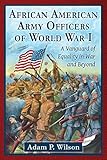
Adam P. Wilson. African American Army Officers of World War I: A Vanguard of Equality in War and Beyond. Jefferson: McFarland, 2015. 236 pp. $39.95 (paper), ISBN 978-0-7864-9512-2.
Reviewed by Shane Peterson (Independent Scholar)
Published on H-War (September, 2016)
Commissioned by Margaret Sankey (Air University)
Adam P. Wilson adds to a growing body of work that seeks to push the start of the modern civil rights movement back to the post-World War I era. He specifically looks at the 1917 school for black officers at Fort Des Moines. While the goal of the school was a military one, to teach black men to lead other black men in battle overseas, Wilson argues that these skills and the commissions that came with them were put to use fighting for civil rights after the war. The introduction cites the 2009 pioneering work of Adriane Lentz-Smith, Freedom Struggles: African Americans and World War I, as well as the 2010 work by Chad L. Williams, Torchbearers of Democracy: African American Soldiers in the World War I Era. By including their studies, Wilson sets a clear tone for the work as a continuation of this “shifting of the historiography” (p. 10).
One point of controversy in Wilson’s analysis might be his rendering of Colonel Charles C. Ballou, the white commander of the training camp, in the third chapter, “Life at Fort Des Moines.” Wilson paints a portrait of a man trapped between the goal of training some one thousand men and a Jim Crow culture determined to not see them as men. Ballou is seen as trading “short-term” acceptance of discrimination for long-term gains of over six hundred new commissioned officers. Wilson writes that it is “unlikely that a military man whose career was tied to the success of the black cadets would risk losing their respect” (p. 63). In contrast to Ballou, Wilson notes in chapter 4, the commander of Camp Grant, Major General Thomas H. Barry, “demanded equal treatment” for black officers (p. 72).
The army brought Jim Crow with it to France, sometimes with rare comical effect. For example, when the only French-speaking man just happened to be black, the newly minted Captain M. Virgil Boutte, the white officers ordered his segregation, and moved on to the hotel in Brest. Without their translator, “they were unable to communicate” and were “turned away” (p. 94). The rooms then went to the black officers. Wilson does not ignore the effects that Jim Crow had, including the negative effects poor training and poor equipment had on combat effectiveness or the infamous order banning black troops from marching in the victory parade. In chapter 5, a chapter that deserves its own book, Wilson looks at army officers combating Jim Crow in the courts, noting the work of Captain Austin T. Walden in Atlanta, Georgia, and many others. The black press also attracted a number of former officers as mentors to what would be the civil rights generation of the 1960s and the fight to desegregate West Point as well as the armed forces.
Wilson includes some photos of black officers from the National Archives, uses endnotes for each chapter, lists an up-to-date bibliography, and provides an index. I hope that this survey will inspire others to expand this work into a series of individual studies using the letters, diaries, and family photographs of the black officers of the Fort Des Moines school.
If there is additional discussion of this review, you may access it through the network, at: https://networks.h-net.org/h-war.
Citation:
Shane Peterson. Review of Wilson, Adam P., African American Army Officers of World War I: A Vanguard of Equality in War and Beyond.
H-War, H-Net Reviews.
September, 2016.
URL: http://www.h-net.org/reviews/showrev.php?id=46361
 | This work is licensed under a Creative Commons Attribution-Noncommercial-No Derivative Works 3.0 United States License. |

