

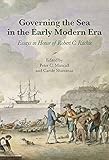
Carole Shammas, Peter Mancall, eds. Governing the Sea in the Early Modern Era: Essays in Honor of Robert C. Ritchie. San Marino: Huntington Library Press, 2015. 368 pp. $60.00 (cloth), ISBN 978-0-87328-260-4.
Reviewed by Kenneth Morgan (Brunel University London)
Published on H-Diplo (July, 2016)
Commissioned by Seth Offenbach (Bronx Community College, The City University of New York)
This volume honors Robert C. Ritchie, former director of research at the Huntington Library, San Marino, California. In the earlier part of his career, Ritchie wrote two well-received books in early American history, dealing with the political development of New York City in its first decades as an English settlement and with the political activities of the pirate William Kidd.[1] Both of these monographs have a strong maritime dimension. The later part of Ritchie’s career concentrated more on promoting research by visiting scholars at the Huntington Library on early modern British America, serving on innumerable committees, convening symposia and conferences, undertaking fundraising for the Huntington Library, and offering guest lectures. Given this scholarly background, the essays in this collection are appropriately based on the broad theme of exploitation of the oceans by early modern governments and how this affected trade connections, the operation of national laws, property crime, the maritime environment, and cultural, economic, and political connections across national boundaries. The ten essays in the book are grouped under four headings: fisheries; piracy; interlopers and smugglers; and slaves. Most contributions concentrate on the Atlantic world, but two essays include material dealing with the Indian Ocean.
The two contributions on fisheries focus on the organization of medieval fisheries in the Mediterranean and the North Sea and on Anglo-French fishing disputes and maritime boundaries in the North Atlantic between 1700 and 1850. Richard C. Hoffmann’s discussion of medieval fisheries traces organizational changes over time from subsistence fishing intended for the consuming household to small-scale artisanal fishing and to large-sale commercial fisheries. Medieval Europeans, it is argued, coped with shortfalls in fish supplies through public regulation of fisheries, localized stocking, the cultivation of still-water species, and the transfer of species from one marine environment to another. The essay includes interesting arguments about environmental changes leading to the migratory population of herring in the Dutch fishery at the end of the Middle Ages. Renaud Morieux, by contrast, focuses on divergent British and French regulations and practices about fishing zones. British and French fishing rights in Newfoundland were determined by clauses in the Treaty of Utrecht (1713). These were relatively uncontentious for the subsequent half-century, as Britain and France had their fisheries on different shores in Newfoundland. But Morieux shows that disputes escalated after 1763 as the resident British migrant population increased in Newfoundland and encroached on French settlements there.
Three essays focus on piracy from different perspectives. Keith Pluymers’s study of piracy operating from the small port of Baltimore, south-west Ireland, in the early seventeenth century, shows that marauders used this location for attacks on West Country fishing fleets sailing to Newfoundland and for regular engagement in illicit and quasi-legal trade. A Dutch renegade attack destroyed Baltimore in 1631, thereby ending this episode in Irish maritime activity. Pluymers’s essay includes interesting gleanings from primary sources, but its argument that piracy operating out of Baltimore had a significant impact on Munster’s economic development is difficult to sustain because the material presented is, perhaps inevitably on this topic, scattered and impressionistic. Margarette Lincoln’s essay on Woodes Rogers’s attempts to curb piracy while he was governor of the Bahamas on two occasions in the 1720s deals with the later career of someone who had once been a prominent privateer. Her essay discusses poor British government support to aid Rogers in his quest, and it explains Rogers’s attempt to present his maritime career as one of respectable exploration. Mark G. Hanna’s reevaluation of the golden age of English piracy is a helpful guide to those wishing to navigate current scholarship on the topic. Acknowledging that the main characteristics of pirates varied over time and in different locations, Hanna argues that piracy was “one part of a more complex and varied career on land or at sea, with a broad array of choices, destinations, and ideologies” (p. 134). This is a different view of the role of pirates from the romanticizing of pirate adventurers or the Marxist “Red Atlantic” conception of pirates as subversive radicals attacking the political establishment.
Three contributions deal with interlopers and smugglers. Alison Games discusses imperial rivalry between the Dutch and English East India companies in Indonesia in relation to the spice trade. Cooperation between the Dutch and the English was evident in terms of sharing information on navigation and shipping, she demonstrates, but disputes arose over access to supplies of nutmeg at Banda: the Dutch expected to exercise a trade monopoly there, while the English wanted their share of this commerce. An Anglo-Dutch treaty of 1619 attempted to solve the disputes by cost- and profit-sharing, but the conflict continued. The Dutch ignored the treaty by invading the Banda Islands in 1621 to secure a permanent monopoly over the nutmeg trade, and then perpetrated the Amboyna massacre of 1623 against the English. Such nationalist tensions in governing the sea were largely overcome in Spanish American ports that attracted British slave traders in the early eighteenth century. Thus Adrian Finucane shows that, despite a long history of suspicion and animosity between Catholic Spain and Protestant Britain, the need for the Spanish to receive slaves under license through a British chartered company was sufficient to ensure that trade flows were not seriously impeded. Where economic benefits could accrue to both nations, political, religious, and legal differences could be overcome. Emma Hart’s essay examines differences between Britain and North America over implementing the Navigation Act of 1696. She finds that vice-admiralty courts established as part of this legislation were largely ineffective in North America, and that colonists developed their own economic objectives which led them to flout metropolitan regulations when it suited their interests.
The final section on slaves has two contributions. David Wheat makes an interesting case for the existence of porous maritime borders for Spain and Portugal during the “joint-crown” period of 1580-1640. His essay shows that the Portuguese and Spanish fleets overlapped in their shipping routes and also intersected with the flow of enslaved Africans from Mozambique to the Spanish Caribbean. This conjoining of maritime endeavors usually analyzed separately illustrates the growth of global maritime knowledge. The concluding essay is Catherine Molineaux’s analysis of the representation of slavery and the slave trade in Anglo-American visual culture during the eighteenth century. She shows that before the rise of abolitionism, Africans were frequently included on maps for decorative purposes, but that the beginning of British abolitionist campaigns led to the production of prints, such as that of the Liverpool ship Brookes, which emphasized the pain and suffering of the enslaved. This is the only essay in the book that uses visual material, but the other contributions draw on wide-ranging empirical evidence to show how their particular focus fits into the theme of governing the sea. Historians specializing in the maritime dimensions of the early modern world will find much interesting material in these essays, which are best dipped into, as is usually the case with such collections, rather than read from cover to cover.
Note
[1]. Robert C. Ritchie, Duke’s Province: A Study of New York’s Politics and Society, 1664-1691 (Chapel Hill: University of North Carolina Press, 1977), and Captain Kidd and the War against the Pirates (Cambridge, MA: Harvard University Press, 1986).
If there is additional discussion of this review, you may access it through the network, at: https://networks.h-net.org/h-diplo.
Citation:
Kenneth Morgan. Review of Shammas, Carole; Mancall, Peter, eds., Governing the Sea in the Early Modern Era: Essays in Honor of Robert C. Ritchie.
H-Diplo, H-Net Reviews.
July, 2016.
URL: http://www.h-net.org/reviews/showrev.php?id=46347
 | This work is licensed under a Creative Commons Attribution-Noncommercial-No Derivative Works 3.0 United States License. |

