

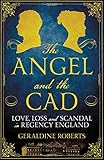
Geraldine Roberts. The Angel and the Cad: Love, Loss and Scandal in Regency England. London: Macmillan, 2015. 352 pp. GBP 20.00 (cloth), ISBN 978-1-4472-8349-2.
Reviewed by Janet Mullin (St. Thomas University, New Brunswick)
Published on H-War (March, 2016)
Commissioned by Margaret Sankey (Air University)
This is the story of a marriage that began with all the romance of a fairy tale, wherein a lovely, young, fabulously rich girl declined the hand of a prince to marry for love. The choice she made was a fateful one: her new husband was a young man of extraordinary charm and good looks which masked his long history of rash, extravagant, and self-indulgent behavior. When Catherine Tylney Long married William Wellesley Pole in March 1812, the stage was set for a morality tale of epic proportions. The audience for this drama was the English public, and the stage managers were the English press.
Catherine was a celebrity of the Regency period, which meant that she lived her life in public, documented by the many newspapers and cartoonists of the age. Stories about the beautiful Miss Tylney Long, and later Mrs. Long Wellesley, were guaranteed to sell papers, as she emerged from her girlhood and became a woman of fashion remarkable even for the Regency period. As a result, many knew her face and thought they knew the woman. Some mistook her gentle character and long-suffering sense of family loyalty for meekness, even weakness; as a result, she was often dismissed by contemporaries as colorless and unremarkable. In fact, she was neither, but as is the case with many mild-natured people, it took a real crisis to bring the true woman to the fore. Geraldine Roberts’s stated purpose in this book is to give Catherine the true, three-dimensional portrait that she merits, and to document the very real and lasting effect her life exerted on the laws of the land.
Catherine’s story begins with her vast wealth and the many suitors it brought to dance attendance on her. While society expected her to choose a man of rank and wealth--she declined the hand of a royal Duke--attraction won out over practicality. When she said yes to William Wellesley Pole, she had heard many rumors about his character, but probably genuinely believed his professions of love and fidelity. Her family’s fears for her finances were allayed by a marriage settlement that should have protected her and her children, and the two were married in London in 1812.
All too soon, there were signs of trouble. William’s affectionate behavior to his wife was offset by his arrogance as the new lord of the manor at Wanstead, Catherine’s estate. His extravagance led to debts, which in turn led him to seek the protection from creditors conferred by a seat in Parliament, which he achieved by hoodwinking the voters. Nor was he content to confine his attentions to one woman, and the result was a bastard child born to William by the mistress of one of his friends. With his debts mounting, he pressed his wife for more and more money, and soon, no longer an MP and vulnerable to arrest for debt, he fled to the Continent, leaving his affairs in disarray.
Catherine soon joined him with the children. With her own income, she was confident that they could live more cheaply and still comfortably abroad, all the while making inroads on his debts. William had other ideas, and their time in Paris and then Naples soon became a self-indulgent holiday. At home, his father negotiated with his son’s many creditors, and meanwhile that son hired many servants and continued his extravagant lifestyle. The end result was the loss of Wanstead House, the proud achievement of Catherine’s family.
William’s insatiable sexual appetite got him into more serious trouble in Naples. His intrigue with the passionate but unstable Mrs. Bligh horrified the English expatriates there and brought terrible distress to Catherine. The family fled to Florence, then back to Paris, but William and his mistress continued their affair, brazenly caressing each other in front of Catherine and her children. While she struggled to bear his increasing cruelty to her, his corrupting of their young sons was the final straw. She wrote to her husband’s father, announcing her desire for a separation, and took the children back to England, where William could not follow because of his outstanding debts. Once there, she took the unprecedented step of appealing to keep custody of her children even in the face of separation. William found himself fighting two legal actions: the first for “criminal conversation” with another man’s wife, and the second for custody of his children.
Though the story of Catherine and William is compelling in itself, this is no mere narrative; Roberts places their marriage and their lives in the context of their world, including the social and legal framework that governed many of the choices Catherine was forced to make. This was an age of almost unlimited rights for men over women. As husbands and fathers, men had near-complete control over their wives and children, which left women at an almost insurmountable disadvantage when things went wrong. Legal separation meant a mother lost her children, even to the worst of fathers; Catherine could not accept that eventuality, and dared for her children’s sakes to challenge the law. The story of the custody battle that forms the story’s climax is told with care but also with flair; the legal context of the case, and the thinking of those who had made and maintained the laws of the land, are clearly explained. By nature the most dutiful of wives, Catherine became a ground-breaking force for women’s rights under the law, and her story changed the way in which wives and mothers were regarded by society.
Roberts’s prose is fluid and uncluttered, its flow lessened only slightly by her decision to divide the story into many short chapters. Occasionally, the transition between narrative and contextual discussion is a bit forced, but on the whole the book moves along briskly, and the author’s deep understanding of Regency elite culture is obvious. In crafting this book, Roberts draws on what remains of Catherine’s own letters--many were destroyed in a fire, possibly deliberately--and the correspondence and comments of contemporaries, as well as the newspaper accounts of various events in her life. However, since most of Catherine’s own words were lost, Roberts is forced to piece together her narrative from the testimony and affidavits of the court proceedings that occurred later. In this she succeeds so seamlessly that the reader notices no break in the story. She also makes good use of the vast breadth of scholarship on England’s long eighteenth century, including such recent work as Nicola Phillips’s The Profligate Son (2013).
The Angel and the Cad will appeal to social historians of the Regency period, especially of the most conspicuous of consumers. Roberts’s richly drawn picture of “The Age of Elegance” shows us the self-indulgent lives of the wealthy, from the clothing they wore to the lavish interiors they inhabited, from the horses in their stables to the gardens where they took tea. An added bonus is the sharply focused discussion of political patronage, especially that which pervaded elections to Parliament in the years before the Reform Act of 1832. The House of Commons was very much the tool of prominent gentry and noble families, who bestowed seats for all the wrong reasons, and whose “pocket boroughs” were bought and sold with no thought to the benefit of the county folk supposedly being represented.
This is a vividly written look at a marriage that began in hope and ended in almost Shakespearean tragedy, where human folly destroyed love and brought ruin and misery to innocent and guilty alike. It is a compelling and at the same time scholarly work, which tells for the first time the story of a remarkable woman who fought against her world and its constraints for the sake, and the future, of her children.
If there is additional discussion of this review, you may access it through the network, at: https://networks.h-net.org/h-war.
Citation:
Janet Mullin. Review of Geraldine Roberts, The Angel and the Cad: Love, Loss and Scandal in Regency England.
H-War, H-Net Reviews.
March, 2016.
URL: http://www.h-net.org/reviews/showrev.php?id=46149
 | This work is licensed under a Creative Commons Attribution-Noncommercial-No Derivative Works 3.0 United States License. |

