

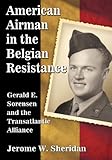
Jerome W. Sheridan. American Airman in the Belgian Resistance: Gerald E. Sorensen and the Transatlantic Alliance. Jefferson: McFarland, 2014. 260 pp. $35.00 (paper), ISBN 978-0-7864-9497-2.
Reviewed by Lisa Beckenbaugh (Benedictine College)
Published on H-War (March, 2016)
Commissioned by Margaret Sankey (Air University)
As the Allies approached his hiding place, Staff Sergeant Gerald E. Sorensen could have stayed hidden with his Belgian family, but this downed airman made the conscious decision to risk his life and join the Belgian Resistance. Sorensen was shot down over occupied Belgium in May 1944. Shuttled from Belgian family to Belgian family, he was saved from a prisoner-of-war camp by the Belgian Resistance. Because he and others knew that an invasion was coming soon, Sorenson did not make the long trek to Spain and back to England, following in the footsteps of hundreds of other Allied airmen. He spent June through September with one Belgian family, the Abeels. He grew very close to this family, especially to Roger, the son, who was close to Sorensen's age. Roger and his father, Arthur, were actively involved in one of the resistance cells in Belgium, the Comet Line, which was "dedicated to finding, sheltering, and returning to the Allies airmen who were shot down over occupied Europe" (p. 88). The Comet Line was one of many resistance organizations active in Belgium and Europe; author Jerome Sheridan does a good job of introducing some of these groups and their main activities, including acts of sabotage, assassination, intelligence gathering, and rescues of Allied airmen.
Not only is this book about Sorensen's time with the Abeels, but it also tells the story of his upbringing, faith, education, marriage, and military service. Sheridan profiles the Abeels family before their encounter with Sorensen and continues the two families' intertwined narrative after the deaths of Sorensen and Roger. The two "brothers" died fighting the Germans just before the British entered the village of Marcq-lez-Enghien (p. 168). Sheridan does a very good job of describing life in occupied Belgium, not just for Sorensen but also for the Abeels family. He explores how Sorensen's background and beliefs made it a logical choice for him to join his "family" in fighting for the resistance. Sheridan argues that these two men were "the very real, human, and personal embodiment of the transatlantic alliance" and that maintaining "that alliance today is what gives their sacrifice its meaning" (p. 219). Sheridan's book is a wonderful reminder of those shared values and sacrifices. He has corrected the record regarding Sorensen's service and reminds readers of those "common values" that "bind America and Europe together today" (p. 4). One distraction from the effort is when Sheridan makes assumptions about what Sorensen was thinking or feeling. These educated guesses about Sorensen's sentiments are Sheridan's voice and not Sorensen's.
If there is additional discussion of this review, you may access it through the network, at: https://networks.h-net.org/h-war.
Citation:
Lisa Beckenbaugh. Review of Sheridan, Jerome W., American Airman in the Belgian Resistance: Gerald E. Sorensen and the Transatlantic Alliance.
H-War, H-Net Reviews.
March, 2016.
URL: http://www.h-net.org/reviews/showrev.php?id=46110
 | This work is licensed under a Creative Commons Attribution-Noncommercial-No Derivative Works 3.0 United States License. |

