

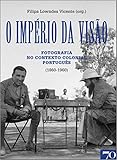
Filipa Lowndes Vicente, ed. O Império da Visão: Fotografia no Contexto Colonial Português (1860-1990). Lisbon: Edições 70, 2014. Illustrations. 504 pp. EUR 35.00 (paper), ISBN 978-972-44-1811-7.
Reviewed by Emília Tavares (Museu Nacional de Arte Contemporânea - Museu do Chiado)
Published on H-Luso-Africa (February, 2016)
Commissioned by Philip J. Havik (Instituto de Higiene e Medicina Tropical (IHMT))
Photography in the Portuguese Empire
[Ed. note: This review first appeared in the Ípsilon supplement of the Portuguese newspaper Público in its March 6, 2015, edition and is republished here with the permission of the author and Público. It was translated from the Portuguese by Philip J. Havik.]
Rarely does an ambitious and scientifically well-structured project in the field of the social sciences and humanities reach the limited editorial world in Portugal and herald a paradigmatic moment in terms of the acquisition of knowledge. But, from time to time, the exception confirms the rule, as in this case with the publication of O Império da Visão: Fotografia no Contexto Colonial Português (1860-1990). The publication of this volume is also relevant because it constitutes an example of resistance against education policies that result in a disinvestment in history, sociology, anthropology, and associated disciplines, relegating them to a fantasmagoric role in Portuguese culture.
The publication of this book becomes even more pertinent when we consider that the research project on which it is based was only feasible with the support of the Foundation for Science and Technology (FCT). This can be symbolically assumed as an outstanding response with regard to the withdrawal of the FCT, and other peer organizations, which have been scandalously overlooked in public tenders, and regarded as minor entities in a hierarchy of knowledge.
O Império da Visão: Fotografia no Contexto Colonial Português (1860-1990) edited by Filipa Lowndes Vicente, includes contributions from a large number of researchers and consultants in a variety of academic fields, such as Isabel Castro Henriques, Joaquim Pais de Brito, Nuno Porto, Ana Cristina Martins, Catarina Mateus, Cosimo Chiarelli, Inês Vieira Gomes, and James J. Ryan.
The project ambitiously strove to map photographic collections in archives and public libraries associated with the subject of the Portuguese colonial empire, seeking, in this manner, to disseminate these same archives as well as joining institutional and academic forces to engage in a critical appraisal of the latter. The project has the merit of being the first serious inventory of the public collections of colonial photography. It also envisages creating a site which will provide online access to research carried out and the knowledge produced.
With respect to its publication, its scope goes far beyond the chronological points of reference of the original research project. Being organized as a reader on Portuguese colonial photography, it allows for interweaving multiple critical approaches and gaining access to many, for the most part unpublished, photographic collections. With the contribution of twenty-nine authors covering different subjects in the context of the social sciences and humanities, O Império da Visão is divided into four main parts: Classification/Mission, Knowledge/Circulation, Exhibition/Reproduction, and Resistance/Memory. It seeks to concentrate on the essential programmatic threads for the production of colonial photography itself, thus overly fragmenting the critical methodology, given that postcolonial Portuguese studies still lacks a relational approach.
The general enunciation is conducive to the projection of a perspective, albeit piecemeal, on the complex mechanisms for the construction of images in a colonial setting, and demonstrates the volatility of the very concept in periods and contexts. It is possible to prove that which we already knew empirically, that there no such thing as colonial photography (a concept that the book’s editor, Filipa Lowndes Vicente, also questions in view of the recent international historiographical developments in this particular field). Rather, the editor evokes multiple uses and productions of images in a colonial context, each of them possessing their own proper structures and narratives that demand an added critical rigor.
The extensive subject matter of this book, which analyzes archives associated with medicine, botany, anthropology, ethnography, or even collections with a more political or economic origin, also finds itself at a theoretical crossroads. The reason is that the very notion of postcolonial studies has been amply debated, internationally, in recent years. Filipa Lowndes Vicente directs her introductory essay of the book towards the concerns that this question poses to Portuguese researchers, given that the path followed by postcolonial studies in the United Kingdom or France obliges them to rethink our—belated—approach to our own history in this respect.
The project and the book present various approaches, but it seems to me crucial that there is a critical discourse that enquires about the history of the sources in question and their political background, while at the same time producing a History which is not just ours. In order to do so, the sources should be reread taking into account the cultural contexts that were previously colonized.
It is very significant that the project coordinator dedicates a large part of her introductory essay to the questioning of the ethical limits of the study of these images, made in a setting of political, social, and cultural subordination. She questions the right of researchers to publish images that were not made to be published, and were often the result of acts of violence committed against colonized peoples. Her response before this self-questioning is that, yes, they should be published, “in a conscientious and reflexive manner,” in accordance with guidelines that were closely followed in the editing of the book (p. 24). It seems to me that they are appropriate with respect to the novelty of the material under consideration.
Only too frequently, public institutions that hold these collections of documents which are of historical interest, tend to resist a broad and cross-cutting understanding thereof, which in itself turns the implementation of this project into an opportunity to change the mentality of the powers that be with regard to historical sources.
As the coordinator of the project states, the studies contained in the book were carried out both by authors with a consolidated scientific production, and by those who stumbled upon colonial photography and understood its potential for research and analysis. The publication does however suffer from a measure of disparity in terms of critical methodologies, maybe because of this approach—sometimes purposeful but also unintentional—to the photographic object, without however calling into question the dimension of its scientific and historiographic validity.
What is possibly lacking is a critical appreciation, which in each chapter could establish the links between the different studies, and thus place it within the broader thinking on the programmatic threads of this first big essay on the production of Portuguese colonial imagery, and articulate it with the current state of the art of postcolonial studies and the debate surrounding it.
The collaboration of James R. Ryan, professor at the University of Exeter in Cornwall (UK) as project consultant and specialist in British imperial photography, was meant to internationalize the project, being meritorious and fundamental for the affirmation of Portuguese researchers. However, it should be noted here that his essay does quite not come up to expectations, demonstrating that the specificity and subject matter of each distinct colonial reality do not allow for generalizations.
This is a book and a project which constitutes a brilliant and ambitious start for a particular field of Portuguese colonial studies. We hope that it will receive the institutional recognition that it deserves so that the continuity of this research is ensured, with contributions resulting from new studies and new approaches.
If there is additional discussion of this review, you may access it through the network, at: https://networks.h-net.org/h-luso-africa.
Citation:
Emília Tavares. Review of Vicente, Filipa Lowndes, ed., O Império da Visão: Fotografia no Contexto Colonial Português (1860-1990).
H-Luso-Africa, H-Net Reviews.
February, 2016.
URL: http://www.h-net.org/reviews/showrev.php?id=46109
 | This work is licensed under a Creative Commons Attribution-Noncommercial-No Derivative Works 3.0 United States License. |

