

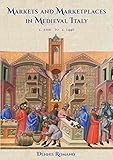
Dennis Romano. Markets and Marketplaces in Medieval Italy, c. 1100 to c. 1440. New Haven: Yale University Press, 2015. 272 pp. $65.00 (cloth), ISBN 978-0-300-16907-2.
Reviewed by Guy Geltner (University of Amsterdam)
Published on H-Italy (March, 2016)
Commissioned by Maartje van Gelder (University of Amsterdam)
Dennis Romano’s fourth monograph is his first major foray beyond Venetian history. It offers, on the one hand, a spatial/platial analysis of later medieval Italian markets; and, on the other, a reevaluation of the market (understood in the broader sense of a nexus of commercial activities) as a cultural and moral agent that impacted processes of identity formation. The book is richly illustrated, certainly by the standards of cultural-historical monographs, with 116 images, many of them large and in color. The author, displaying a growing interest in material culture, ably employs and interrogates the artifacts these images depict, which cover diverse genres, from manuscript illuminations and murals to carvings and building plans, to city views and even a rare market zoning marker. Evidence from written sources is similarly diverse, comprising for the most part published editions of urban and guild statutes and augmented by sermons, didactic literature, chronicles, letters, poetry, and prose fiction. Archival documents of practice are largely absent, a legitimate and pragmatic choice given the author’s wish to trace “market ideals” across 340 years and in one of Europe’s most richly documented regions (p. 10). It is, however, curious to read that the evidence of practice he does marshal (“where possible”) “suggests that concerns expressed in normative literature and legal codes reflected not only tradition but also the realities of everyday market experience” (p. 11). Romano is no stranger to Italian archives, yet his familiarity with the pertinent sources out of print seems to be too limited to merit such a claim. The impression is confirmed by his observation that, despite women’s intense involvement in market activities, their perceptions and experiences of it are “now almost completely lost from view” (p. 11). An abundance of fiscal and court records attesting to the contrary awaits historians in various archives.
To its inhabitants and visitors the Italian city was a great market. Romano accordingly zooms out of the marketplace itself, or rather marketplaces, since—as he shows—most cities housed several designated locations for buying and selling goods, sometimes even outside their walls. This refocus spotlights the importance of including production centers such as workshops or informal places of exchange such as streets, riverbanks, and domiciles in any cultural history of urban exchange. The polycentric character of these activities is key to understanding the challenges faced by governments and guilds in regulating credit, ensuring product quality, and monitoring cleanliness and general conduct. This is not to argue that formal marketplaces failed directly to attract policymakers’ and urban planners’ attention, but that their solutions for controlling these spaces usually stemmed from an integrated view of urban well-being, order, safety, piety, and decorum, and not merely from a desire to optimize economic gain in a particular location. In other words, the marketplace was more than a hub, whose spokes—the city’s main thoroughfares—linked it through various gates to ever more distant production centers. It was marketplaces’ physical accessibility rather than their exclusive commercial function that rendered them emblematic of a city’s (or a regime’s or a particular guild’s) stability and prosperity, and it was this visibility that lent itself in turn to enduring contests for control, as “an incontrovertible sign of authority and prestige” (p. 43). Romano makes many more valid observations, and anyone interested in a concise survey of medieval Italian retail spaces’ morphology, legal organization, scripted rituals, and the myriad political pressures attendant upon their (re)production will find the book’s first two parts (“Space and Place” and “Buying and Selling”) very rewarding indeed.
Romano has further goals in mind. In the two chapters comprising the volume’s third part (“Marketplace Ethics”), he enters two historiographical frays. The first concerns the impact of the medieval Commercial Revolution, with markets (read: cities) at its core. Here the author extends a tradition, stretching from Fernand Braudel to Martha Howell, that challenges the depiction of these markets as forerunners of capitalism. The latter appreciation, endorsed by eminent medievalists such as Jacques Le Goff and Lester K. Little, among others, often builds on Italian (and Flemish) cities’ image as precocious production, exchange, and financial centers, whose profit economies threatened to crush traditional Christian values, especially Apostolic poverty. Yet much more was clearly at stake, as Romano has by now shown, in the spatial production of Italy’s markets. He acknowledges that profit was widely seen as a sign of success, but underscores how numerous normative texts and artifacts, both secular and religious in origin, promoted honesty and piety in trade and inveighed against fraud and extreme forms of greed. The normalizing, premodern gaze trained upon markets was moreover enhanced through efforts to make transactions visible, for instance by encouraging the participation of sworn notaries, witnesses, and guarantors; increasing markets’ accessibility and open physical layout; and introducing diverse regulations on the display of goods, the use of weights and measurements, and strict operating hours meant to ensure access to quality products at a just price. The process may have been less linear than Romano suggests, but it ultimately meant that, “[f]or the individual participant in the medieval moral marketplace, success depended on his good name, on his reputation for trustworthiness” (p. 175). But what social practices does this literature purportedly reflect? The popularity of the trickster in literature and the triumph of avarice over pride as “the deadliest of the deadly sins” (p. 164) in law, theology, and art likely attest to more than just tradition. In practical terms, there is certainly some evidence that modest profit rates were common and that accomplished merchants like Francesco di Marco Datini built their wealth and reputation gradually, carefully, and without any sign of religious laxity. However, the degree to which commercial transactions failed to comply with Christian morality, let alone secular law, has left rich traces in local archives, where allegations of fraud and breach of trust (including unpaid loans) fill numerous registers, and collectively attest that (male and female) merchants’ notions of success and strategies for achieving it could be diverse. Either way, Romano succeeds in charting the urgency with which such matters were discussed.
The same urgency buttresses Romano’s second historiographical intervention, which leads us back to modernity, albeit without its customary plank of capitalism. Markets may not have sown the seeds of modern profit economies, but they certainly amplified or indeed created people’s self-awareness as moral subjects, according to Romano. Indeed, in his view, this development amounts to nothing less than “a possible first cause for the development of a new sense of interiority—the necessity to judge the character and trustworthiness of those with whom one wishes to engage in commercial exchanges” (p. 188). Putting aside the ontological debate on causality, this is an explicit attempt to resurrect Jacob Burckhardt’s argument about the rise of selfhood in Renaissance Italy, a process that culminated in “the formation of the modern subject” (p. 189). Here, archival evidence appears to support Romano’s argument: there is certainly a marked increase of documented transactions, which had by the later Middle Ages reached large swathes of the population. And it is also plausible that learning how to negotiate these transactions, including the ability to establish one’s fama, was a skill that many people had to hone across socioeconomic strata.[1] Yet arguing from quantity to quality would require much more comparative (in this case, chronological) work, and of the several stimulating agendas this book promotes, redating the so-called birth of the individual may be among the least pressing.
Note
[1]. For parallel processes in England and southern France, respectively, see Michael T. Clanchy, From Memory to Written Record: England, 1066-1307, 2nd ed. (Oxford: Blackwell, 1993); and Daniel Lord Smail, The Consumption of Justice: Emotions, Publicity, and Legal Culture in Marseille, 1264–1423 (Ithaca, NY: Cornell University Press, 2013).
If there is additional discussion of this review, you may access it through the network, at: https://networks.h-net.org/h-italy.
Citation:
Guy Geltner. Review of Romano, Dennis, Markets and Marketplaces in Medieval Italy, c. 1100 to c. 1440.
H-Italy, H-Net Reviews.
March, 2016.
URL: http://www.h-net.org/reviews/showrev.php?id=46096
 | This work is licensed under a Creative Commons Attribution-Noncommercial-No Derivative Works 3.0 United States License. |

