



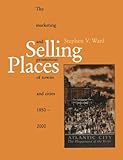
Stephen V. Ward. Selling Places: The Marketing and Promotion of Towns and Cities, 1850-2000. London and New York: Routledge, 1998. ix + 269 pp. $110.00 (cloth), ISBN 978-0-419-24240-6.
Reviewed by John Krueckeberg (Department of History, The University of Arizona South )
Published on H-Urban (October, 2000)
So Bracing: On the History of British Boosterism and its Context in the West
So Bracing: On the History of British Boosterism and its Context in the West
British historians, planners, geographers, and those interested in marketing will welcome the twenty-third addition to the "Studies in History, Planning and the Environment" series: Stephen V. Ward's Selling Places. Ward is Professor of Planning at Oxford Brookes University, the United Kingdom's largest planning school. The co-editor of Place Promotion: The Use of Publicity and Marketing to Sell Towns and Regions (1994) and the author of several books covering planning history (mainly focused on interwar Britain and garden cities), Ward conjoins his previous works and brings his talents to the subject of how places were developed for, and promoted to, targeted audiences; mainly English-speaking North Americans and Britons. His eight-page introduction and five-page conclusion bound nine chapters concerning five places: the frontier, resorts, suburbs, the industrial town; and the post-industrial city. With the exception of the frontier, two chapters each cover the places sold: one chapter covers the history of the place; the other chapter explores the themes advertising the place.
Readers should enjoy most of the book. Most of Ward's prose is gracefully straightforward, and he complements his words with seventy-eight advertisements (unfortunately in black and white). More impressive, however, is the sense exuding from almost every paragraph that Ward enjoys his subject. It is easy to believe his first sentence: "Few books can have given their authors more happy hours of innocent enjoyment than this one" (p. viii). Ward clearly loves the ways places have been sold, and this love led him into quite an ambitious project. He states that his purpose is to create the first "coherent and comprehensive story" of place selling. (p. 3) Thus, it appears at first that his work will be a sweeping history: his initially stated parameters of exploration are bound by years that stand fifteen decades apart and are not limited to any one country. After Ward defines "place selling" loosely (as "a broad entrepreneurial ethos or ideology which, at specific times, has permeated the common affairs of particular places"), the reader knows a lot of ground will be covered (p. 3).
Because of the adventurous nature of Ward's project, I shall address its content in some depth. H-Net provides the forum for, and encourages, longer-than-traditional reviews, and I shall take advantage of this. Also, I believe it necessary to cover each chapter in some depth for two other reasons: the length of the book warrants more than a casual review (each nearly 8x10-inch page contains a lot of prose); also, it should convey whether the disparate subject of the book will be worth perusing. Ward's book ultimately needs to be considered from two perspectives: that of the microcosmic histories of the specific places "sold" and that of the macrocosmic history of place-selling captured by the course of the entire book. The larger history may leave some readers feeling a bit cheated out of what Ward promised -- his focus really is on Britain, and he emphasizes the first half of the twentieth century -- but such a sense is fairly well compensated by the micro-histories contained in each of the five parts.
Before tackling the frontier, Part One introduces the book by briefly discussing its methodological contexts and the structure of the larger history to be detailed. Ward casts his net widely to cover a topic with roots in several disciplines and in ten short paragraphs discusses thirty-two books covering an array of approaches to understanding place selling. The array is so disparate, one wonders after reading it how anything more than a piecemeal methodology will be employed in the chapters that follow; but Ward finishes the discussion promising "a synthetic approach." Unfortunately, Ward does not use the Introduction to define his methodology precisely, choosing instead to summarize four traditions from which his synthesis shall "borrow" ("celebration of place selling," "the marketing approach," "cultural studies critics,"and "public policy"). "The exact character of the synthesis," he explains, "will become clearer as it is elaborated throughout the text" (p. 6). For this reader, it never happened. Nevertheless, Ward finishes the Introduction with a summary of the three-era history covered by his five-part book: a pre-railroad era of "agricultural colonization" followed by an era of "urban functional diversity" followed by our contemporary era attempting "urban regeneration."
The selling of agricultural areas, namely the U.S. "frontier," Kicks off the first stage of Ward's book. Four times as long as the Introduction, it comprises the majority of Part One. Except for two sentences noting that Canada adopted equivalents of the United States's Homestead Act and Pacific Railroad Act and a paragraph on Canadian cities subsidizing railroads, the chapter focuses chiefly on the United States with some attention to Britain. Using traditional histories of the United States, mainly those by Paul Wallace Gates and Daniel Boorstin, Ward discusses how "a relatively empty land is settled" through government largess and boosterism (p. 7). "New West" historians may feel displeased at the oversimplification committed by Ward here, but it fits into one of the two over-arching themes of his book: that government-sponsored (or condoned) boosterism leads to successful place selling. And for much of his book, Ward seems amiss that it took Britain so long to figure this out.
When Ward turns to Great Britain's agricultural regions of the mid-nineteenth century, he does so for a juxtaposition that reveals the book's second theme. Compared to the United States, he concludes, "there were no longer any large and relatively empty areas into which agrarian settlers needed to be attracted" (p. 25). Containing an already "mature urban system," compared to the American West, there was no "growth imperative" to try and sell England's agricultural hinterlands (pp. 26-27). The "imperative" to grow is the second theme of Ward's book, and the first chapter establishes that, as far as place selling goes, it did not exist in mid-nineteenth century Britain; however, it arrives in England in the next chapter, where Ward argues that two groups (resort communities and railroad officials) felt a growth imperative to sell England's resorts and turned to imperfectly imitating the boosterism that marked the selling-history of the U.S. frontier.
Part Two's concern with resorts opens with a chapter in which Ward walks the reader through roughly four centuries of spa history in just eleven paragraphs before introducing the question that lies at the heart of the chapter: how did a place such as Blackpool move from being the forty-third largest resort in England in 1851 to fifth in 1911? The answer is advertising in the face of the growth imperative. In 1872, according to Ward, the railroad raised its rates and thus threatened Blackpool's economic future. The resort community concluded it needed to make travelers believe the destination was worth the new ticket price and after Blackpool passed a local act to tax for advertising purposes, it assembled an Advertising Committee to sell itself as a prosperouscommunity. No other British resort community successfully boosted itself.
Other resorts in Britain and elsewhere grew too, but through private initiative and not local community action. When British railroads felt the growth imperative, they turned to advertising resorts as a way to get rail tickets purchased; town development was incidental. The non-Blackpool British model reflected that used by the French when the Compagnie de l Ouest railroad boosted its unprofitable lines to the English Channel. But the French added innovations to their advertisements by using costly posters (the British relied mainly on newspapers and books) and campaigns directed overseas. The French believed international tourists would help make their resorts successful, and successful resorts in turn would attract domestic travelers on the l'Ouest railroad. Similarly, Belgium advertised abroad but conducted its advertising campaigns through a centralized national-public office: what was good for Belgium resorts was good for Belgium. And in the United States, Ward concludes, private promoters of turn-of-the-century Atlantic City (both hoteliers and railroads) used the same boosterism as had railroads in the U.S. West, decades before.
The global comparison, Ward concludes, shows that Britain was slow. As a nation, it did not realize quickly the importance of advertising abroad; using posters; and, most significantly, using both public taxation and public-private committees to organize promotions. Ward will not give full credit to Britain realizing these place-selling solutions until his last chapters on the post-industrial era; but he argues in this chapter that Britain did try to correct its ways in the face of global competition (the growth imperative again). The 1921 Health Resorts and Watering Places Act allowed for taxation for limited advertising and the tax was increased over the next two decades. As the restrictions on types of advertisements were lifted, Britain caught up in the history of advertising as it was practiced internationally. When the government started supporting paid holidays for workers, British resorts entered what Ward calls the "golden age" (p. 48). Unfortunately for the resorts, World War Two interfered and signaled the decline of the glorious era. This decline is discussed briefly in the last six paragraphs of the chapter.
Chapter Four serves as the visual aid to the previous one and rounds out the history of resorts by addressing the post-war era. It uses splendid advertisements to reveal pre-Cold War British holiday themes but uses no advertisements in its discussion of the demise of British resorts. Noting American and continental European differences from (and similarities to) the British advertisements, Ward discusses five transnational marketing themes that travel somewhat in a chronological order through the first four decades of the twentieth century: the resort as a healthy getaway; the resort as a distinct place of sunshine; the resort as either a place for, or an escape from, morality; the resort as a middle-class experience; and, the resort as a place to exploit the nostalgia of the past. The Cold War era, however, ended such campaign themes as the automobile supplanted the railroads and all British resorts but Blackpool lost their ability to lure tourists. Ward claims that the automobile's intrusion into British resorts was both unsightly and poorly planned; when coupled with poor attempts by some resorts to be "fun" like Blackpool, it doomed British tourism to warmer environs in international communities that had a more entrenched tradition of state-supported marketing techniques aimed at foreign markets. Britain's antistatism and focus on domestic tourism thus failed resorts in the age of the automobile and warm vacation.
The age of the automobile also brings to an end the place and period Ward investigates in Chapters Five and Six: suburbia. Like the resort, this place receives a two-chapter treatment that leaves the illustrations to the end; also it too has a golden era in the 1930s and again the primary focus is on England. There is a splendid look at the American side of the Atlantic and Ward's history of suburbia nicely and concisely synthesizes Anne Keating's study of Chicago with the classic works of suburbanization by Sam Bass Warner and Kenneth Jackson. Linking the United States with England, Ward effectively brings to life for the reader, Samuel Eberly Gross, whom Ward convincingly portrays as the "master of advertising" and "a genuine showman" with awe-inspiring talents (pp. 88, 90). Ward importantly links Chicago to England through Gross and shows how the advertiser-developer's talents first appeared in London in 1889, were furthered in early twentieth-century England by his business partner, Charles Tyson Yerkes, and were replaced by the advertising efforts of the railroads. Once again, the railroad's usurpation of locally inspired place selling was driven by the growth imperative faced by "insecure railway companies" (p. 100). English railroads in the years between the world wars dominate the last quarter of the chapter, once again revealing Ward's love for this era: again he finds "the outbreak of war in 1939 brought this golden age of British suburban development to an abrupt end" (p. 108). That the age of suburbanization was about to explode in the United States and elsewhere, is over-looked in this chapter on history, instead left to the chapter on advertisements for suburbia.
Ward's advertising chapter analyzes how promotions of suburbia provided a less "mercenary" and "an all together more poetic vision of how a widening section of the population thought they wanted to live" (p. 110). Suburbanites, to borrow the title of Chapter Six, wanted to live in a "realm of romance." Advertisers sold this romance through several themes explored by Ward: the English countryside of historic manors, the American vision of pioneers recreating an Eden with access to "civilization;" suburbs as both healthier than cities and offering pride of ownership; and, a place where womanhood "was firmly circumscribed, limited exclusively to the domestic realm" (p. 136). These themes, however, only are explored up through the "golden age."
Continuing the pattern established by the section on resorts, this place's history in the post-war era is both left to the chapter on visual themes and is not supported by any visual aids. Certainly he makes no overstatement when he observes that "things were never quite the same again after Levittown;" but the progress of the chapter seems to lose its focus when he claims that "the same rural values [continued and] continue to pervade promoted imagery of the suburban place in the years after World War II," yet he uses not a single visual aid or corporate logo (p. 141). Ward does introduce the importance of place names in the post-war era, although this does not seem to fit the focus on visual aids used throughout the book.
Thus something seems to go askew in the progress of the book whenever Ward addresses the post-war periods of his places. What does it mean to divorce the post-war era from the chapters on history and leave them to the chapters on advertising? Are their histories somehow less important or interesting than those of the "golden age"? And what does it mean to discuss the post-war era in chapters focusing on advertising images but not include even a single image from the last half of the twentieth century? No doubt the answer lies in that the period is covered in the last section, which does include visual aid, but some greater attention to the post-war histories of resorts and suburbs, along with some illustrations, would have been welcomed in the sections thus far discussed.
The fourth section turns to the industrial town. Whereas the first three places held in common being promoted against the backdrop of the urban center, their successes resulted in creating a growth imperative for cities turned "anxious to grow, or to replace declining industries" (p. 144). Ward explores the histories of this place in three areas: Canada, the U.S. South, and Britain. Repeating the core-periphery model that subtly undergirds the frontier chapter, the American places in this section's two chapters serve as juxtaposition to Britain by being areas "on the edge" (p. 145).
Ward titles the first of the two chapters in this section, "Selling Places or Buying Industries?" This signals a shift in the book, as it begins to focus less on the people who might respond to place selling (farmers, tourists, and residents) and more on the businesses that might respond to place selling (or place selling's counterpart, industry buying). Apparently, he disdains the notion of bribing businesses to settle in particular communities (preferring, I presume, the tricky innuendos of artistic advertisements). Notice his language: when Canada >suffered "a desperate scramble for factories," it turned to paying subsidies "to the tune of millions of local tax dollars." [144] This seems to echo the "desperation" that led the town folks of fables to hire the pied piper to play his tune. Similarly suggesting disdain, he puts Atlanta on par with drug dealers keeping their cash deals off the record, when offers to move industries to the U.S. South "began to be backed with hard cash and other 'dubious' inducements" [Emphasis added.] (p. 145). Ward does acknowledge, however, that some Canadian towns came to their promotional policies by different routes. Some places, for example, Paris and Hanover in Ontario, were anxious to lay a "proper" social basis for their communities to grow. [Emphasis added.] [150] Interestingly, in the first section, Ward never leveled such critiques at the U.S. frontier communities that he examined in the same time frame. Their reliance on government-passed acts that gave away land "legally" apparently excuses the detriment caused to Native Americans' social basis.
If Ward is critical of some of the New World's practices, he laments nonetheless Britain's inability to follow suit. Looking at Luton, Cardiff, and West Ham, Ward reveals the hamstrung course industrial town promotion followed because the national government forbade local councils to bribe businesses with direct inducements or use taxes for large-scale advertising. Local communities eventually learned to attract industries with different electric rates, but even then they had to rely on paltry funds for advertising themselves to business. British industrial towns thus shared the same problems faced by British resorts. Small budgets, however, did not characterize the campaigns of the New South.
Ward discovers that the New South practiced promotional tactics in common with Canada (arguably going further by stretching the definition of "public" money to include building factories with funds marked for education). Ward-the-professional-planner is rightly outraged by extralegal practices, and he argues that Mississippi chose to "introduce some sanity" in its place promotion when it created a state board "comprising three very experienced businessmen, [who] undertook industrial marketing, carefully targeting and screening likely prospects" (p. 159). Thus Ward shows the New South becoming more "sane" in its approach to sell itself.
In the second chapter concerning the industrial town, Ward leaves behind his place-hopping-through-history and turns again to the advertisements used. They shared some things in common, and Ward claims that no matter which place is examined, one finds being sold "a place of destiny. Local history was plundered to demonstrate the inevitability of success.... Everywhere in the promoted place there was efficiency, modernity and progress" (p. 163). Ward provides sixteen advertisements to reinforce that places were sold as hubs where "civilization" and production joined. They also incorporated factual information to both assure that the place already was succeeding, and to suggest that the energy of success was transcendent to all who built there. Walking hand-in-hand with the promise of success were key "facts" that pointed to industrial success. Ward breaks these into three themes: good labor relations ("strikes almost unknown"); good facilities for working-class communities ("happy and contented employees"); and good social attitudes ("acceptable Anglo-Saxon people"). Using few facts but crafting an equally mythical view, Ward argues, were two themes that addressed the place of womanhood: socially as single workers or culturally as industrial towns waiting for her masculine industry. (Unfortunately, Ward's choices of posters to reprint do not reveal these gendered themes.) Ward finishes the chapter by noting that although industrial towns now are promoted for their "heritage, tourism, tertiary and quaternary sector employment" nevertheless "old habits die hard ... [and] many North American advertisements today are remarkably similar to those of the early twentieth century" (pp. 180, 183). Three post-1945 North American ads support this claim, but again the emphasis of the chapter (as has been the book so far) is on the early twentieth-century. The last section of the book corrects this somewhat.
The post-industrial city is Ward's last place. Like the previous parts, this one is divided into two chapters where the latter examines advertisements and their themes. (Unlike earlier sections, it is the only one to not separate Britain into a distinct geographical subsection.) Fraught with the growth imperative, "as cities seek to achieve international prominence in the twenty-first century," the post-industrial place is heralded by Ward for having learned the lessons in proper place selling. Indeed, the post-industrial city seems to be the culmination of all that came before: it is managed by governments that have learned that local cities need advertising funds and government support (as the US frontier had); it has the freedom to promote themselves (known in Britain only in Blackpool); and its promotions are kept in the realm of the sane with the use of both professional agencies and public relations offices that legally promote respective cities' attractions. The post-industrial city also is a place that combines all the people of the previous sections: developers, tourists, residents, and businesses. Thus the chapter nicely "ends" the course charted by the previous sections.
Nonetheless, the section on the post-industrial city has a striking difference from the rest of the book. Although it serves as an endpoint to the book's larger chronology, unlike earlier parts it lacks an internal sense of chronological change. The first chapter of the section details those sociological elements that juxtapose the current period to those that preceded it without connoting a sense of how it came to be. Ward simply describes conditions of the post-industrial city (unemployed; oriented towards service and tourist economies; and, especially important for Britain, now encouraged by governments of all levels to market themselves.) The sense of historical agency has evaporated: the actors (individuals, their community organizations, and their companies) who developed railroads, promoted resorts, sold suburbs, and advertised their cities (each with a sense of purpose for their specific place and time) are replaced by advertising campaigns with little sense of history. In essence, Ward's last section ends with a sense of being static. Thus, Michael Kelly's and John Struthers's decision to promote a Scottish post-industrial city as Glasgow's Miles Better is contextualized by one paragraph concerning the place's decline and nine paragraphs on the slogan's relationship to the ad, "I [heart] New York." Comparisons between places such as London's Canary Wharf and Boston's Faneuil Hall dehistoricized the places. None of this seems to fit in a book that noted so much action: the development of the "frontier"; the evolution of Roman resorts; the promotion of suburbs; and even the creative techniques adopted by peripheral places wanting to be at least regional cores. But the post-industrial city just comes across as a transnational "place" suffering from social issues divorced from their historical specificity and not being promoted in any one place with an over-arching sense of purpose.
Oddly enough, when Ward writes the chapter that turns to the actual advertisements used, he seems to contradict the earlier portrayal of the post-industrial city as transnationally homogenized and static. Ward discerns that for the first time in the history of place selling, the "dream" being sold is not uniform: "While other types of place, and especially industrial towns, have seemingly projected their sameness, post-industrial city marketeers emphasize their city's distinctiveness" (p. 209). The last chapter before the conclusion thus explores how certain post-industrial cities use their specific histories and geographies to promote themselves as: having survived their past and now can celebrate that fact; having a competitive advantage as a place with enough cultural capital to aesthetically please and offer amusement; being better than you have been led to believe; a place successfully rebuilding itself; populated with people very different from what you have been led to believe live there (Yuppies you would like in the Docklands, vibrant youth celebrating their fun-loving culture in Manchester, homosexuals "up north" of London); and, full of local pride. Ward seems to like the advertisements of the post-industrial period, but apparently its place-selling does not compare to the inter-war period: a "golden age" ... has not yet appeared. It may never come, of course" (p. 234). Without a sense of the post-industrial city being anything more that the end-product of a chronology that sketches a macrohistory "rise and fall of the city" (and portrayed as a period without a distinct sense of having even a microhistory), the last section proves interesting, but ultimately disappointing to the history promised at the book's opening.
Ward's brief conclusion, divided into two subsections, furthers the sense of disappointment concerning the book's promise to serve as a "complete and comprehensive" history. In its first subsection, Ward concludes that some universal truths concerning place selling include the process being "mainly associated with periods of economic change and with urban systems or parts of urban systems which are experiencing that change." [p. 236] Thus the "growth imperative" rears its head again. Ward also concludes that although "place selling has not been solely or even mainly the prerogative of government," it "has normally blossomed in settings where a higher government has tolerated local autonomy and encouraged fiscal self-reliance" (p. 238). Finally Ward notes that successful place selling also requires private industries, companies, and "local factors" such as "key local individuals [,] ... the particular local relationship of business and political leaders ... [and] the extent to which the promotional visions of the place sellers could be embraced, or at least tolerated, by the wider population" (p. 238).
The second subsection of Ward's conclusion turns to the topic of "language and imagery" only to offer seemingly contradictory conclusions. First Ward challenges his work's relevance to the fields of history and geography: "In an almost timeless and placeless fashion certain messages and images have recurred in the selling of different kinds of places" (p. 238). He chooses to not review them "chapter and verse" because "each type of place selling has its own particular repertoire of the mundane" (p. 238). Yet within two paragraphs he backtracks to argue that place-selling advertisements *are* "expressions of time, place, society and culture ... [and] we can read the imagery and texts of place marketing as a mirror, albeit perhaps a distorting mirror, of a varied and changing wider world." [p. 239] Choosing to not summarize the history of that mirror as contained in his book, but to discuss instead the aesthetics of advertisements, Ward finishes by warning the reader to separate images from reality. This conclusion, for all practical purposes, peters out a book that has a lot to offer.
There is a great history contained in Ward's book. I shall describe it below; however, it is important to note that it is overwhelmed by a sense of constant competition within the book as to what the book's purpose is supposed to be. The book is supposed to be global, and even the cover illustration is an ad for Atlantic City, yet the book focuses on Britain; but even the emphasis on Britain is lost both in subsections on foreign places and in the last chapter synthesizing British cities with Boston, New York, and Atlanta advertising campaigns. The non-British places that do appear seem arbitrarily chosen, as there is no methodology to explain their selection; also they are discussed at strikingly different levels of depth - from a sentence to a paragraph to a subsection. Although the bulk of the book presents first one chapter on a micro-history of a place and then one chapter on the ads that promoted it during that period, the "frontier" chapter has both elements synthesized and both suburbia and industrial towns have their post-1945 "history" in the advertising chapter. Finally, with respect to the three-stage historical narrative promised in the Introduction, the last stage consistently gets shorted throughout the book, ultimately not even having written a micro-history of its key place, the post-industrial city. I mention these not as detractions, however, but merely to suggest that there are distractions from the important history the book does write.
Ward's book details the fascinating history of British boosterism. His discussion of American boosterism and continental Europe's competition with Britain both provide fitting contexts in which to understand the British experience. But the book is not structured on this history. Indeed, if it had been structured around such a history, it might go something like the following: "In the latter half of the nineteenth century, as stockholders in the Illinois Central Railroad and as readers of W.J. Palmer's advertisements for places in the American West, the British tasted for the first time the boosterism that would come to dominate their history of place selling. By the end of the nineteenth century, British private industry explored the tactics learned in the United States to develop their railroads serving resorts and suburbia. In the early twentieth century and through the outbreak of World War Two, developers and promoters (such as Gross and Tykes) furthered British boosterism in the private sector while public initiatives tried to sell places such as resorts and industrial centers in the face of growing international competition. British national policies limited the public sector's ability to campaign actively and only Blackpool showed success at first. Nonetheless, British advertising flourished and contained both uniquely British themes and themes shared by other nations trying to reach the same goals. As Britain began to embrace paid holidays and local tax relief for advertising, as well as embrace more fully the advertising themes being used internationally, it slowly caught up with the rest of Western Europe and North America with respect to selling resorts, residences, and industrial towns. Unfortunately it was too late with respect to promoting resorts, but both outlaying industrial towns and urban centers had a chance and have survived. Today Britain's post-industrial cities (which incorporate the functions once associated with the previously mentioned places) embrace boosterism fully by hiring private-sector firms and creating public offices to both modify and continue the advertising themes used in the long and rich history of selling British places. This story, replete with its revealing advertisements, is worth the read.
All in all, Ward has written a great book that not only is enjoyable to read, but also is great to view. Some issues do exist that I will raise as an historian from the American side of the Atlantic. Although his analyses of resort ads seem quite thorough, his analyses of other places' images do not get the same broad treatment and none go as deep as I would have liked -- it seems fair enough to let readers interpret some meanings for themselves, but some analyses seemed too superficial. Had Ward wanted to deepen his analysis, he might have employed the approach used by Roland Marchand in his classic history, Advertising the American Dream. [1] Also, for all his discussion of how advertising mirrors the social tableau of the time, I would have appreciated greater elaboration on the connection between certain images and their histories/meanings such as Robert Rydell discerned in his works on world fair images.[2] (This especially goes for the image of "Miss Dakota" in the chapter on the "frontier" -- an advertisement that to me makes the whole book worth its purchase price.) As stated earlier, Ward does not share the same historical agenda as "New West" historians, and this is fine; although their critiques of the U.S. West's history could warp some of his conclusions away from celebrating development in the ways that he celebrates them. Indeed, the issue of "conquest" is nowhere to be found, although the ads do provide the reader the chance to contemplate the issue individually. (The "flip-side" of his argument can be found, for example, in Patricia Limerick's A Legacy of Conquest or her co-edited Trails.)[3] Ward's bibliography does not reflect the works of John Kasson and Kathy Peiss on Coney Island, and I wonder if his history of resort selling might have had more of a class analysis and addressed the culture of consumption as something more than just "fun" had he incorporated their views on the historic changes of resorts.[4] But all this is petty, compared to what Ward does accomplish in his book.
Ward's hard work produces a book that is, to borrow the phrase once used by British resort advertisements, "bracing." Ward describes "bracing" as a British term that characterized the cool-crisp seaside air: "This was important because air was all pervasive, capable of being enjoyed by everyone ...." [p. 58] Ward's book, too, should be capable of being enjoyed by everyone. Indeed, to describe the delight I received in learning about British boosterism and viewing scores of wonderful advertisements I would merge Ward's book into the 1951 ad used to promote Skegness: "The tonic air stimulates the visitor so that he soon feels braced up and keen to enjoy wholeheartedly the countless delights which this beautiful resort provides." Ward's book, filled with delights, is beautiful, enjoyable and stimulating; it is bracing.
Notes
[1]. Roland Marchand, Advertising the American Dream: Making Way for Modernity, 1920-1940 (Berkeley: University of California Press, 1985).
[2]. Robert Rydell, All the World's a Fair: Visions of Empire at American International Expositions, 1876-1916_ (Chicago: The Universityof Chicago Press, 1984).
[3]. Patricia Limerick, The Legacy of Conquest: The Unbroken Past of the American West (New York: W.W. Norton, 1988); Patricia Limerick, Clyde Milner, III, and Charles Rankin, eds., Trails: Toward a New Western History (Lawrence: University Press of Kansas, 1991).
[4]. Kathy Peiss, Cheap Amusements: Working Women and Leisure in Turn-of-the-Century New York (Philadelphia: Temple University Press, 1987); John Kasson, Amusing the Million: Coney Island at the Turn of the Century (New York: Hill and Wang, 1978).
Copyright (c) 2000 by H-Net, all rights reserved. This work may be copied for non-profit educational use if proper credit is given to the author and the list. For other permission, please contact H-Net@H-Net.MSU.EDU.
If there is additional discussion of this review, you may access it through the network, at: https://networks.h-net.org/h-urban.
Citation:
John Krueckeberg. Review of Ward, Stephen V., Selling Places: The Marketing and Promotion of Towns and Cities, 1850-2000.
H-Urban, H-Net Reviews.
October, 2000.
URL: http://www.h-net.org/reviews/showrev.php?id=4605
Copyright © 2000 by H-Net, all rights reserved. H-Net permits the redistribution and reprinting of this work for nonprofit, educational purposes, with full and accurate attribution to the author, web location, date of publication, originating list, and H-Net: Humanities & Social Sciences Online. For any other proposed use, contact the Reviews editorial staff at hbooks@mail.h-net.org.

