

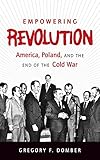
Gregory F. Domber. Empowering Revolution: America, Poland, and the End of the Cold War. The New Cold War History Series. Chapel Hill: University of North Carolina Press, 2014. Illustrations. xvii + 392 pp. $39.95 (cloth), ISBN 978-1-4696-1851-7.
Reviewed by Patryk Babiracki (University of Texas-Arlington)
Published on H-Poland (May, 2016)
Commissioned by Paul Brykczynski
How US Dollars, Sanctions, and Salons Helped Unravel Polish Communism
Poland's transformation from Communism to democracy in the 1980s was a key episode in the story of East European political contestations. Much has been written about the crucial role of Solidarity and various social movements in the toppling of Polish Communism. Several recent studies have illuminated US-Polish relations in the all-important 1980s. Chief among them are Helene Sjursen's The United States, Western Europe and the Polish Crisis: International Relations in the Second Cold War (2003) and Patryk Pleskot's Kłopotliwa panna "S": Postawy polityczne Zachodu wobec "Solidarności" na tle stosunków z PRL (1980-1989) (2013). Both works show that, despite their pro-democratic rhetoric, Western governments were slow to embrace Solidarity because they feared either spoiling relations with the USSR or destabilizing Europe, or both. Pleskot in particular, drawing largely on Polish archival material (and a wealth of other documentation and secondary sources, including Gregory F. Domber's earlier work) does much to illuminate the extent of US support to Solidarity, as compared to West European countries and international organizations.
In contrast, Gregory F. Domber examines a rather different set of tensions. Rightly, he observes, many in the United States claimed (and received) considerable credit for bringing down Communism in Poland. As Domber reminds us, no lesser personality than Lech Wałęsa expressed his gratitude "to the American people" for their help in the 1980s as he addressed the US Congress in November 1989 (p. 2). What exactly did he thank the Americans for? Are perceptions of decisive US actions justified? Do the facts bear out complacency in the "conventional wisdom" (p. 4)? Do they support triumphalist rhetoric in some US policy circles, but also some subtler scholarly assertions, such as, for instance, the "implicit claim" that Domber detects in John Lewis Gaddis's work, according to which Ronald Reagan provided international "moral leadership" in the fight against Communism, thus ushering change in Poland as well (p. 261)? Perhaps, Domber concludes, but with several key qualifications.
The book is organized into six chapters. Chapter 1 examines the first thirteen months of the Polish crisis from the momentous recognition of Solidarity by the PZPR (Polish United Workers' Party) in August 1980 to a month after a break between the United States and the Polish government following the imposition of martial law by General Wojciech Jaruzelski on December 13, 1981. Chapter 2 concentrates on the flow of humanitarian aid to Poland and US trade union help to Solidarity in the months after the imposition of martial law. Chapter 3 examines how the US government used economic sanctions to push for political concessions from Polish leaders, and it also looks at American nongovernmental help to the Polish opposition from the end of 1982 to early 1985. In chapter 4, Domber explores broader international influences on PZPR's decision making through September 1986. Chapter 5 traces US-Polish attempts to normalize bilateral relations in 1986-87. Chapter 6 zooms in on US active support for the moderate faction of Solidarity on the eve of the trade union's victory in Poland's national elections.
Domber sets out to show that the United States "empowered" Solidarity, and especially the union's moderate wing, in its struggle against the moribund but tenacious party-state. Titles can easily misrepresent a book's content; in this case, though "empowering" truly is the key to Domber's argument. The United States, he shows, did nothing less and nothing more than that, consistently lending active but limited support. The US government assisted Solidarity through multiple channels. From the outset, Reagan led the way, using economic sanctions, such as cutting off agricultural subsidies and loans to obtain political concessions from the economically beleaguered, perennially indebted Polish government. Reagan reacted to further crackdowns on Solidarity—as on October 9, 1982, when he suspended Poland's most-favored-nation trade status; conversely, Washington consistently rewarded the Polish government for lifting repressive measures, a theme throughout the book.
While pursuing sanctions, Reagan engaged with nongovernmental organizations (NGOs) and private organizations authorizing millions of dollars worth of humanitarian aid to the Polish people, thus fulfilling US political goals of punishing the Polish government for martial law while minimizing the hardships of ordinary Poles. The humanitarian aid, points out Domber with reference to the mid-1980s, "did not go unnoticed by the Polish people" (p. 197). Simultaneously, Reagan unleashed a public mass-media campaign, making his personal cause into a cause célèbre, and making his public defense of Poland into a broader attack on Communism—and a justification for a vastly increased US budget in the second Cold War. "Without martial law," writes Domber, emphasizing the key causal links here and throughout the book, "the executive branch may well have pursued these policies, but the president's urgency and public arguments would have taken a very different turn" (p. 61).
As Domber demonstrates, others in the Reagan administration also made Solidarity into their personal cause. US ambassador to Poland John R. Davis and his wife Helen hosted regular salon-like parties for Polish opposition members. For US diplomats and visitors, these events were opportunities "to meet with heroes," such as Wałęsa; for Solidarity attendees, they offered a chance to show that "it [Solidarity] remained an important force" to the PZPR (pp. 184, 185). Presumably it boosted Solidarity's legitimacy in Polish society as well.
Domber fine-tunes and finesses his case for "empowering" by showing that American actions were limited in scope. Thus, the author effectively complicates the traditional vision of strong US historical agency in several ways. He shows that "foreign policy" in the US-Polish context meant more than a bilateral relationship between the two states, since the United States forged separate links with the Polish government and with Solidarity, sometimes aiming somewhere in-between, at Polish society (p. 4). In addition, US government institutions operated within a complex network of institutions, such as other states and international organizations, but also US NGOs, including the AFL-CIO, the Polish Workers Aid Fund, and private organizations, which pursued their own agendas, and which often informed official US policies, and sometimes acted independently of the US government. In short, the aid that flowed from the United States was not always government aid, and several NGOs that did much to bolster Solidarity financially were staffed mostly by Poles.
Domber further shows that the US government acted as a force that was sympathetic but largely reactive to the chief players in the Polish crisis behind the Iron Curtain: Solidarity, which regularly requested support in the form of money or office equipment, but also the Polish government and the Kremlin, which always figured in considerations of US policy toward Poland. Although substantial, US aid proved hardly decisive, argues Domber, as patterns of Poland's "liberalization mirrored changes in the Soviet leadership more closely than shifts in American or Western policies" (p. 258). And the economic sanctions failed more often than they succeeded. Finally, in Domber's view, "empowering" was all that the United States could realistically do without provoking the Soviets into invading, or indeed, the Poles into rebelling—memories of the irresponsible US call to arms in Hungary in 1956, combined with its utter unwillingness and failure to support the insurgents, were still fresh.
In Domber's story, Reagan figures as a passionate anti-Communist but also a pragmatic. After "the break of trust" between the two governments following the US sanctions and the Poles' anger at US sanctions, dialogue broke down, while Reagan remained interested in Poland "in terms of how it was used to secure global goals" (p. 86). The book helps us understand why so many Poles have a soft spot for Reagan and, indeed, why the political divisions in the so-called new Europe do not always translate easily into those existing elsewhere in the West. Yet to those Poles who might be inclined to romanticize Reagan, this is a welcome reminder that, like Napoleon two centuries earlier, he treated Poland largely as a pawn in a game with Russia.
In the end, Domber shows compellingly that neither the US government nor Reagan personally "led" the Polish opposition in any discernible way. If anything, US officials "revered" Polish leaders and often sought guidance from them, supporting them in meaningful ways. As Domber states: "American broadcasts were well received, not because they opened Poles' eyes to the evils of the Jaruzelski regime and the Communist system, but because they showed that Poles were not alone" (p. 264)
Domber's overall argument for "empowering" is crisp and nuanced, while his intervention in the ongoing discussions of the US role in 1980s Poland is incisive. The book is based on a wide range of Polish and US archival sources. The author's examination of records of various US NGOs and personal papers of key US decision makers, as well as numerous interviews, contributes to our understanding of the US role in the Polish crisis (this is also what makes the book different from Pleskot's work, which came out a few months before Domber's and which Domber did not include in his discussion). Interesting and relevant photographs add to the book's attractiveness. I did notice consistent, and often odd, Polish-language errors throughout the book; they do not diminish the quality of Domber's work, but they are distracting and could have easily been avoided.
Perhaps the chief weakness of this book, though, is that it takes up an argument with "implicit" theses of others. Contrary to arguments in Domber's work, in Gaddis's account the great historical actors who brought about the fall of Communism hardly compete with each other for undue credit. And it seems neither an overstatement nor a contradiction to say that while Wałęsa daringly led the Poles in the fight against Communism, Reagan led the world. In fact, this is something that Domber himself shows but is more reluctant to admit.
If there is additional discussion of this review, you may access it through the network, at: https://networks.h-net.org/h-poland.
Citation:
Patryk Babiracki. Review of Domber, Gregory F., Empowering Revolution: America, Poland, and the End of the Cold War.
H-Poland, H-Net Reviews.
May, 2016.
URL: http://www.h-net.org/reviews/showrev.php?id=46003
 | This work is licensed under a Creative Commons Attribution-Noncommercial-No Derivative Works 3.0 United States License. |

