



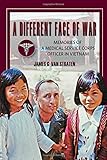
Jim Van Straten. A Different Face of War: Memories of a Medical Service Corps Officer in Vietnam. Denton: University of North Texas Press, 2015. 576 pp. $34.95 (cloth), ISBN 978-1-57441-617-6.
Reviewed by Paul Clemans (Air University, Air Command and Staff College)
Published on H-War (September, 2016)
Commissioned by Margaret Sankey (Air University)
Major James Van Straten, US Army, deployed to Da Nang Air Base, Vietnam, in June of 1966 as a Medical Service Corps advisor. His mission was to advise the South Vietnamese medical corps on how to effectively run their medical operations such as medevac, hospital operations, interhospital transfers, medical supply and logistics, and civilian health care. In this capacity, he also acted as a liaison between the US and Vietnamese medical systems and coordinated the activity of his fifty widely distributed medical advisors across his area of responsibility in the northernmost portion of the country, called I Corps Tactical Zone. His duties drove him through three conceptual crossroads and immersed him in a rich cultural experience during his yearlong deployment from June 1966 to June 1967.
As an army medical officer, he was privy to I Corps strategies and operational plans in order to anticipate the medical demands future battles would place on the Vietnamese medics, medevac system, and hospitals. He in turn advised his Vietnamese counterparts to ensure their readiness. This experience came at watershed period in the Vietnam War. The United States injected combat units for the first time in 1965, so that, by the time Van Straten arrived in theater both advisory and combat missions were being executed side by side. In Saturday morning staff meetings he gained exposure to General Walt’s continuing “hearts and minds” philosophy as it was being overtaken by General Westmoreland’s “search and destroy” approach to the war. Van Straten provides a unique, full-spectrum perspective, from the overall strategy to the medical preparation and operational execution to the aftermath of the medevacs and hospital operations. It is within this context that he describes US and Vietnamese cultural differences. When an Army of Vietnam (ARVN) unit comes under attack and takes heavy casualties, a US helicopter comes to their very hot landing zone to evacuate the wounded. However, the ARVN insist on evacuating their dead along with the wounded due to their Buddhist beliefs. The US pilots is not willing to risk his life to evacuate the dead and threatens not to return to the landing zone. At this point, Van Straten steps in to resolve the situation and learns about the culture along the way. Once the ARVN casualties arrived at their Vietnamese hospital, Van Straten advises them to transfer some patients to the US naval or other Vietnamese hospital to mitigate their overcrowding issues. The hospital patients numbered nearly twice the number of beds. Amazingly, the Vietnamese medical personnel refused to transfer the patients. Their culture dictated the wounded to be near their families and the families took care of their patients’ needs, such as bathing, that the understaffed medical personnel could not perform. There are many other stories, but this is enough to demonstrate he received an education in Vietnamese culture.
Van Straten offers a second perspective as he coordinates his US medical advisor field teams to implement two civil programs, the Medical Civic Action Programs (MEDCAP) and Military Provincial Health Assistance Programs (MILPHAP). These programs reached out to Vietnamese communities to prevent the spread of diseases such as malaria, rabies, dysentery, and bubonic plague, as well as provide medical care and advice. These responsibilities brought Van Straten into contact with local village issues; in one case in particular, when the Vietnamese relocated villages from the Demilitarized Zone to Cam Lo, he goes into greater detail. Related to these responsibilities, he reached out to the Vietnamese community to help social outcasts with deformities from harelips and clubbed feet to abnormal growths. A Dr. Giles deserves special mention in this regard, as he treated these Vietnamese cases at the naval hospital on a noninterference basis. The Vietnamese accepted Van Straten’s help in many, but not all, instances. He shares his insights into the cultural ostracization imposed on people with these conditions. The occasions when treatment was refused provided tremendous insight as well. In one case, the family believed deformity was God’s punishment and to remove the punishment would be to invite more punishment in its place. In another case, the family believed US medical treatment would be perceived by the Viet Cong as collusion with the Americans and they would be punished. Van Straten illuminates more of Vietnamese culture with each story.
The third window into the culture opened when Van Strated was perceived as a “doctor” and teacher. Doctors and teachers were highly revered in Vietnamese culture. Several times he protested he was a medical services administrator, not a doctor, but that did not matter. Given this perception, his commander, Colonel Hamblen, routed many functional and ceremonial invitations to Van Straten. He was highly encouraged to accept all the invitations he was offered and many were extended within the Vietnamese tradition of one day’s notice. One such invitation was to teach English to mostly children and some adults. This activity led to some of his female students asking him to meet their parents, which he initially refused. He learned these invitations were devoid of romantic implication; instead, they reflected a cultural belief that a teacher’s visit bestowed great honor on a home. Naturally, he then accepted several invitations. His interactions as doctor and teacher are interwoven in many of his short stories.
Van Straten’s memories are based upon 352 letters he wrote to his wife during the yearlong deployment and reread, apparently for the first time, in 2012. Whereas most deployments consist of very monotonous routines, Van Straten’s was atypical, as he was thrust into a wide variety of circumstances. Although he never explicitly states why he wrote the book, the prologue contains some hints. He mentions that relatively little has been written about military advisors in support services and dedicates his work to his family, American servicemen, and those American military members who died in Vietnam. This reflects his approach to the book, as he seems to stay true to his letters and the facts as he saw them at the time. Of course, his feelings, thoughts, and opinions are wrapped up in the short stories, but he does not really venture into his feelings and thoughts of today until the last chapter, entitled “Reflections.” The structure of the book is such that each chapter represents a month and contains short stories in chronological order based on the letters. These stories are poignant and range from heartwarming to soul-crushing and everything in between. Due to the chronological order and the chaotic nature of the war, it is nearly impossible to predict the nature of the next story on any one page. This structure does make the book difficult to read at points, but that seemed to be a conscious tradeoff to remain faithful to the primary sources. Some themes certainly do run through the book. He supported General Walt’s “hearts and minds” campaign in I Corps and he emphasizes the high number of civilian casualties and the dear price they paid in the conflict. However, the overarching theme is his education in Vietnamese cultural and adaptation to it. Van Straten does a great job of illuminating the impact an effective medical program can have when it operates within the cultural norms of a society. His work brings out a very human, redeeming side to the conflict, which I believe readers will embrace.
If there is additional discussion of this review, you may access it through the network, at: https://networks.h-net.org/h-war.
Citation:
Paul Clemans. Review of Van Straten, Jim, A Different Face of War: Memories of a Medical Service Corps Officer in Vietnam.
H-War, H-Net Reviews.
September, 2016.
URL: http://www.h-net.org/reviews/showrev.php?id=45934
 | This work is licensed under a Creative Commons Attribution-Noncommercial-No Derivative Works 3.0 United States License. |

