



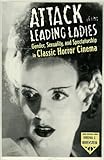
Rhona J. Berenstein. Attack of the Leading Ladies: Gender, Sexuality and Spectatorship in Classic Horror Cinema. New York: Columbia University Press, 1996. xvi + 274 pp. $67.00 (cloth), ISBN 978-0-231-08462-8; $27.50 (paper), ISBN 978-0-231-08463-5.
Reviewed by Robert Chamberlain (Emory, Virginia)
Published on H-PCAACA (June, 1996)
Horror Films and the Theory of Gaze
Attack of the Leading Ladies explores the concept of the gaze in film studies and applies its author's interpretation of this concept to American horror films produced in the early 1930s. Rhona Berenstein asserts that this gaze is neither solely masculine/ feminine nor sadistic/masochistic but fluid and malleable, as are the gender roles displayed within the films. Furthermore, the audience responds to and imitates this shifting of gender roles, each member adopting a range of responses suitable for both genders. The result is what Berenstein calls "'spectatorship-as-drag'" (pp. 30 ff).
Berenstein builds on the academic work of such critics as Carol Clover and James Twitchell but does not ignore sources outside traditional scholarship. She reviews a number of popular sources, such as Photoplay, Picture Play, and Screenland as well as contemporary reviews, press kits, and advertising materials, to demonstrate that the films themselves provide only one text amid competing, often contradictory, versions of the story. This analysis enables Berenstein to provide incisive and fresh readings of often neglected films.
Attack of the Leading Ladies's greatest strength, its focus on what its author terms "classic horror movies" (p. 2), may also be its greatest weakness. Early on, Berenstein explains why she concentrates on films produced from 1931 to 1936: A-budget horror productions ceased in 1936 even as B-budget productions continued, foreign markets refused to accept the then graphic horror films, and domestic censors began to look more closely at horror (pp. 14-15). Berenstein is correct; all horror productions diminish in 1937 and 1938, but, by 1939, a number of A- and B-budget films appear appropriate for Berenstein's analysis: The Gorilla, Return of Doctor X, and Rowland Lee's Tower of London and underrated Son of Frankenstein. In fact, other critics suggest that the American horror film cycle extends into the mid-1940s. But, even if Berenstein's emphasis is correct, she ignores several films from the same period, such as Freaks (1932), Ouanga(1935), She (1935), Werewolf of London (1935), and Revolt of the Zombies (1936). Yet, curiously enough, Berenstein does not limit herself solely to the early 1930s; when it suits her needs, she provides an extended discussion of 1975's Rocky Horror Picture Show (pp. 120-23, 159).
This willingness to bend ground rules in choosing films to analyze is nowhere more striking than in the extended discussion of jungle films. Although Berenstein links jungle and horror films with King Kong (1933) and discusses similarities and differences between the two genres (pp. 11, 162-63), this discussion emphasizes the gap. Readers are left wondering why they are reading interpretations of such films as Trader Horn in a book on classic horror cinema. Berenstein's choice of films to analyze finally leaves one wondering if she is not picking and choosing very carefully only those films that fit her theory.
In spite of these shortcomings, Attack of the Leading Ladies is an excellent contribution to film theory. Berenstein's incorporation of theories of cross-dressing and performance serve to complicate usefully the whole concept of the gaze, unfortunately often reductively rendered by critics such as Laura Mulvey, and thus to account for filmgoers' actual experiences.
This review is copyrighted (c) 1996 by H-Net and the Popular Culture and the American Culture Associations. It may be reproduced electronically for educational or scholarly use. The Associations reserve print rights and permissions. (Contact: P.C.Rollins at the following electronic address: Rollins@osuunx.ucc.okstate.edu)
If there is additional discussion of this review, you may access it through the network, at: https://networks.h-net.org/h-pcaaca.
Citation:
Robert Chamberlain. Review of Berenstein, Rhona J., Attack of the Leading Ladies: Gender, Sexuality and Spectatorship in Classic Horror Cinema.
H-PCAACA, H-Net Reviews.
June, 1996.
URL: http://www.h-net.org/reviews/showrev.php?id=459
Copyright © 1996 by H-Net and the Popular Culture and the American Culture Associations, all rights reserved. H-Net permits the redistribution and reprinting of this work for nonprofit, educational purposes, with full and accurate attribution to the author, web location, date of publication, originating list, and H-Net: Humanities & Social Sciences Online. For any other proposed use, contact P.C. Rollins at Rollins@osuunx.ucc.okstate.edu or the Reviews editorial staff at hbooks@mail.h-net.org.

