

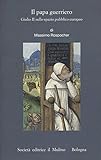
Massimo Rospocher. Il papa guerriero: Giulio II nello spazio pubblico europeo. Annali dell'Istituto storico italo-germanico in Trento Monografie Series. Bologna: Il Mulino, 2015. 392 pp. $29.95 (paper), ISBN 978-88-15-25350-7.
Reviewed by Catherine Fletcher (Swansea University)
Published on H-Italy (November, 2016)
Commissioned by Maartje van Gelder (University of Amsterdam)
The title of Massimo Rospocher’s book gives an unfortunately narrow impression of its scope. This is not particularly a study of The Warrior Pope but rather of political communication in Europe during the pontificate of Julius II. It explores the construction of Julius’s image by those who supported him and those who opposed him, in Italy and beyond, taking in visual propaganda, learned argument, and popular poetry to make broader points about political culture. It complements Christine Shaw’s earlier biography of the pontiff (Julius II: The Warrior Pope, 1997).
Although Julius is described here as a key personality in the “collective imagination of the Renaissance” (p. 12), that seems to me less true for Anglophone histories of the period, where he is often squeezed between the larger-than-life figures of Alexander VI (Rodrigo Borgia) and Leo X (Giovanni de’ Medici). This study, which I hope will be translated into English, is important in demonstrating the pivotal role he played in the early years of the Italian Wars, a crucial moment for European history. Julius ruled at a high point for papal secularization. He actively sought to expand and consolidate the popes’ territorial holdings, which stretched from Rome through Bologna (a city he fought for twice), to Ravenna on Italy’s Adriatic coast. His warlike activities—hardly the usual for the vicar of Christ—required justification, and the question of what made a just war lay at the heart of the swirl of argument that surrounded this pontificate.
Il papa guerriero is divided into three parts. The first considers the varieties of positive images that were constructed in support of Julius. The second explores the propaganda of three Italian city-states that opposed him: Bologna, Ferrara, and Venice. The third assesses responses beyond the Italian peninsula in France and England.
Julius’s family name was “della Rovere”: in Italian rovere means oak, and the tree was used widely as a symbol for the pope. His own arms included a golden oak, which represented vigor and power. Chapter 1 considers the combination of this imagery with rhetoric of the “golden age” and “universal rebirth,” arguing that the “illusion of the golden age” was “vital as a promotional message” (p. 71). While it is often argued that “the Renaissance” is a later historical construct, Rospocher shows how ideas of rebirth and renewal were central to the period’s own propaganda.
Besides the imagery of his family name, Giuliano della Rovere’s choice of Julius as his papal name facilitated comparisons with Julius Caesar, discussed in chapter 2. Parallels were drawn between Caesar’s conquests in Gaul and Julius’s own conflict with the French. Some disapproved, notably, Erasmus of Rotterdam and Julius’s own master of ceremonies, Paride Grassi. The extent of Julius’s imperial ambition is a question that has divided historians, some questioning whether the sources really support the idea that Julius saw himself in this way, but Rospocher points out that it is not necessary to argue that Julius identified directly with Caesar in order to agree that the diffusion of this imagery was significant.
Chapter 3 further challenges existing historiographies, arguing that more attention should be paid to the concept of peace in Julius’s iconography. Although contemporary humanists emphasized the peacemaking qualities of Julius’s successor Leo X in contrast to Julius, there were more continuities than they liked to admit. The “peace” that Julius brought might have to be achieved by force of arms, but concepts of pax romana and pax ecclesiae were certainly present in his rhetoric.
The idea of the crusade was important too, as chapter 4 shows. Much of Julius’s military action was accompanied by accusations that his enemies were in league with the Ottoman Empire. Papal propaganda showed Venetian senators dressed in “Moorish style”; in Bologna, Julius’s opponents turned that on its head, calling his papal troops “Moors, Saracens, and Turks” (pp. 124, 131). Julius also made effective use of excommunication and interdicts to condemn his enemies: these were printed for wide distribution and could provoke significant public anxiety.
Part 1 of the book closes with a chapter focusing on Julius’s representation as liberator of Italy. “Italy” itself, of course, is an interesting concept in this period: the peninsula was divided into city-states that took different (and shifting) sides in the prolonged conflict between 1494 and 1559. Yet ideas that Italy as a whole—and not merely a single polity—should be freed from foreign domination were powerful, appearing not only in learned discussion but also in the piazza. The 1513 carnival procession through Rome opened with a depiction of Italia liberata: Italy liberated. The reality of the wars, however, as Francesco Guicciardini would point out, was instead French and Spanish domination.
The second part of Il papa guerriero considers three cases of opposition to Julius within Italy. Chapter 6 focuses on Bologna, which Julius seized from its Bentivoglio lords in 1506, though he lost it again briefly in 1511-12. The Bolognese had plenty of insults to level at the pope: he was accused of homosexuality (a metaphor for military impotence); the head of his statue was used as a football; and his legate was the subject of a vicious satirical poem that not only called him a killer, tyrant, and thief, but also compared him to a Turk, a Jew, and a range of wild animals. The cruel punishments imposed by the papal regime in Bologna for seditious speech in turn became the target of Julius’s opponents in Ferrara, who, as chapter 7 shows, claimed that papal government would compromise freedom of speech.
In 1510, Alfonso d’Este, duke of Ferrara, was excommunicated after refusing to submit to papal authority. Ferrarese propaganda once again compared papal backers to Jews, and there are interesting comparisons to make here with later Protestant propaganda. Chapter 8 picks up another case of excommunication: Venice. The Venetians fluctuated from opposition to Julius, to alliance, and back again, prompting what Rospocher describes as some of the most “incisive critiques” of Julius on the peninsula (p. 255).
The Italian Wars, however, extended well beyond the boundaries of what we now know as Italy. The two chapters contained in part 3 consider France and England in relation to Julius and, in particular, the propaganda of rulers Louis XII and Henry VIII. Like Julius, Louis was portrayed as Caesar, employing classical triumph imagery. Public opposition to spending on warfare, however, prompted a rethink, and later he was styled instead as a “humble Christian soldier” (p. 274). Street theater helped tackle concerns about justifying war against a pope, emphasizing the principle of self-defense and suggesting that Julius was unfit for office.
In England, Henry VIII sided with Julius against the French. English troops were promised a papal indulgence and Julius’s excommunication of Louis was published in London in 1512. In the aftermath of Henry’s break with Rome in the 1530s, many of the English texts published in defense of the papacy fell into obscurity, and printers turned instead to translating and publishing propaganda against Julius that had been produced by their French enemies! From the point of view of English history, this chapter adds very helpful international context to our understanding of the early years of Henry’s rule.
In an epilogue to the book, Rospocher turns to probably the best-known text on Julius: Erasmus’s thoroughly hostile Julius Exclusus, in which the deceased pontiff arrives at the Pearly Gates only to be denied entrance by Saint Peter. Written in 1514, it was printed in 1517, defining a negative image of Julius that would gain ground in a new religious climate. Among the most important aspects of Rospocher’s book is its careful exploration of both pro- and anti-papal rhetoric in the years shortly before the Reformation, which will no doubt interest scholars in that field.
This work should also find an audience among students of political communication and propaganda, both textual and visual. Among its many strengths is its attentiveness to the range of people who produced and engaged with Julius’s imagery, from street performers and procession audiences to scholars and literati. No reader of this book will be left doubting the vibrancy of this political culture, nor the brutal punishments that those convicted of sedition might have faced. It makes a vital contribution to our understanding of how politics worked at the start of the sixteenth century, both in Italy and beyond.
If there is additional discussion of this review, you may access it through the network, at: https://networks.h-net.org/h-italy.
Citation:
Catherine Fletcher. Review of Rospocher, Massimo, Il papa guerriero: Giulio II nello spazio pubblico europeo.
H-Italy, H-Net Reviews.
November, 2016.
URL: http://www.h-net.org/reviews/showrev.php?id=45898
 | This work is licensed under a Creative Commons Attribution-Noncommercial-No Derivative Works 3.0 United States License. |

