

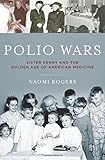
Naomi Rogers. Polio Wars: Sister Kenny and the Golden Age of American Medicine. New York: Oxford University Press, 2013. 488 pp. $36.95 (cloth), ISBN 978-0-19-538059-0.
Reviewed by Jacqueline Foertsch (University of North Texas)
Published on H-Disability (March, 2016)
Commissioned by Iain C. Hutchison (University of Glasgow)
Naomi Rogers, a tenured associate professor in the Program of the History of Science and Medicine at Yale, established her reputation as a polio historian with her 1992 monograph Dirt and Disease:Polio Before FDR. In this more recent text, Rogers returns to the topic of polio as it affected Americans, and people worldwide, in the epidemic years of the mid-twentieth century--and as it was importantly shaped by the healing hands of Elizabeth Kenny (1880-1952), a care provider from the Australian outback who made the Twin Cities her US operating base during the eventful final decades of her career. Kenny claimed the British honorific “Sister,” bestowed on nurses who had reached a senior level, throughout the years of her professional life, although, as Rogers reports, it is most likely that Kenny did not receive much formal training. There is no evidence that she was ever certified to the level of the American registered nurse (or even Licensed Practical Nurse or nurse’s aide), and her lack of credentials may account for the non-medical terminology she used in her lecturing, teaching, and textbook-writing (e.g., a polio-affected muscle becoming “alienated” from the brain). Kenny’s outsider status also likely provoked the hostile reception she received from prominent medical men (doctors, philanthropists, public health workers, government officials) who bristled at the prospect of the large, white-haired, garishly dressed Kenny (who favored dark dresses in rich fabrics and outsize hats, like a dowager escaped from an earlier age) insistently lecturing them on all that she knew and all that they did not. Throughout Polio Wars the question emerges, and is never sufficiently answered, whether Kenny was an intuitive genius with a profound contribution to make to the treatment and recovery of polio-affected muscles (even those required to breathe), or whether she was an overblown, self-promoting snake oil saleslady whose results were exaggerated and whose methods were never as original as she proudly claimed them to be.
Polio Wars moves chronologically over three parts (three chapters each) through the main decades of Kenny’s career and approaches her story from multiple perspectives to an exhaustive degree: arrival in the United States and early impressive demonstrations of her pain-alleviation and movement-restoration techniques, early friendly dealings with the National Foundation for Infantile Paralysis (NFIP; the “March of Dimes” fundraising organization originated by Franklin D Roosevelt), celebrity status among Hollywood royalty (including Bing Crosby, who was an early chairman of the Kenny Foundation’s own fundraising campaigns and Rosalind Russell, who portrayed Kenny in an RKO film in 1946), and the messiah-like role she played among families with polio-affected loved ones, underrespected nurses, and the beleaguered profession of physical medicine whose technicians formed Kenny’s front ranks. Kenny was an ambassador nationwide and abroad for her method of treatment, which involved mobilizing affected limbs in the earliest stages of the disease process, identifying muscles in spasm, reestablishing a connection between a paralyzed muscle and control centers in the brain, and applying wrung-out boiled-wool strips known as hot packs to affected muscle bellies. All of this flew in the face of orthodox treatment, which for decades had prescribed the immobilization (in plaster casts, braces, and splints) of polio-affected limbs in the weeks following acute infection and had a rather half-hearted, tremendously various approach to heat therapies and muscle physiology. As Rogers notes, Kenny worked with patients whom doctors had given up on and, evidently, in a some miraculous instances trained iron lung-bound patients to breathe again on their own.
But Kenny’s career was fraught with struggle and setback; as can be easily inferred, the medical men referred to above did not care to have their orthodoxies thrown in the their faces, and it was easy to dislike Kenny with her overbearing, defensive manner, her bizarre terminology, and her insistence that what she had to offer was not just an improved technique, but a revolutionized concept of the disease itself. As Rogers ably demonstrates, Kenny was ostracized simply for being a woman daring to insist that some men do something differently, and her path only traveled uphill from there. A frequent reference is to Kenny’s “allies” (not friends, associates, or confidants), while “antagonists” remained so in formal meetings and in print throughout Kenny’s career. A less-informed student of this subject (the one writing here, for instance) may have an image of Kenny as a benign and well-regarded adjunct to the March of Dimes onslaught that eventually conquered polio, but as Rogers reveals, Kenny spent much of her time “at war” with the leaders of the NFIP and the medical establishment--providers of braces, crutches, and iron lungs and eventually men in white coats holding up test tubes--it repeatedly favored with publicity and funding. In Rogers’s own apt summation, “Kenny’s patients and their families became increasingly central in shaping both clinical care and a new populist ‘Kenny movement,’ which defined itself against the medical establishment exemplified by the [American Medical Association] and the NFIP.… Kenny’s cause provided a national forum for the public to express long-standing frustration with unresponsive physicians and hospitals, autocratic public officials, the dismissal of strong women, the neglect of chronic disease, and the enforced orthodoxy of medical care” (p. xix).
Rogers has scoured the archives of newspapers, private collections, research hospitals, and historical societies, and in an era when people sent letters as frequently as we open a “new message” in email today, this is certainly no small task--but is, luckily for us, a richly rewarded one. The narrative arc regarding Kenny’s populist appeal amongst America’s first militant disability community and the overworked, underpaid care providers who supported them is one of the most affecting in Polio Wars. As Rogers notes, “for their part, [Kenny’s] graduates reveled in a method they saw as a break from older unsatisfactory practices.” As one former student enthused, the Kenny method “has added new zest to a job I was already crazy about.... It is fun to be doing polio work when there are such bright prospects for the patients” (p. 92). As for the patients themselves, “it is striking that absent from all the letters, memoirs, and articles written in the 1940s and 1950s by and about polio victims treated by Sister Kenny and the Kenny method are negative comments about the treatment patients received” (p. 168). Perhaps strongly correlated with these favorable reviews, “Kenny’s techniques demanded that patients themselves, even toddlers, be active and knowledgeable participants in muscle exercises and learn the location of muscles” (p. 162).
Polio Wars positions Kenny at many remarkable intersections, and an important aspect of the polio story has been brought to light in this work. Yet the vigor with which Rogers calls upon the archive here is a limitation as well as a strength; at more than four hundred densely worded pages, there are moments when the reader is simply swimming in ephemera, and insufficient care was taken to cull and organize this material to its greatest effect. Despite the breakdown into parts and chapters, for instance, there is less a sense of forward momentum than endless circling (even bickering) between Kenny and her detractors over the main points of conflict: clinical demonstrations versus controlled experiments, limb immobilization versus reactivation, treatment method versus disease concept, neurotropic versus peripheral-organ involvement, male professional reserve versus brash bush-nursing. No matter where or when in her career we might locate Kenny, the reader of Polio Wars finds her embroiled in the same controversies, and this reader finds no final ruling on who has “won” this war: Rogers comments that Kenny “often did exaggerate her results” (p. xi), and later a challenger declares, “I’ve read all the literature.... Orthodox or Kenny treatment, the results are all the same” (p. 356). Comments like these form the most damning aspect of the Kenny narrative--because she (and even “experts” and “orthopedists,” p. 98) refused on ethical grounds to subject desperate polio patients to controlled studies, she can never be exonerated from the suspicion of cherry-picking the cases she demonstrated, many of which, her skeptics averred, would have become better by themselves. But in the case of the physician who speaks about all the literature he has read and at many moments throughout Polio Wars, the reader is hoping for some exposure to “the literature,” the studies that demonstrate the ultimate efficacy of Kenny’s methods. Instead the reader is taken only to “the archive”--to the numerous letters and opinions written by those with, as Rogers herself demonstrates, more, or less, meritorious axes to grind.
If in fact “the literature” is nonexistent (we learn at one point that indeed studies are few), why does Rogers simply quote the physician who claims to have read all the literature instead of challenging the veracity of his statement? Eventually, it is clear that many of Kenny’s methods were widely adopted by rehabilitation centers nationwide and worldwide, often without crediting her for their invention, so why is the argument of Dr. Albert Key, “one of Kenny’s most prominent critics,” that “the Kenny treatment of spasm was harmful because it rejected crucial therapies such as immobilization and rest” allowed to innocently stand (p. 106)? Unadjudicated contradictions abound in this text: the paragraph discussing the lack of reference to pain in Kenny memoirs, for instance, is revised moments later to admit that treatment administered by “untrained volunteers supervised by overworked technicians” (p. 168) led to many bitter pain experiences, and there is outright contradiction in another patient’s recollection of Sister Kenny herself slapping him in the face. Elsewhere, NFIP president “O’Connor sought to downplay both Kenny and her clinical results,” yet ten lines later the New York Times is “quoting O’Connor’s statement that her methods had been proven ‘superior to the present orthodox methods of treatment’” (p. 67). I have no doubt that the record itself produces exactly this welter of cross-canceling information, but the reader comes away somewhat shortchanged when diligence shades into reticence to spell out the rights and wrongs of Kenny’s contribution--and the commensurate rights and wrongs of the medical men who sought to derail her at every turn. If in fact the lack of published research on the Kenny method makes such a call impossible, we needed a clear admission of that at the outset and, again, perhaps a somewhat shorter book; if Kenny is one day ruled incontrovertibly as more “charlatan” than “saint,” we will wonder at the amount of ink spilled more or less in her honor here (p. 421).
If there is additional discussion of this review, you may access it through the network, at: https://networks.h-net.org/h-disability.
Citation:
Jacqueline Foertsch. Review of Rogers, Naomi, Polio Wars: Sister Kenny and the Golden Age of American Medicine.
H-Disability, H-Net Reviews.
March, 2016.
URL: http://www.h-net.org/reviews/showrev.php?id=45862
 | This work is licensed under a Creative Commons Attribution-Noncommercial-No Derivative Works 3.0 United States License. |

