

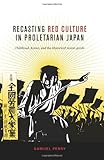
Samuel Perry. Recasting Red Culture in Proletarian Japan: Childhood, Korea, and the Historical Avant-garde. Honolulu: University of Hawai'i Press, 2014. 228 pp. $49.00 (cloth), ISBN 978-0-8248-3893-5.
Reviewed by Nayoung Aimee Kwon (Duke University)
Published on H-Asia (January, 2016)
Commissioned by Douglas Slaymaker (University of Kentucky)
Editor's note: This review was originally published prematurely. It has been revised to reflect the correct version of the review.
Recasting Red Culture in Proletarian Japan is a welcome addition to a growing Anglophone library of monographs that collectively shed new light on the multilayered complexity of proletarian cultural movements in East Asia. Perry’s book joins exciting recent contributions such as Ken Kawashima’s The Proletarian Gamble (2009), Mark Driscoll’s Absolute Erotic, Absolute Grotesque (2010), Jonathan Abel’s Redacted (2012), and Sunyoung Park’s The Proletarian Wave (2015), among others, that consider these important historical movements in correspondence not only with like-minded efforts in the Soviet Union and Euro-America, but also elsewhere in Asia. Especially fresh are new perspectives on the heretofore little-examined but historically significant impact that the colonies had in the development of such political and cultural movements in the Japanese empire.
Recasting Red Culture and other important contributions have taken narratives of leftist cultural movements beyond inherited assessments about centers and peripheries and breathed new life into our understanding of the wide-ranging global impact that radical movements had in the early twentieth century as well as the violent force of their suppression into the Cold War era and beyond. This book also joins other recent publications that further complicate cultural perspectives on the Japanese empire in general with particular focus on relations with colonial Korea, such as Serk-Bae Suh’s Treacherous Translation (2013), Janet Poole’s When the Future Disappears (2014), and my own Intimate Empire (2015). These works, as well as several others, have recently moved the nexus of the critical terrain of the region beyond the national border, to turn substantial focus on the little-understood significance of Japan’s most proximate colony in particular in enhancing our understanding of broader cultural movements in imperial contexts and the intimately connected question of modernity at large.
Furthermore, Recasting Red Culture also joins a rich collection of newly available translations of literary works into the English language such as Perry’s own From Wonso Pond (2009), Sunyoung Park’s On the Eve of the Uprising (2010), Theodore Hughes et al.’s Rat Fire (2013), and Norma Field and Heather Bowen-Struyk’s For Dignity, Justice, and Revolution (forthcoming 2016), as important correctives for our limited literacy on this era’s transnational proletarian artistic endeavors.
Considering these new reassessments, there is no doubt, as Perry convincingly tells us at the outset of the book, that these proletarian cultural movements were indeed influential. This influence spanned not only the short decade (1920s-30s) in which they flourished in Japan and elsewhere in East Asia, but through their resonance in subsequent cultural movements national, regional, and global, despite the overwhelming state violence that forcibly curtailed their open and free expression. Keeping this violent history of suppression and censorship in mind, Perry is compelled to underscore “how enormously influential proletarian cultural workers were in laying the foundation for generations of East Asian artists” lest we may forget (p. ix). Furthermore, the author astutely shows that these movements were transnational and cosmopolitan from the beginning, rigorously engaging, translating, and referencing a plethora of contemporaneous writings and art works from far-flung areas such as the Americas and Eastern and Western Europe, not to mention elsewhere in Asia. Perry’s narrative reveals the sophistication of these cultural producers who were aware of the political and artistic camaraderie with like-minded socially engaged movements with a shared commitment to the radical idea that literature and art had a firm place beyond the elitist bourgeois drawing room, in the sociopolitical movements of the common worker, with the right and perhaps even a mandate to transform unjust social relations.
In the preface and chapter 1, “Introduction: Recasting Red Culture in Proletarian Japan,” the author lays out the main framework of the book. Rather than focusing on better-known texts of the proletarian oeuvre which Perry informs readers were in fact canonized mainly by the Japanese Communist Party, he seeks to excavate heretofore little-available materials that were themselves situated at the margins of the proletarian movement. The three case studies the author has chosen to examine, each in the remaining three chapters of the book are: “proletariat practices involving children, the revolutionary genre of ‘wall fiction,’ and works of literature about Koreans” (p. 5). These richly eclectic and disparate themes are collected here by the author in order to foreground the very colorful variety of perspectives that were circulating at the time.
What is at stake in Perry’s archival turn and the impulse to excavate from a relatively obscured body of texts is to “reconstruct … and restore … the forgotten ideological and aesthetic complexity of Japan’s proletarian movement and show that it must be central to any understanding of modern Japanese culture” in the early twentieth century (p. 3). In the case of Japan, proletarian cultural workers had to negotiate a particularly thorny terrain of a “highly capitalized marketplace.” Perry is especially interested in exploring the specificities of “a resistance movement in a rich, capitalist country.” He elaborates that Japan’s radical cultural movement was “neither the bedfellow of a totalitarian state that claimed to represent the very people it oppressed, nor had it embraced a so-called ‘monolithic,’ unchanging notion of class as a privileged point of departure for social analysis.” He further explains that “beneath the common banner of the ‘revolutionary proletariat’ existed the extraordinary efforts of thousands of cultural workers to create coalitions between middle-class and working-class activists, factory workers, and farmers, café waitresses and female teachers, as well as Japanese citizens and Asian minorities” (p. ix). It is this “complex and contradictory” dialectical movement, with a focus on literature that “had little to do with the clichés of a dreary, dogmatic, socialist realism” but on the contrary were “intimately connected to the historical avant-garde” that Perry sets out to explore throughout the book (p. ix).
Chapter 2, “Fairy Tales on the Front Line: Reading Childhood, Class, and Culture,” maps the changing parameters of what the author identifies as an emerging revolutionary children’s cultural movement in early twentieth-century Japan. In this chapter, Perry shows us that ideas about what constituted the conception of childhood as well as childhood lives became new sites of class contestations during this time. Through a close examination of a wide range of discourses on childhood through literary works, the contents of prominent proletarian children’s journals, contending movements in childhood education and activism, along with sociological debates on childhood developmental theories, this chapter convincingly demonstrates that the “figure of the Japanese proletarian childhood that emerged … was anything but monolithic” (p. 14). The chapter further reveals various tensions within the movement that both adapted and challenged fundamental assumptions of the past as well as the bourgeoisie mainstream.
For example, “multicultural elements” in proletarian stories at times perpetuated racist depictions of ethnic Others and at other times struggled to overcome such bigotry by calling for identification with Chinese, Korean, or African children in a call toward international class solidarity. Along with such racial tensions, Perry also examines the movement’s negotiation of bourgeois culture. The author informs readers that publication venues of such revolutionary writings were ironically largely “underwritten by an emerging cultural industry that was relying on the marketplace for children’s commodities” for middle-class consumers for its very existence (p. 24). Despite the various contradictions and tensions he traces, Perry concludes that “the archival evidence clearly suggests that proletarian children’s culture was at the forefront of liberal and scientific efforts to educate and protect children in Japan, to empower them to become agents of their own transformation and to secure an institutional framework to promote their healthy development” (pp. 15- 16).
Chapter 3, “Writing on the Wall: Kabe shōsetsu and the Proletarian Avant-garde,” examines how proletarian literature became the focus of avant-garde aesthetic experimentation while at the same time a site of active social participation. Writing against the popular claim that art and politics were necessarily mutually exclusive, this chapter sets out to demonstrate the dialectics of how proletarian literature was “aesthetically complex in their experimental melding of art and social practice” (p. 74). At the center of this chapter is a masterful close reading of samples of a heretofore little-known and little-examined genre called wall fiction (kabe shōsetsu). Wall fiction, as Perry defines, is an “extremely short work of literature meant to be torn out of a newsletter and magazine and posted up on public walls” (p. 70), presumably to be read by workers without the luxury of time or money to indulge in full-length fictional works. While informing readers that this very brief and very short-lived genre remained at the margins of the empire, with limited availability, circulation, and effectiveness (p. 121), and only a “modicum of success” (p. 74), Perry focuses the chapter on their embodied radical politics and their impact as a “literary manifestation of the contradiction between radical leftism and bourgeois culture, or the emblematic tension within proletarian art’s need simultaneously to mimic while debunking forms of high and low cultural forms” (p. 70).
Some of the most satisfying parts of the chapter are the masterful translations of some of these fascinating pieces that Perry makes available in their entirety to Anglophone readers for the first time, allowing readers to draw their own conclusions about them. Eloquent translations are supplemented by related literary debates of the time as well as similar genres such as the modernist short forms of “palm-of-the hand” fiction and the conte that together show readers the complexity of literary forms, debates and, theorizations circulating at the time (p. 80). The chapter concludes with full translations and close readings of similarly short fictional works from colonial Korea.
Chapter 4, “Comrades-in-Arms: Zainichi Communists, Revolutionary Local Color, and the Antinomies of Colonial Representation,” examines various representations of Koreans in Japanese proletariat writings in order to highlight a ubiquitous but historically suppressed presence of colonial Koreans in the Japanese proletarian movement. The chapter further seeks to explore the possibilities and contradictions underlining attempts to form class solidarity across ethnic and colonial divides. The chapter opens with close readings of writings by Japanese proletarian writers Makimura Kō and Nakano Shigeharu that depict the “Kando partisan,” the figure of the Korean revolutionary in northeast Manchuria which was a popular literary trope and stereotype at the time.
The author then moves onto a careful analysis of colonial Korean writer Chang Hyŏk-chu’s prize-winning story “Gakidō,” written for imperial Japanese audiences, and then to the translation and analysis of poet Kim Yong-je’s gruesome “remembrance” of officially sanctioned massacres of thousands of Koreans following the Kantō Earthquake, among other haunting works. While acknowledging the existence of deep fissures such as racism and ethnocentricism as “serious limitations” within the Japanese proletarian movement (p. 137), Perry insists that such contradictions did not negate many of the good intensions to form solidarity within the movement. He writes: “even if the ‘arrogance’ of Japanese imperialism had infected the proletarian cultural movement, it certainly did not invalidate all of its thinking” (p. 143). The author further claims that “Korean cultural workers in the Japanese Communist Party themselves were far less concerned about the contradictory practices of those Japanese who helped to enable their own struggles than they were in actively collaborating with their Japanese colleagues to create more class-conscious cultural practices that were simultaneously anticolonial and antiracist” (p. 143).
Each of the three substantial body chapters is followed by a helpful chapter conclusion that usefully summarizes that chapter’s main themes. However, in light of the eclectic richness of the texts carefully translated and closely read, as well as the wide-ranging critical terrain covered in each chapter, the book would have been enhanced by a concluding chapter that underscore some of the complex and overarching connections made throughout the book. Such a conclusion would have been especially useful for readers who may be less familiar with the region’s interlocking history and context, who may encounter the book as part of a general comparative curriculum beyond East Asian studies courses and research agendas.
In the preface, Perry writes, “my book unapologetically seeks to recast the proletarian movement in a more affirmative light” (p. xi). Recasting Red Culture has indeed accomplished this goal through dedicated and careful excavations, translations, close readings, and critical reassessments. In the eagerness to recuperate and reevaluate the movement in a “more affirmative light” however, the book at times negates the validity of recent critical efforts to highlight the antinomies of colonial collaborative efforts across the hierarchical context of empire. For example, the last chapter offers translations and close readings of Japanese literary works about Korea in part to recuperate them through a response against recent leftist scholarship that has brought self-reflexive attention to the uncomfortable coexistence of racism and sexism within the proletarian movement’s attempts at forming solidarity across ethnic, gender, and class divides. Perry goes so far as to claim that these new perspectives exhibit an overtly critical perspective that is tinged with “anticommunism … informed by postcolonial theory … marshaled ahistorically for the purposes of identitarianist critique” (p. 141).
Many of these contemporary critics in Japan, Korea, and elsewhere, in fact, may not be at odds with the broader aspirations of Perry’s own book; that is to say, in their commitment to excavating the neglected complexities and contradictions within such movements. The reader wonders if a more generous reading, which the author himself performs and calls on others to engage for past proletarian writings, were also applied to these recent self-reflexive criticisms about the proletarian movement, it may be possible to recognize how they are much more in camaraderie, in spirit if not in their conclusions, with this book’s goals “to dignify the movement” in all its variations than acknowledged here.
Overall, Perry’s book is a significant achievement that highlights neglected aspects of a radical cultural movement in its richness, complexity, and contradiction that has long been the object of contestations and misunderstandings. The book documents this fascinating yet marginalized history through carefully unearthing, translating, and reassessing a rich body of works from not only Japan, but from Korea and elsewhere in the global proletarian movements. Recasting Red Culture is recommended as a required reading for anyone with a serious interest in proletarian and other influential radical social movements within East Asia and beyond.
If there is additional discussion of this review, you may access it through the network, at: https://networks.h-net.org/h-asia.
Citation:
Nayoung Aimee Kwon. Review of Perry, Samuel, Recasting Red Culture in Proletarian Japan: Childhood, Korea, and the Historical Avant-garde.
H-Asia, H-Net Reviews.
January, 2016.
URL: http://www.h-net.org/reviews/showrev.php?id=45793
 | This work is licensed under a Creative Commons Attribution-Noncommercial-No Derivative Works 3.0 United States License. |

