



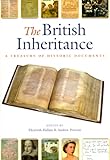
Elizabeth Hallam, Andrew Prescott, eds. The British Inheritance: A Treasury of Historic Documents. Berkeley, Los Angeles: University of California Press, 1999. x + 150 pp. $39.95 (cloth), ISBN 978-0-520-22470-4.
Reviewed by Michael Landon (Department of History, University of Mississippi)
Published on H-Albion (October, 2000)
A Work of Art
A Work of Art
From its title, one might expect this book to contain an anthology of the major documentary texts of British history, from the Dooms of Ethelbert to New Labour's latest election manifesto. Instead it contains lots of wonderful colored pictures of the originals of many of those documents, with accompanying notes and commentary. All, or portions, of many of the actual texts are shown, but often on a scale that requires a magnifying glass to read them. The editors, in their three-page "Introduction," note that the history of the "United Kingdom" has been a comparatively short one, and that, with Irish Independence since 1921, and Welsh and Scottish Devolution coming about in 1999, it may not last very much longer. They note also that the "events" of British history "are frequently elusive and difficult to pin down." Indeed: "It might be said that the British inheritance is marked out not so much by events, but by documents whose impact resonates down the ages" (p. viii). In this lavishly illustrated publication they give us a full-color picture of what that inheritance looks like, accompanied by some brief but interesting and perceptive commentary and much scholarly notation. The originals of most of the documents illustrated can be seen either in the Public Record Office (where Hallam is the Director of Public Services) or in the British Library (where Prescott is the Curator of Western Manuscripts). But a few are located in the National Library of Scotland, the Scottish Record Office, or the National Library of Wales.
The "British" inheritance demonstrated concerns mainly that of the island of Great Britain. "The complex story of Ireland's involvement with Britain," the editors note, "would have required another book" (p. ix). And discussions of the "far-flung British Isles," such as the Orkneys, the Shetlands or the Channel Islands, are also omitted. But the fact that Britain, in the past few centuries, has been, in fact, a world power, is reflected by the inclusion of sections, in Part Three, "The 18th and 19th Centuries," with such titles as "Britannia, Rule the Waves," "A Passage to India," " No Taxation Without Representation," "Captain Cook and Australia," "New Zealand," "Canada: The First Dominion," and "The Scramble for Africa." Part Four, "The 20th Century," early on, includes sections on "Scott of the Antarctic" and Lawrence of Arabia. And some of its later sections discuss documents relating to Indian independence, the end of Empire, the Commonwealth, and "Britain in Europe."
Part I, "The Middle Ages," after a brief look at twelfth-century manuscripts recounting the King Arthur legends and King Alfred's launching of the Anglo-Saxon Chronicle ("the oldest history of a European people in their own language," p. 3), leaps quickly into the post-1066 era with a description and discussion of the Domesday Book. Then, Thomas Becket's correspondence, the Exchequer's Pipe Rolls and also Gerald de Barri's twelfth-century writings on the history of Wales are briefly depicted and described, before Magna Carta, which "one [unnamed] historian" is reported to have described as being "by reason of its comprehensiveness and minuteness ...the practical starting point of our history" (p. 12), gets four whole pages. Other period topics addressed and illustrated include Westminster Abbey, the Tower of London, and "The Mother of Parliaments." Military topics include "The Conquest of Wales," "Scotland: The Wars of Independence," "For Harry, England and St. George," and "The Wars of the Roses." The book also depicts and discusses documents relating to "Patron Saints,"the "Black Death," the Peasants' Revolt (1381), and Chaucer and Caxton.
Part Two, the shortest section, devotes only twenty-three pages to the "Tudors and Stuarts," beginning with "Henry VIII and the Reformation," and concluding with "Sir Christopher Wren and St. Paul's Cathedral." Besides the usual political topics, "William Shakespeare," "Virginia: an Early American Colony," and "Gunpowder, Treason, and Plot" are also addressed. "Bloody Mary" is not mentioned, but Mary, Queen of Scots' last letter written (in French), to her brother-in-law, Henri III of France is depicted, along with two sketches made of her execution. Part Three includes, from the eighteenth-century, a page each on Handel and Wesley, and two pages each on both the Agricultural and the Industrial Revolutions, but Hogarth is conspicuously absent. In the nineteenth-century, a new kind of illustration of popular culture, in the form of dramatic, brightly colored political, sporting and commercial posters, became available, and several of them are included. Sections are devoted to Charles Darwin, "The Great Exhibition of 1851," and "London's Parks." Samples of the handwriting of Robert Louis Stevenson and Charles Dickens are shown, also that of Florence Nightingale and Elizabeth Fry. Victoria and Albert share a couple of pages, and so do Gladstone and Disraeli.
Part Four, besides depicting "The End of Empire," devotes five pages to various aspects of World War I, and three to world War II. "Votes for Women," the birth of "The Beeb" (the BBC), and "The Abdication of Edward VIII" are illustrated from the first half of the twentieth-century. And the Festival of Britain (1951) and the Coronation of Elizabeth II (1953) are lavishly treated from the second half, along with "the White Heat of Technology" (television, penicillin and the origins of the digital computer). George Orwell is the only twentieth century author addressed. A section on "England Swings" illustrates the new Britain of the 1960s. And "Eisteddfodau and Thistles" tells of cultural developments in the century related to the growth of Welsh and Scottish nationalism. "The Falklands Factor" addresses developments in the Thatcher era. A final page showing documents related to non-white immigration into Britain beginning in the late-eighteenth century illustrates the first beginnings of the "Multi-Cultural Britain" that exists today.
Though one note refers to the "Boston Tea party" as taking place on December 17, 1783 (p. 76), there are virtually no errors in the text. And, certainly, The British Inheritance is a beautiful book that anyone interested in British History would like to have on their coffee table. Also, university and college libraries probably should have a copy, so that their students can see just what the documentary heritage of the English part of our culture looks like. Also teachers of British history (and literature) might well want to project some of its pages onto screens in their classrooms. In spite of what its title might lead one to believe, however, for the reasons already mentioned, it really would not be of much use as a supplementary textbook for any of their courses. It is not a book of "Readings in English History."
Copyright (c) 2000 by H-Net, all rights reserved. This work may be copied for non-profit educational use if proper credit is given to the author and the list. For other permission, please contact H-Net@h-net.msu.edu.
If there is additional discussion of this review, you may access it through the network, at: https://networks.h-net.org/h-albion.
Citation:
Michael Landon. Review of Hallam, Elizabeth; Prescott, Andrew, eds., The British Inheritance: A Treasury of Historic Documents.
H-Albion, H-Net Reviews.
October, 2000.
URL: http://www.h-net.org/reviews/showrev.php?id=4574
Copyright © 2000 by H-Net, all rights reserved. H-Net permits the redistribution and reprinting of this work for nonprofit, educational purposes, with full and accurate attribution to the author, web location, date of publication, originating list, and H-Net: Humanities & Social Sciences Online. For any other proposed use, contact the Reviews editorial staff at hbooks@mail.h-net.org.

