

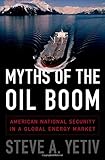
Steven A. Yetiv. Myths of the Oil Boom: American National Security in a Global Energy Market. New York: Oxford University Press, 2015. 272 pp. $29.95 (cloth), ISBN 978-0-19-021269-8.
Reviewed by Marta Musso (Cambridge)
Published on H-Energy (April, 2016)
Commissioned by Tammy Nemeth
Few resources in history have been surrounded by as many myths as oil; only the obsession for gold in the mercantile era can perhaps be compared to the quest for hydrocarbons that has predominated since the twentieth century. The presence of a mythology around the contemporary oil industry should not come as a surprise; oil and its products have had a significant impact on international relations since the beginning of the last century, and they still are at the center of industrial systems, economic development, and political structures on a worldwide level. Hydrocarbons are the energy paradigm on which development booms were built in the West, the basis for the race of newly industrialized countries, and the premise of many countries’ postcolonial economy. In spite of this wide scope, however, energy--and oil in particular, as Prof. Yetiv points out in his conclusion--is still grossly misunderstood in the field of international relations. As suggested by its title, Myths of the Oil Boom engages with the popular narrative around petroleum, disproving one by one the many myths around the current oil industry. In particular, Yetiv refutes the “revolutionary” status of the current American oil boom, putting into context the overly optimistic assumptions on the future of energy that came out of the “shale revolution.” The author shows that any positive long-term effect of this accrued domestic production will only be possible through equal efforts to diminish overall oil consumption not only in the United States, but on a global scale.
Yetiv’s work is divided into three parts, each analyzing three macro-aspects of the Age of Oil: markets and prices, the geopolitics of oil, and the wider costs of oil consumption, particularly the environmental one. Each section is divided in three chapters, all titled with the myth the author intends to tackle, such as “The US Oil Boom Should Erase Peak Oil Concerns” and “More American Oil, Less Persian Gulf Intervention.” In the first section, Yetiv describes the mechanisms that influence the prices of crude: the relationship between demand and supply; the role of OPEC and of Saudi Arabia in particular; the supposed power of the US administration to affect gasoline prices. In the second section, Yetiv reconstructs the reasons for US involvement in the Persian Gulf, the oil shocks and the crisis-absorption mechanisms developed by consumer countries after the 1970s; he shows that it is the capability of consumer countries as a whole to reduce oil consumption, rather than increasing domestic production in the United States, that allows consumers to exert power on producer countries. In the third section, Yetiv illustrates the overall costs of oil consumption, beyond what is paid at the pump: economic and geostrategic risks, the links between oil and nondemocratization, and even more importantly, climate change. In the conclusion, he does not deny the importance of the American oil boom, but he shows that it could be effective in the long term only through what he calls a “synergistic strategy”: to accompany the increase in domestic production with serious efforts to decrease American and global consumption as much as possible.
The book has its starting point in the contingency of US shale development, which was welcomed as a revolution in the world’s energy system, making the United States the first world oil producer. Some predicted it would increase energy security, stabilize prices, boost the economy, and reduce American involvement in the Middle East. By the time the book reached the stores, facts had already proven many of these predictions to be wrong, and the shale revolution highly overestimated. However, the American oil boom is for the author only the point of departure to analyze the many issues around the oil industry: price formation and speculation, the rise of OPEC and of the national oil companies, the relationship between the United States and the Middle East, energy security, climate change. While shattering the easy optimism around domestic extraction, Yetiv shows that it is not increased control over production, but decreased dependence upon oil, that will solve the problems that the shale revolution was predicted to eradicate.
Prof. Yetiv supports his thesis by listing all the issues characterizing our current energy system; in doing so, he turns a book written as a counternarrative to the contemporary oil boom into a comprehensive overview of the oil industry. While the style and structure aims to a wider audience rather than to specialists of energy policies, Yetiv does not try to simplify the oil industry; on the contrary, he adds complexity to the discourse, refuting many of the simplifications that drives the narrative of the American oil boom. Overall, Myths of the Oil Boom provides a comprehensive introduction to the problems related to the Age of Oil; it does not examine in depth any of the problems it tackles, but it gives an important overview, addressing the gap in the literature on the fundamental role of energy in international relations. Yetiv is convincing and exhaustive in arguing that international security will never be reached simply through more control over oil supplies, but requires a new quest: that of a different world energy paradigm.
View the author(s) response to this review: https://networks.h-net.org/node/19200/reviews/120517/musso-yetiv-myths-oil-boom-american-national-security-global-energy#reply-120519. If there is additional discussion of this review, you may access it through the network, at: https://networks.h-net.org/h-energy.
Citation:
Marta Musso. Review of Yetiv, Steven A., Myths of the Oil Boom: American National Security in a Global Energy Market.
H-Energy, H-Net Reviews.
April, 2016.
URL: http://www.h-net.org/reviews/showrev.php?id=45678
 | This work is licensed under a Creative Commons Attribution-Noncommercial-No Derivative Works 3.0 United States License. |

