



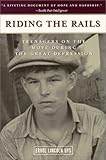
Errol Lincoln Uys. Riding the Rails: Teenagers on the Move During the Great Depression. New York: TV Books, 1999. 304 pp. $16.00 (paper), ISBN 978-1-57500-136-4.
Reviewed by Grace Palladino (The Samuel Gompers Papers, University of Maryland College Park)
Published on H-Childhood (September, 2000)
Born to Run Depression-Style
Born to Run Depression-Style
We take it for granted today that kids grow up much faster than they used to--that they lack the sense of security and protection adolescents enjoyed in the past. Critics decry the loss of youthful innocence, respect for authority, and faith in the future that, they insist, went out with the Sixties. In fact, if you believe what you read in the papers today, it's easy to assume that growing up is harder and more dangerous than it ever was.
But as Errol Lincoln Uys reminds us, in Riding the Rails: Teenagers on the Move During the Great Depression, the good old days didn't look as good in the 1930s: Children as young as fourteen years old were often obliged to work. When they could not (or would not) they generally left home, sometimes at their parents' insistence. Uys also demonstrates that the Andy Hardy-image of respectful, earnest teenagers was an adult fantasy even in the 1930s: The book is packed with smart-mouthed kids who discounted parental advice, skipped out of school (one even "decked" the principal) and risked life and limb for a thrill, long before anyone ever heard of "sex, drugs, and rock 'n' roll." Some even resorted to violence, even though video games had not yet been invented. Just listen to a Depression-era migratory worker talk about teenage youth: "It's different now. You find high school kids on the road armed. They can't get work, and they're sick of begging the old man for cigarette money. They're out for what they can get while it lasts" (p. 39).
A companion book to the documentary film of the same name, Riding the Rails tells the stories of "box car boys and girls" --both black and white--who searched for jobs and adventure during the Great Depression, but often found hardship, danger, and disappointment instead. Along the way, they became symbols of a national youth crisis: There were 250,000 teenage hoboes, Uys tells us, a number large enough to cause a social, political and commercial stir, particularly since their stories often involved sexual exploitation, crime, and even revolutionary politics. Magazines warned readers about "An Army of Boys on the Loose." Hollywood captivated audiences with movies like "Wild Boys of the Road." And social scientists and reformers built new careers around teenage wanderers. In 1932 for instance, graduate student Thomas Minehan took to the rails disguised as a hobo in order to collect information for his 1934 book, Boy and Girl Tramps of America.
As captivating as these stories were at the time, though, they were all but lost to history. In fact, when the producers of the film Riding the Rails tried to follow up on Minehan's leads, the trail was cold: Few teenage travelers recorded their experiences. So they placed ads in the AARP magazine, Modern Maturity, and found three thousand former box car kids willing and eager to tell their stories. Some wrote letters, others offered personal memoirs, some answered questionnaires, others were interviewed. Organized by the producers as the American History Project, the material collected provided the basis of both the film and the book.
Thanks to this detective work, Riding the Rails introduces us to determined adolescents who cannot bear to remain burdens at home, to desperate kids escaping abusive parents, and to adventure-seeking college students, out on a summertime lark--apparently, the Chicago World's Fair was a popular destination. We discover that there were parents who encouraged their sons (and in rare cases, their daughters) to hop a freight and see the country, and others who put their own survival ahead of their children's. We learn about "catching out" (the act of hopping the freight), utilitarian hobo camps, and railroad detectives who think nothing of throwing homeless kids off the train, especially if they are black. And while we observe large numbers of ordinary Americans who demonstrate incredible generosity to these kids on the road, we also get a sense of why, perhaps, such generosity seems less prevalent today: As the travelers themselves tell us, they learned to hustle from master hoboes and cheerfully exploited their benefactors' good will and sense of shared experience.
Despite its subtitle, Teenagers on the Road During the Great Depression, this book ultimately tells us more about hobo culture, homelessness, and the history of the American road trip (a subcategory, perhaps, of the pioneer spirit) than it does about teenagers. To be sure, the participants were young, and they make frequent references to their search for freedom and the spirit of youth. "I was young, I felt nothing could defeat me," one witness recalls his time on the road (p. 250). "That's what kept us going," another adds, "knowing that we were alive and OK at that moment and never thinking about tomorrow" (p. 196). But except for a few mentions of not being able to dress like the other kids in school, we don't get a sense of what it meant to be young in the 1930s, on or off the road. "We went from childhood to being adults," a former box car kid put it. "We never thought about being teenagers. All we thought about was surviving" (p. 200).
Perhaps it is impossible to recapture the perspective of youth, once historical actors have the benefit of age, experience and hindsight. But that doesn't doom the enterprise by any means. The oral histories, letters, and memoirs that comprise this book provide a fascinating and detailed look at life on the road, and recover a slice of Depression history that is both enlightening and entertaining.
If there is additional discussion of this review, you may access it through the network, at: https://networks.h-net.org/h-childhood.
Citation:
Grace Palladino. Review of Uys, Errol Lincoln, Riding the Rails: Teenagers on the Move During the Great Depression.
H-Childhood, H-Net Reviews.
September, 2000.
URL: http://www.h-net.org/reviews/showrev.php?id=4563
Copyright © 2000 by H-Net, all rights reserved. H-Net permits the redistribution and reprinting of this work for nonprofit, educational purposes, with full and accurate attribution to the author, web location, date of publication, originating list, and H-Net: Humanities & Social Sciences Online. For any other proposed use, contact the Reviews editorial staff at hbooks@mail.h-net.org.

