



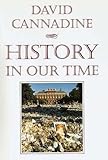
David Cannadine. History In Our Time. New Haven: Yale University Press, 1998. ix + 308 pp. $25.00 (cloth), ISBN 978-0-300-07702-5.
Reviewed by Stephen L. Keck (Department of History, National University of Singapore)
Published on H-Ideas (September, 2000)
Writing History in Our Time
Writing History in Our Time
History In Our Time is a collection of book reviews which David Cannadine wrote for many of the most significant publications in Britain and the United States. These essays, which were published between 1988-1998, appeared in publications such as the London Review of Books, Times Literary Supplement, the New York Review of Books and The New Republic. Because a good portion of what Cannadine writes is in reaction to various manifestations of Thatcherism, many of the individual reviews can already be read as historical documents. They are also inviting as vignettes of a major historian whose career is still ascending. Students of modern British history know that David Cannadine has been prolific, publishing both a range of articles and substantial works such as The Decline and Fall of the British Aristocracy and G. M. Trevelyan: A Life in History. His career has taken place within the walls of the university: he has held academic positions at Cambridge and Columbia University, and he is currently Director of the Institute for Historical Study at the University of London. Taken all together, these pieces reveal the way in which a distinguished historian analyzes books which leading transatlantic publications deem to be significant.
Many of Cannadine's reviews address that relatively rare range of historical matters which interest the general public. Since readers of History In Our Time will discover individual essays on topics such as the career of the Prince of Wales, the death of Princess Diana, the significance of Winston Churchill and Margaret Thatcher, the book could be understood as an example of the ways in which historians can contribute to public debate in democratic societies. However, Cannadine's reviews are important in their own terms: History In Our Time shows how a gifted historian understands many of the definitive issues (some of which engender only modest public interest) which have shaped and continue to shape modern Britain. Despite the fact that thirty different pieces on a great range of subjects comprise the volume, Cannadine's historical analysis is fairly well unified. In addressing the monarchy, recent history and biography, Cannadine works within relatively traditional boundaries of professional historical thought and practice.
In these essays Cannadine's treatment of the monarchy succeeds because he is able to write about the Royals with great command of detail and, more important, he then holds them up against the broader historical experience of the British people. For example, when Cannadine reviews Sarah Bradford's King George VI, he uses many of the definitive events of mid-century to assess not only the book's subject but also the way in which Sir John Wheeler-Bennett had written about the late king in his official biography which appeared in 1958. George VI came to power unexpectedly (as a result of the abdication of Edward VIII) in 1936 and he would reign through the Second World War until his death in 1952. His first biographer, Sir John Wheeler-Bennett, wrote a pious, uncritical account of his life which was "courtly and obsequious" and amounted to the history "of an icon rather than of an individual" (p. 60). In contrast, Bradford's work exhumes George VI from the "sanitised sarcophagus" (p. 61) by treating the monarch as a three-dimensional figure.
Cannadine welcomes Bradford's biography but uses the review to instruct his readers about George VI. Having met the demands of becoming King, George VI worked tirelessly at the job: Cannadine recounts that he traveled to London each day (from Windsor) to share the agonies of the Blitz; he also visited many parts of Britain to boost morale; he provided a haven for royal refugees who had been driven to Britain by Hitler's conquests; finally, the king provided strong public support for Churchill and his policies. However, George VI's limitations were quite real: he lived a life of great privilege and while the monarch acquired a reputation for understanding industrial conditions "he knew next to nothing about how most of his subjects lived, and his prescriptions for promoting industrial peace and ending the class war were naive in the extreme. . . .George VI was obsessed with medals and decorations, clothes and uniforms, precedent and protocol. He rebuked General Montgomery. . .for wearing a beret rather than a peaked cap, and one of the greatest solaces of his declining years was that he personally designed a new style of trousers to wear with the Order of the Garter. (pp. 64-65)"
More importantly, George VI, who held no desire to play a role in law-making, was in many ways the "ideal man to take on the emasculated job of being a constitutional monarch" in 20th century Britain (p. 65). Cannadine believes, furthermore, meeting the demands of king prematurely ended George VI's life. A popular king, nonetheless, he was the monarchy's "sacrificial victim" (p. 66); the combination of his dutifulness and fate meant that he had his "greatness thrust upon him, beneath the weight of which he eventually collapsed" (p. 67). In short, Cannadine's review is a tour de force because he deftly places Bradford's book into a scholarly context, while writing to instruct the wider public.
At the same time, these reviews also reveal an interest in trying to understand recent British history in its own terms. In "Victorians", which originally appeared in The New York Review of Books in 1990, Cannadine asserts that twentieth century Britain is "still haunted by its nineteenth-century past" (p. 129). To some extent, "Victorians" is representative of many of the individual pieces which make up History In Our Time in that they can be viewed as a series of protests against Mrs Thatcher's call to restore "Victorian values". Cannadine fires a number of broadsides against the type of facile image of Victorian Britain which might be useful to politicians -- especially Conservatives. In so doing, Cannadine exploits the richness of recent Victorian scholarship to show that the nineteenth century was more diverse and complex than Mrs. Thatcher might have wished her constituents to think.
Yet Cannadine's political agenda does not divert him from one of the missions of professional historical study: rigorous analysis of the past. The view of the nineteenth century which emerges from the review of Asa Briggs' Victorian Things, F. M. L. Thompson's The Rise of Respectable Society and Harold Perkin's The Rise of Professional Society: Britain Since 1880 is one that is both complex and informed. Cannadine's command of historical scholarship gives him the ability to review Perkin's work from a high and distinguished vantage point, claiming that The Rise of Professional Society is "that all-too-rare genre: social history so total that it is truly the history of society" (p. 139); in addition, it also allows him to recognize (as have many other scholars) the weaknesses of Briggs' Victorian Things: "it lacks the necessary framework of ideas" and it suffers from an "excess of miscellaneous detail" (p. 133).
Cannadine's commitment to rigorous and informed scholarship is evident when he reviews three books written by prominent historians about Winston Churchill. In reviewing the works of William Manchester (The Last Lion: Winston Spencer Churchill, vol 2: Alone 1932-1940), David Irving (Churchill's War, vol. 1: The Struggle For Power) and Martin Gilbert (Winston S. Churchill, vol. 8: Never Despair,1945-1965), Cannadine shows that he has command of both the biographer's craft and, more broadly, the historian's grasp of Churchill's significance for the 20th century, who he understands as a "statesmen in an age of decline" (232). For instance, William Manchester provides a new and spirited interpretation of Churchill's years out of power, but he does so, according to Cannadine, without properly understanding the historical context. The controversial David Irving, who blames Churchill for the loss of the British Empire, employs an unfair "evidential double standard" (224) which demands absolute documentary proofs to convict the Germans of war crimes and only circumstantial evidence to condemn British policy. Yet Cannadine finds some value in the book because Irving used the archives of Churchill's critics, which revealed, ironically, that Churchill's position in 1940 was much weaker than has been previously imagined, and, as a result, his achievements are even greater. Last, Churchill's official biographer, Martin Gilbert, provides a revealing glimpse at the Prime Minister's final years. The eighth and final volume, though, as Cannadine points out, refuses to engage the growing secondary literature on Churchill and leaves the reader with little understanding of its subject's broader significance. Out of these three books, Cannadine weaves together a review which skillfully manages to draw upon the results of detailed historical scholarship, remains sensitive to the obligations of the biographer, is unflinching in its assessment of the use of primary materials, while also interpreting the outlines of Churchill's career against the fate of the British Empire in the twentieth century.
The book's title, History In Our Time, also reflects Cannadine's approach of engaging historical scholarship with an eye on the present. Despite the commitment to the standards of professional historical study, the very vigor of these essays suggests that Cannadine does not write from a predictable vantage point. Nonetheless, it is clear that his aim is to use historical scholarship to engage a range of contemporary concerns--Mrs Thatcher's ideas, public understanding of "the Royals", contemporary social questions--in order to show that the study of history can be of service to the broader public. In essence, Cannadine's identity as a reviewer is that of a "mediating historian", relating aspects of history and contemporary life which otherwise might remain unconnected. As a reviewer of scholarship he fuses biographical details and specific historic circumstances, revisionism with traditional topics, miniature subjects with broad patterns of history; yet, more important is his ability to relate these discussions which might interest the academic specialist to the wider public. Cannadine, then, mediates historical scholarship itself with the contemporary world: past to present, private life to public affairs, academic analysis(often of the royalty) to the tabloid press, and the concerns of intellectuals to the realities of nationalism and patriotism.
The public's concern for History In Our Time, however, has not been primarily scholarly. Instead, as many commentators have noted "heritage" has become the vehicle for preservation and reconstruction of the past. If there has been a broad attempt to relate to the past through preservation, there has also been an assault under the banners of post-modernism to rethink the very presuppositions of scholarship. Academic theorists have in different ways attempted to rethink "objectivity", the nature of evidence, and emplotment of narrative -- all building blocks to the traditional study of history. To some disciplines, the writing of history has come to look first suspect and naive and, second, in consequence, to be a type of discourse which is valuable because it can be easily exploited for political or social ends. History is transparent not because it makes the past comprehensible, but instead, it reveals patterns of exploitation or domination.
During the same time, David Cannadine's star has arisen within the historical profession. The combination of his books, articles and book reviews have made him a "name" in every history department in Britain and North America. His mediating approach to the profession suggests that the role for the historian in our time is to be employed in scholarship which can be engaged to a public which does want to take the past seriously. The challenge for the mediating historian is to find the means to navigate professional scholarship successfully between the enthusiasm for heritage and the yield of postmodern work so that we can have history which is written with intellectual sophistication and serves a larger public than specialized university audiences. Therefore, those who would write "history in our time" have much to gain from studying David Cannadine's mediating approach to the subject.
Copyright (c) 2000 by H-Net, all rights reserved. This work may be copied for non-profit educational use if proper credit is given to the author and the list. For other permission, please contact H-Net@h-net.msu.edu.
If there is additional discussion of this review, you may access it through the network, at: https://networks.h-net.org/h-ideas.
Citation:
Stephen L. Keck. Review of Cannadine, David, History In Our Time.
H-Ideas, H-Net Reviews.
September, 2000.
URL: http://www.h-net.org/reviews/showrev.php?id=4560
Copyright © 2000 by H-Net, all rights reserved. H-Net permits the redistribution and reprinting of this work for nonprofit, educational purposes, with full and accurate attribution to the author, web location, date of publication, originating list, and H-Net: Humanities & Social Sciences Online. For any other proposed use, contact the Reviews editorial staff at hbooks@mail.h-net.org.

