

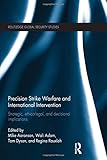
Mike Aaronson, Wali Aslam, Tom Dyson, Regina Rauxloh, eds. Precision Strike Warfare and International Intervention: Strategic, Ethico-Legal and Decisional Implications. New York: Routledge Press Ltd., 2015. 264 pp. $155.00 (cloth), ISBN 978-0-415-73020-4.
Reviewed by Bert Frandsen (Air War College)
Published on H-War (February, 2017)
Commissioned by Margaret Sankey (Air University)
Since the end of the Cold War, the United States has been involved in continuous warfare in which it has exploited its asymmetric advantage in air power to achieve national security objectives. The transformation of air power, enabled by precision and stealth, promised quick wars with little risk to American soldiers. By the early 2000s, the transformation’s next stage began to take shape in the form of armed, remotely piloted aircraft enabled by GPS and satellite communications. In uncontested air environments, drones provide persistent surveillance and when armed, the opportunity to destroy high value targets to protect American troops in such war zones as Iraq and Afghanistan. More secretive drone operations by the Central Intelligence Agency (CIA) assassinated terrorist leaders in countries where the United States is not at war, such as Pakistan, Yemen, and Somalia, and have been more controversial.
Precision Strike Warfare and International Intervention examines the pitfalls and benefits of precision strike capabilities. The origins of this volume of essays lie in a multidisciplinary workshop held in July 2012, organized by the Centre for International Intervention at the University of Surrey in Great Britain. The authors of the eleven chapters reflect a variety of academic disciplines, including security studies, international relations, law, philosophy, psychology, and engineering. The variety of academic perspectives is one of the book’s principle strengths. The breadth of topics covered by the essays should satisfy a wide range of interests in this type of air warfare. The editors loosely organize these essays into three parts, focusing on strategic consequences, moral and ethical issues, and decision-making implications. While some attention is indeed provided to the broader concept of precision strike warfare, which can be conducted by a wide range of aircraft and missiles, a majority of the essays focus on “drone warfare” conducted by the United States during the Obama administration.
Part 1, “Strategic and Foreign Policy Drivers and Consequences,” provides the widest aperture on precision strike warfare. The overall context is the US-led revolution in military affairs that began in the 1990s. Because pilots are not endangered, armed drones represent a risk-free technology and thus the potential increase in international intervention. An argument in the first chapter that the global war on terror has become an endless risk management enterprise in which drones kill people but will not win the war provides a stinging critique of US foreign policy. Additional essays employ international relations theory to explain the diffusion of precision strike capabilities beyond the United States. For example, realist balance of power considerations are driving convergence between Britain, France, and Germany to adopt revolution in military affair’s advanced military capabilities. On the other hand, “drones are hot” not only because of their usefulness but also because they symbolize technological sophistication. The last essay in part 1 analyzes how Pakistani football hero and politician Imran Khan exploited opposition to drone strikes to discredit the country’s rulers and advance his own career.
The second part of the book explores legal and moral implications of drone strikes. Those interested in just war theory will find useful essays here. One could argue that precision strike capabilities make warfare more humane by limiting collateral damage. States using drones might even be more willing to contribute to humanitarian operations, a topic of one of the essays. The main focus in this part, however, is on civilian casualties resulting from CIA strikes against non-state actors in such places as Pakistan, Yemen, and Somalia. The number of civilian casualties attributed to drone strikes varies widely. The explanation for this variance is that the United States tends to classify almost all military-aged males killed in covert strikes as combatants. Moreover, CIA tactics lead to increased civilian casualties. “Signature strikes” target individuals not based on confirmed identity but on patterns of behavior. “Double-tap strikes,” in which a second missile is fired at those attempting to give aid after a first strike, “serve as particular evidence of the potential of a moral slippery slope” (p. 128).
The final part of the book, “Implications for Decision Making at the Strategic, Operational, and Tactical Levels,” is the most theoretical. One essay roughly correlates various models of decision making with the level of the decision maker in the hierarchy. The final chapter examines the debate about fully autonomous weapons. Suggested criteria for designing the human in the decision loop may prove useful for autonomous weapons developers.
The newness of drone warfare and secrecy surrounding it challenges scholars in arriving at firm conclusions. Consequently, the most important contribution of Precision Strike Warfare may be the questions it frames for future study. One of the more important questions regards the effectiveness of targeted assassinations. Decapitation strikes remove enemy leaders, but they can be replaced. Drone warfare may be highly advantageous in the short-term disruption of enemy organizations, but what are longer-term consequences? Collateral deaths and violations of the national sovereignty may actually strengthen the opposition in the zone of conflict.
If there is additional discussion of this review, you may access it through the network, at: https://networks.h-net.org/h-war.
Citation:
Bert Frandsen. Review of Aaronson, Mike; Aslam, Wali; Dyson, Tom; Rauxloh, Regina, eds., Precision Strike Warfare and International Intervention: Strategic, Ethico-Legal and Decisional Implications.
H-War, H-Net Reviews.
February, 2017.
URL: http://www.h-net.org/reviews/showrev.php?id=45567
 | This work is licensed under a Creative Commons Attribution-Noncommercial-No Derivative Works 3.0 United States License. |

