

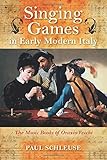
Paul Schleuse. Singing Games in Early Modern Italy: The Music Books of Orazio Vecchi. Bloomington: Indiana University Press, 2015. x + 372 pp. $50.00 (cloth), ISBN 978-0-253-01501-3.
Reviewed by Stefano Mengozzi (University of Michigan)
Published on H-Italy (May, 2017)
Commissioned by Matt Vester (West Virginia University)
Sociologizing Orazio Vecchi
A new monograph on Modenese composer and poet Orazio Vecchi (1550-1605) can only be greeted as a welcome addition to the meager scholarly literature on a much-neglected composer of the late cinquecento. Despite an unimpressive professional career (he only held the position of maestro di cappella in second- and third-rate institutions, such as the Cathedral of Modena), Vecchi was unquestionably one of the most original and prolific composers of his time, as confirmed by the over eighty printed musical anthologies that include his works. Some of his canzonette, such as “So ben mi ch’a bon tempo,” became wildly popular across Europe--particularly in England, where they were sung to new texts by Thomas Morley. Yet, perhaps because his secular production concentrated on the lighter form of the canzonetta and on what Vecchi himself called comedia harmonica (later dubbed commedia madrigalesca by his worthy follower, Adriano Banchieri, and now generally known as a “madrigal comedy”) the Modenese composer tends to fall through the cracks of modern historiographies of Renaissance music. From the perspective of operatic history, he seems to have been barking up the wrong tree by trying to extract musical comedy out of polyphony, while his significant production of sacred music is still largely unknown because until recently it was mostly unavailable in modern edition.[1] As a result, he is generally viewed at best as a precursor who made history more for his forward-thinking ideas on dramatic music than for his actual musico-dramatic contributions to the genre.
Paul Schleuse’s new study refrains from characterizing Vecchi as a composer of dramatic music ante litteram, attempting instead to portray his lifelong creative project as one of capturing with his works the “sociability” of the time. This term refers to the recreational customs that took place throughout the Renaissance in private and semi-private spaces, where small groups of educated courtiers and city-dwellers entertained themselves by engaging in polite conversation, readings of poetry, and madrigal singing. As the author puts it, “[Vecchi’s] music is almost always composed for the singers themselves as its primary audience, and their enjoyment derives from singing as a form of social recreation coexistent and imbricate with the conversation and game playing central to the social life of the courtly and subcourtly classes” (p. 3). In Vecchi’s time, this well-established model of musical performance coexisted with an alternative one, en vogue particularly in the courts of Ferrara and Mantua, which relied on professional musicians performing for a spatially separated audience (p. 2). This emerging model was suited to the aesthetics of Baroque spectacle, which aimed at “moving the affects” of the audience in a way that soon culminated with the convergence of musical and visual media ushered in by opera.
Key to this largely unknown world of amateurish singers were the musical prints of the time, which indeed were largely produced for such musically educated dilettanti. Thus, from its early pages the monograph places Vecchi within a cultural practice where music books, more available and more affordable than ever thanks to an increasingly efficient printing process, had greatly expanded the opportunities for amateurish music making. In line with these assumptions, the six chapters of the monograph are each centered on a different Vecchi print: chapters 1-2 focus on the canzonette and madrigals of the 1580s, chapter 3 on the Selva di varia ricreazione (1590) and the Convito musicale (1597), chapter 4 on L’Amfiparnaso (1597), and chapter 5 on the Veglie di Siena (1604), culminating with a final chapter that examines the portrayal of social classes in select works by Vecchi and other authors from his time (“Representation and Identity in Musical Performance”).
In the early chapters on the canzonette and the madrigals, the author highlights Vecchi’s creative confrontation with contemporary conventions of genre and style. For instance, the chapter on the four-voice canzonette offers an insightful analysis of Vecchi’s poetic choices, arguing that the pastoralism and the erotic overtones of the texts are the key ingredients of Vecchi’s coded critique of courtly life from his perspective as an outside observer. In the following chapter (“Intertextuality,” arguably one of the most persuasive sections of the monograph), a perceptive reading of Vecchi’s references to other works (such as Jacob Arcadelt’s “Il bianco e dolce cigno”) leads the author to conclude that “the successful recognition of these intertextual references constitutes one of the game-like aspects of recreational singing that pervade Vecchi’s music” (p. 67).Schleuse’s textual-exegetical approach to Vecchi’s music delivers its goods in the analysis of the madrigal “Tremolavan le fronde,” highlighting the relatively conventional melodic and harmonic means by which Vecchi depicts sexual ecstasy. Chapter 3, on the Selva and the Convito, (“Forest and Feast: The Music Book as Metaphor”), marks something of a turning point in the study, in that it presents the printed book as in integral part of Vecchi’s artistic goals, or as “a coherent aesthetic statement” (p. 90). It also betrays a basic ambiguity in the use of the term “book” throughout the monograph: although Schleuse refers to the Selva and the Convito as “music books,” his discussion focuses on the “forest” of literary and musical genres that distinguishes them, thus using “books” to mean “creative works” unified by their own diversity. Elsewhere, however, “book” stands for the physical interface that delivers Vecchi’s music to his readers/singers, imposing on them a particular visual format and a carefully planned internal organization that impact the fruition of the works in it.
The centrality of the printed book in the interpretive economy of the monograph is reinforced at the end of the chapter on L’Amfiparnaso, where the author criticizes as misguided Cecil Adkins’s attempt to construct a “Genealogical Table of the Madrigal Comedy” that includes works by Vecchi, Giovanni Croce, Alessandro Striggio, and Banchieri. The suggestion is that the mode of transmission of particular musical texts, that is, their print formats and circumstances of publication, directly impinges on the question of genre and on the even more pressing question of their intended mode of performance. As Schleuse writes: “Circulating in printed form in the decades around the turn of the century, these works [listed in Adkin’s Table] are best read in terms that were familiar to sixteenth-century creators, buyers, and users of music books, with particular attention to the musical genres and ensemble sizes employed, the specific theatrical styles or social situations imitated, and the visual presentation of the print itself” (p. 174).
For their part, the singers who performed Vecchi’s “books”--or from them--emerge primarily as readers who enter into personal contact with the large menu of social types, settings, and gestures found on the printed page, and proceed to flesh them out in their minds. The goal of musical performance, in this scenario, is a form of sublimated comedy where the live interaction between singers, implied particularly in those works by Vecchi that suggest some kind of stage action, takes second seat to the “self-fashioning performance of identity” that takes place in the singers’ minds as they engage in private dialogue with the printed texts. The driving impulse behind this interpretation is a model of entertainment as evasion, as the author argues that Renaissance singers found in Vecchi “the opportunity to enact attitudes and desires far from those they would ordinarily display” (pp. 128-129).
One may agree with the author that these works were not conceived for the stage, but rather expected to be “beheld by the imagination, which it enters through the ears, not the eyes,” as Vecchi himself famously tells his “illustrious spectators” in the prologue of the Amfiparnaso (p. 140). The adoption of this now largely shared view, however, does not vanquish the need of an in-depth investigation of Vecchi’s unique path to musical comedy through polyphonic means. Whether his works were written for the stage or not, it seems that a study of this kind cannot avoid a sustained investigation of the musical strategies by which the viewers/listeners are indeed led to “imagine the spectacle through their ears.” After all, it would seem that musical comedy may afford to relinquish the opportunity to exert a visual impact on its audience only to the extent that it can deliver compelling sound representations of its contents.
In other words, the argument that L’amfiparnaso was not conceived for the stage does not lead ipso facto to the conclusion that it was performed, and listened to, essentially as a series of madrigals, as the study seems to suggest. Given the explicit reference to the characters of the commedia dell’arte in that work, the challenge for the historian is to interpret Vecchi’s musical gestures as aural signifiers of the visual and theatrical markers that define the Isabellas and the Grazianos of such theatrical tradition. Along these lines, for instance, Emily Wilbourne seeks an interpretive strategy that highlights the musical sounds and gestures of the commedia dell’arte as an integral part of the “eloquence of the bodies” of the characters involved (“The extant scripts of commedia performance are resonant with sound, and the printed word thick with aural import”).[2] Of course, the theatrical “bodies” of the commedia acquire credibility by virtue of speaking in their own regional dialects (Venetian, Neapolitan, Bergamask, etc.), often colored by a variety of local and macaronic inflections, and by the social rank of the individual characters. Yet as a number of recent and not so recent contributions have shown, not only does Vecchi’s musical theater retain the plurilinguistic selva of the commedia, but it also strives to enhance it through suitable musical means.[3] Other scholars have provided an initial account of the balance between poetic forms and musical strategies at work in Vecchi’s canzonette, a methodology that may serve as a starting point for a musico-theatrical analysis of works such as L’Amfiparnaso and the Veglie.[4]
Singing Games does not capitalize on these earlier studies, as it locates musico-theatrical meaning more in the format of performance than in its visual and sonorous products. The direct consequence of this methodological choice is that the monograph approaches Vecchi’s polyphonic language not so much as the integrated sign system by which listeners “imagine the spectacle through their ears,” but rather as a symbolic code of communication that qualifies the social and sexual attributes of the characters impersonated by the singers (“in performing such music, singers engage identities that define who they are, who they are not, and whom they aspire to be,” p. 3). Arguably, Vecchi’s musical theater is not a typological representation of “identities” to be played out in the singers’ minds, but rather the exaltation of human gestures, interactions, sensations, and the like, as they unfold on a fictitious stage (albeit no less verisimilar than a real one) governed by the communicative and expressive toolkit of musical space/time.
For instance, in his commentary on the “Hore di recreatione”--an extended musical scene in the countryside, where seven participants sing various songs and engage in real-life interactions in between them--the author underscores Vecchi’s skillful rendition of the salient narrative moments and of the individual and collective subjectivities that take part in it. Schleuse aptly decodes the social connotations of the various musical styles evoked in the scene (ranging from a popular dance to a madrigal), and draws attention to the meticulous use of different polyphonic textures to represent different kinds of interactions, so that, for instance, the alternation between two half choirs suggests a dialogue, whereas a series of unpredictable entrances of the voices mimics a heated argument. Arguably, however, with his musical setting Vecchi accomplishes something more than token representations of class types and various modes of interaction. With his surprising musical twists in melody and rhythm (not to speak of his skillful transitions from diegetic to mimetic moments, and vice versa), he actually enables his characters to jump off the printed page and to acquire a life-like dimension, if in necessarily schematic form.
In similar fashion, the main question informing the analysis of the meeting between the gardener and the passerby in the Convito musicale (“O giardiniero,” in three parts) is whether the episode should be interpreted as a veiled representation of a sexual encounter. The author argues that it should, as the rich garden imagery of the text may hide a number of double entendres (plump grapes, fleshy wines, flowing juices, etc.). Schleuse concludes: “The moral hazard depicted in ‘Giardiniero,’ whether one reads it as a coded homosexual encounter or simply as a drinking bout … is of socializing across class boundaries. Vecchi’s other musical settings of courtiers and peasants depict them as enclosed within their own social spheres, even when the view is parodistic or cynically critical. Drinking games played among peasants (or courtiers imitating peasants) are harmless fun, but when a young urban man crosses into a rural garden of delights, his honor and his dignity are at greater risk” (p. 290). Such a moralizing reading, however, seems at odds with Vecchi’s musical delivery of the scene, which constantly crosses boundaries of all kinds with its endless mix of low-brow and high-brow polyphonic styles and its inexhaustible rhythmic energy. In the interest of musical realism, Vecchi does not hesitate to reject the conventions of musical decorum of his time, and with them any trace of didascalic intent.
Again, Schleuse’s sociological reading of the scene is not supported by an in-depth analysis of the musical means by which Vecchi dramatizes his story. The author limits himself to commenting on an unusual harmonic transition from F to A (possibly suggesting drunkenness), on a descending line in the bass on the words “in sin’al fondo” (possibly suggesting penetration), and on the abrupt final cadence (possibly suggesting the visitor’s quick disappearance down the street, or “loss of both verbal and musical eloquence,” p. 290). Schleuse also reads the vocal ranges associated with the two characters in the opening sections of the piece as hinting at their relative ages.
Pertinent as these observations may be, they fall short of providing a convincing account of how Vecchi converts into theatrical sound the gestures and even the bodily sensations of the two characters by means of unerringly effective musical choices. See, for instance, the setting of Passaggiero’s priceless hendecasyllable “Porgilo quà, ch’à berlo, i’ mi ci incarno” (meaning something like, “hand it over, as in drinking it I enflesh myself with it”) in the third part of the piece (measures 40-45). The impatient request by Passaggiero, conveyed by hurried repetitions of “Porgilo quà” in the upper voices, contrasts with the anticipation of flavorful bliss in the second half of the phrase, which literally becomes musical carne in the form of a thick contrapuntal texture made of slow-moving notes and a string of “fleshy” dissonances. This is music that Vecchi wants us to taste and smell as if it were a fragrant glass of wine, at the same time that he is inviting his singers/listeners to identify with Passaggiero’s inebriating experience of pleasure, and not just with the sociological implications of the meeting with his host. Comedy, removed from the stage, relocates to the music, which conveys the “eloquence of the body,” in dell’arte fashion, by encoding its movement and sensuality.
Vecchi’s rhythmic solutions also pose interpretive problems to performers, precisely because they fulfill at the same time both a musical and a dramatic function. For instance, the choice of tempo at any given moment--not to mention the choice of dynamics (piano, forte, etc.)--cannot be dictated by musical considerations alone, but also, if not primarily, by the narrative pace deemed appropriate at any given moment. Again, Vecchi’s stage may have been ideal or imaginary, but the theatrical gestures that populate it, resulting from a highly personal blend of music and language (or languages) are very real.
One may legitimately sense a certain methodological tension in the very title of the monograph, then, which indeed pervades the pages that follow. The “music books” that were no doubt indispensable--now and then--for transmitting and for studying Vecchi’s works can hardly serve as a promising starting point for an investigation of how the composer’s “games” “sing” the way they do. Perhaps more than the works of any other Renaissance composer, Vecchi’s unforgettable musical tableaus exist first and foremost not as texts on a page, but as performative acts, and call to be understood as such. Schleuse’s study largely accomplishes what it sets out to offer, namely, a perceptive and at times provocative sociology of Vecchi’s works based for the most part on close readings of those works qua texts. At the same time, however, it falls disappointingly short of tackling the nuts and bolts of the musico-mimetic art of this extraordinary composer of the late cinquecento.
Notes
[1]. The scores of over thirty motets from (presumably) the composer’s middle period are now available in Orazio Vecchi, Motecta (1590), ed. William R. Martin and Eric J. Harbeson, Recent Researches in the Music of the Renaissance, 160 (Madison: A-R Editions, 2013). See also the studies by Giovanni Indulti, “Sacro e profano, nuovo e antico nei mottetti di Orazio Vecchi, Theatro dell’udito: società, musica, storia e cultura nell’epoca di Orazio Vecchi: conferenze tenute durante le celebrazioni del IV centenario della morte di Orazio Vecchi, ed. Ferdinando Taddei and Alessandra Chiarelli (Modena: Mucchi, 2007), 265-314; Rodobaldo Tibaldi, “I mottetti di Orazio Vecchi: Un’antologia,” Polifonie: Storia e teoria della coralità 5/2(2005): 47-117, and Rodobaldo Tibaldi “Stile e struttura nei mottetti di Orazio Vecchi, con un’appendice su Ave virgo gratiosa di Monte e di Porta,” Polifonie: Storia e teoria della coralità 5, no. 3 (2005): 179-270.
[2]. Emily Wilbourne, “Lo Schiavetto (1612): Travestied Sound, Ethnic Perforance, and the Eloquence of the Body,” Journal of the American Musicological Society 63 (2010): 1-43; citation on 2. Wilbourne offers a broader formulation of her theories in Seventeenth-Century Opera and the Sound of the Commedia dell’Arte (Chicago: University of Chicago Press, 2016), especially 19-50.
[3]. On this topic, see Vittorio Coletti, “Il gioco delle lingue cinquecentesco e il teatro di Orazio Vecchi,” in Theatro dell’udito, theatro del mondo, Atti del convegno internazionale, nel IV centenario della morte di Orazio Vecchi, ed. Massimo Privitera (Modena: Mucchi, 2010), 111-120; and the much earlier contributions by Johannes Hol (“L’Amfiparnaso e le Veglie di Siena,” Rivista musicale italiana 40 (1936): 3-22; and “Le Veglie di Siena di Horatio Vecchi,” Rivista musicale italiana 43 (1939): 17-34. The landmark study of plurilingualism in sixteenth-century secular music is by Warren Kirkendale, “Franceschina, Girometta, and Their Companions in a Madrigal ‘a diversi linguaggi’ by Luca Marenzio and Orazio Vecchi,” Acta Musicologica 44 (1972): 181-235.
[4]. Rossana Dalmonte and Massimo Privitera, Gitene, canzonette. Studio e trascrizione delle ‘Canzonette a sei voci d’Horatio Vecchi (1587)’ (Florence: Olschki, 1996), 15-65.
If there is additional discussion of this review, you may access it through the network, at: https://networks.h-net.org/h-italy.
Citation:
Stefano Mengozzi. Review of Schleuse, Paul, Singing Games in Early Modern Italy: The Music Books of Orazio Vecchi.
H-Italy, H-Net Reviews.
May, 2017.
URL: http://www.h-net.org/reviews/showrev.php?id=45549
 | This work is licensed under a Creative Commons Attribution-Noncommercial-No Derivative Works 3.0 United States License. |

