

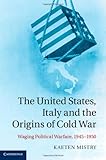
Kaeten Mistry. The United States, Italy and the Origins of Cold War: Waging Political Warfare, 1945–1950. Cambridge: Cambridge University Press, 2014. 308 pp. $99.00 (cloth), ISBN 978-1-107-03508-9.
Reviewed by Marco Mariano (Università del Piemonte Orientale)
Published on H-Italy (December, 2015)
Commissioned by Matteo Pretelli (University of Naples "L'Orientale")
US Political Warfare in Italy: Illusions of Coherence and (Mis)perceptions of Success in the Early Cold War
Kaeten Mistry’s The United States, Italy and Origins of the Cold War: Waging Political Warfare, 1945-1950 provides an in-depth, comprehensive, and sophisticated look at one of the crucial chapters of the early cold war as well as of the history of post-World War II Italy, namely, the premises, developments, and consequences of US involvement in the general elections held in Italy in April 1948. His focus is on “political warfare,” that is, on the wide array of instruments “short of war” adopted by the Truman administration to influence the Italian political scene. Since the 1980s, several historians on both side of the Atlantic have made significant contributions to our knowledge of the political, military, and economic dimensions of US-Italian relations in the early postwar years. Building on this considerable body of literature, Mistry sheds new light on the role played by non-state and local actors, on the influence of cultural and ideological prisms through which American officials looked at Italian events, and finally on the wider implications of what came to be mistakenly seen as a success story to be replicated elsewhere.
The eight chapters of the book, arranged in a rigorous chronological frame, weave together three major threads. First, Mistry’s painstaking account highlights tensions among different American actors at various levels (George Kennan and the Policy Planning Staff, mid-level State Department officials, Ambassador James Dunn, and the operatives at the American Embassy in Rome). These bureaucratic conflicts made US political warfare in Italy much more contradictory and improvised, and much less brilliantly planned and smoothly executed, than self-congratulatory accounts stemming from the diplomatic and intelligence communities were willing to acknowledge.
Second, efforts by US actors were instrumental in the emergence of Alcide De Gasperi as the leader of the centrist pro-Western coalition amid the fragmented and polarized political landscape of postwar Italy, whose intricacies often confounded external observers. The author emphasizes the role played by non-state actors both in Italy and the United States, such as the Catholic Church, labor leaders, Italian anti-Fascist exiles, and influential figures in the American media. Their efforts facilitated the “marriage of convenience” between Italian Christian Democrats and American centrist liberals that was at the heart of Italian-American relations in the late 1940s. As he explores the complexities of those relations and the multiplicity of the actors involved in detail, Mistry also addresses larger issues. “The United States was neither dominant nor impotent” he concludes, thus taking a critical look at Geir Lundestad’s well-known “empire by invitation” thesis: “Any Italian invitation was conditional and emerged from a particular strand of a complex body politic” (p. 15).
Finally, decisions and policies by US actors about the Italian situation were rooted in a shared set of cultural and ideological assumptions about the superiority of the American standard of self-government and other people’s ability to live up to and absorb those standards. A report drafted only a few days before the elections warning against the “ever-present danger of a politically immature populace” who behaved “like children” is just one of many examples of what the author defines as the “ideology of Italian frailty” (p. 153). Deep-rooted representations of Italy and Italians as weak and inferior affected the assessment of the potential as well as the dangers of US attempts to modernize and stabilize Italy, thus illustrating the larger contradiction between universalistic ambitions and ethnocentric assumptions that is typical of American exceptionalism.
Mistry’s work is based on an impressive command of the classic interpretations and new directions in the study of US foreign relations, as well as on a remarkable amount of archival work in US and Italian archives. It also benefits from the author’s familiarity with Italian history, politics, and public life. A closer look at the role played by European actors might have been useful, although the scope of his book is by no means narrowly bilateral. In fact, its most significant and original contribution transcends the Italian case and sheds light on how the victory of De Gasperi in the Italian elections of April 1948 led to a widespread, delusional “perception of success.” For the foreign policy and intelligence establishment of the early cold war years, American political warfare in Italy came to signify a success story and, consequently, a model to be replicated elsewhere, especially in Eastern Europe, irrespective of the influence of specific historical and political conditions and of the role played by local actors. Mistry convincingly shows how Italian events generated “illusions of coherence” and a mystique of political warfare whose implications were felt in larger, more important contexts.
If there is additional discussion of this review, you may access it through the network, at: https://networks.h-net.org/h-italy.
Citation:
Marco Mariano. Review of Kaeten Mistry, The United States, Italy and the Origins of Cold War: Waging Political Warfare, 1945–1950.
H-Italy, H-Net Reviews.
December, 2015.
URL: http://www.h-net.org/reviews/showrev.php?id=45437
 | This work is licensed under a Creative Commons Attribution-Noncommercial-No Derivative Works 3.0 United States License. |

