



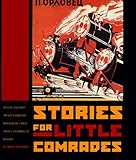
Evgeny Steiner. Stories for Little Comrades: Revolutionary Artists and the Making of Early Soviet Children's Books. Seattle: University of Washington Press, 1999. xv + 214 pp. $30.00 (cloth), ISBN 978-0-295-97791-1.
Reviewed by Jacqueline M. Olich (Center for Slavic and East European Studies and Department of History, University of North Carolina at Chapel Hill)
Published on H-Russia (September, 2000)
The Art of Early Soviet Children's Books[1]
The Art of Early Soviet Children's Books[1]
The title of Evgeny Steiner's book, Stories for Little Comrades: Revolutionary Artists and the Making of Early Soviet Children's Books, is misleading; visual texts or images, not stories, lie at the center of the work.[2] Steiner examines the history of "avant-garde-Constructivist children's book illustration in the 1920s" (p. 5). According to Steiner, the "great artistic-aesthetic experiment of the 1920s, which found perhaps its fullest, most clearly articulated expression in the art of illustrating and designing children's books, did not bring these artists what they had fought for. Or perhaps it did -- only the reality of what they fought for turned out to be more awful, more merciless, dirtier and uglier than the Constructivist design for the future" (p. 175).
In his preface and introduction, Steiner convincingly explains why artists eager to aesthetically and socially shape the "New Man," and earn a paycheck, gravitated to children's book illustration. Chapter one, "Laying Out the Boundaries: Architects of the Constructivist Project," examines prints by Natan Al'tman, Yury Annenkov, Nikolai Lapshin, and Elena Turova -- all members of the short-lived Segodnya (Today) artists' collective (1918-1919). In addition, Steiner discusses images produced by El Lissitzky, Solomon Telinger, Vladimir Lebedev, Vladimir Tatlin, Kuz'ma Petrov-Vodkin, A. Suvorov, Vladimir Konashevich, and Mikhail Tsekhanovsky. Most interesting is Steiner's analysis of Lissitzky's Four Arithmetic Operations (Berlin, 1928), an unpublished book in which the artist attempts to create a "sign system based on mechanical, regular pictographic forms" or a new language (p. 38).
Chapter two, "Elements of the Constructivist Project," probes subtopics -- trades, machines, mass kitchens, and steam engines --within the production book genre. Books such as Dogonim amerikansuyu kuritsu (Let's Catch Up to the American Chicken), Steiner notes, altogether defy categorization (p. 93). In his third chapter, "The Production Book: Locomotives and All the Rest," Steiner analyzes how "quasi-religious, Romantic notions of a rapid transition from past to future in a 'historically short period' evoked visions of dynamically accelerated time" (p. 118). Artists, including Boris Pokrovsky, Boris Virgansky, Alisa Poret, Boris Ender, Nikolai Ushin, Galina and Olga Chichagov, adopted the locomotive as a metaphor for a society and a culture moving toward permanent revolution.
By the early 1930s, Steiner concludes, this "failed social and artistic experiment" had come to an end (p. 176). Cultural policy was "being conducted by a different sort of person, by workers promoted up through the ranks, people with grade-school educations, utterly unspoiled by any idea of aesthetics, but who had the lackey's powerful hankering for the high life" (p. 170).
Steiner's stated goals are overly ambitious for a book of this length. Firstly, he argues that leading artists "consciously or unconsciously shared the same mental framework as the 'new life's' political leaders, and that they quite actively took it upon themselves to design that life" (p. x). Echoing historian Boris Groys,[3] Steiner regards the avant-garde as "part and parcel of the totalitarian era" or as the creators of the era's very "face" (p. xi). "The avant-garde movement did not die," Steiner writes, "it merely adapted itself to a new historical situation" (p. 3). Secondly, Steiner claims to be investigating not the books' aesthetic qualities but "their impact on children, and the long-term sociopsychological consequences of that impact" (p. 46). Thirdly, Steiner aspires to reconstruct the mentalities of the early Soviet era (p. 7).
Steiner succeeds in bringing previously marginalized artists and art onto center stage. Drawing upon books from the Russian State Library, private collections, publisher's archives, and his own command of Russian children's literature, Steiner makes the artistry of children's books accessible to non-Russian speaking readers and provides compelling readings of the foundation works. The author and the press are to be commended for the fine quality of the many vivid reproductions.
For the most part, the consumer is absent from Steiner's analysis. How commercially successful were avant-garde books? Were they widely circulated and republished? If not, could their failure to resonate with the book-buying public in part explain why "the powers-that-be in the Soviet Union decreed that henceforth the avant-garde had no right to exist"? (p. 3). Were young readers as malleable as writers, artists, and ideologues presumed? These questions remain unanswered.
At times, Stories for Little Comrades reads like an art exhibition catalogue. Steiner assumes too much of his reader; he would be well served to provide more historical background and address issues of continuity between Imperial and Soviet traditions. Grounding his study in the context of recent work on Soviet poster art, cultural revolution, and the growing body of scholarship about children's literature would also help Steiner advance his arguments.[4]
Despite these minor criticisms, Stories for Little Comrades is essential reading for specialists in Russian art history, literature, and cultural history.
Notes
[1]. Steiner wrote the Russian-language version of this book in 1989 and 1990 and revised it in 1994.
[2]. For more on how Bolshevik and non-Bolshevik elites anxious to ensure that their cultural heritage would take root among the next generation of Russians put forth their own versions or stories of children's literature in an attempt to create new culture, see Jacqueline M. Olich, "Competing Ideologies and Children's Books: The Making of a Soviet Children's Literature, 1918-1935," (Ph.D. diss., The University of North Carolina at Chapel Hill, 2000).
[3]. Boris Groys, The Total Art of Stalinism: Avant-Garde, Aesthetic Dictatorship, and Beyond, trans. Charles Rougle (Princeton: Princeton University Press, 1992).
[4]. See, notably, Victoria Bonnell, Iconography of Power: Soviet Political Posters Under Lenin and Stalin (Berkeley: University of California Press, 1997); Sheila Fitzpatrick, "Cultural Revolution in Russia, 1928-1932," Journal of Contemporary History 9: 1 (1974); Michael David-Fox, "What Is Cultural Revolution?," Russian Review 58 (April 1999): 181-210; Fitzpatrick, "Cultural Revolution Revisited," Russian Review 58 (April 1999): 202-9; David-Fox, "Mentalite or Cultural System: A Reply to Sheila Fitzpatrick," Russian Review 58 (April 1999): 210; Katerina Clark, Petersburg: Crucible of Cultural Revolution (Cambridge: Harvard University Press, 1995). For an overview of children's literature studies, see Understanding Children's Literature, ed. Peter Hunt (Routledge: London and New York, 1999).
Copyright (c) 2000 by H-Net, all rights reserved. This work may be copied for non-profit educational use if proper credit is given to the author and the list. For other permission, please contact H-Net@h-net.msu.edu.
If there is additional discussion of this review, you may access it through the network, at: https://networks.h-net.org/h-russia.
Citation:
Jacqueline M. Olich. Review of Steiner, Evgeny, Stories for Little Comrades: Revolutionary Artists and the Making of Early Soviet Children's Books.
H-Russia, H-Net Reviews.
September, 2000.
URL: http://www.h-net.org/reviews/showrev.php?id=4540
Copyright © 2000 by H-Net, all rights reserved. H-Net permits the redistribution and reprinting of this work for nonprofit, educational purposes, with full and accurate attribution to the author, web location, date of publication, originating list, and H-Net: Humanities & Social Sciences Online. For any other proposed use, contact the Reviews editorial staff at hbooks@mail.h-net.org.

