

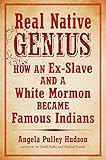
Angela Pulley Hudson. Real Native Genius: How an Ex-Slave and a White Mormon became Famous Indians. Chapel Hill: University of North Carolina Press, 2015. 270 pp. $29.95 (paper), ISBN 978-1-4696-2443-3.
Reviewed by James Carson
Published on H-AmIndian (February, 2016)
Commissioned by F. Evan Nooe (University of South Carolina Lancaster)
Playing Race in America
Remember Rachel Dolezal? The leader of the Spokane, Washington chapter of the NAACP who, it turned out, was “actually” white and not black though she had been passing persuasively for some time? Critics scoffed at the notion of the transraciality she practiced while the public simply regarded it all as a preposterous hoax and laughed her into oblivion. At the same time, however, if we cast our eyes toward the farthest edges of today’s gender and sexual politics we find transgender and transsexual issues next in line for full public debate and progressive legal and cultural reform. Why are the cultural constructions and power implications of gender and what people widely assume to be the biological facts of sex open to such creative and increasingly accepted challenges while the parallel practice of a transracial identity—whether one chalks it up to biology, culture, or some mix of both—draws such sharp and total hostility?
Angela Pulley Hudson’s timely book Real Native Genius explores transgressive racial practices in the middle of the nineteenth century through the curious lives led by a former slave from Natchez named Warner McCary and his wife Lucy Stanton, who together perfected a musical stage routine that pitched them as Okah Tubbee, son of a Choctaw chief, and Laah Ceil, an “Indian princess” of indeterminate origin. Hudson’s work witnesses the transformation of racial identity in antebellum America from ideas about the mutability of culture to the fixed notions inherent in biological understandings of race, and how the two protagonists learned how first to play and second to pass as “Indians” in a popular culture coming to grips with the aftershocks of the removal era and the ostensible eventual disappearance of the people called “Indians.” Whether as redface minstrels or as patent medicine peddlers, the couple earned a living by conforming to broad stereotypes of Indianess, which provided cover for a marriage that was illegal at the time owing to legal and cultural racial proscriptions. Such conformity to some racial ideas and complete violation of others stands as the central paradox of the couple’s lives, leaving us now to wonder to what degree they internalized their new identities, by what names we should call them, and how modern racial language can accommodate such shifting and shifty lives.
Much of American history is written with resort to the same black/white/Indian trinity that underwrote nineteenth- and twentieth-century racial mores, but Hudson avoids the traps that race language sets by not committing to any racial description of Okah Tubbee or Laah Ceil. Lucy Stanton was not a white women but was, rather, “raised as a white woman” (p. 3). Warner McCrary was born a slave and then freed, but he is not “black.” Instead, he was understood then, and, to be sure, would be understood now, as “black.” The authorial decision to refuse to identify racially either of the book’s protagonists accentuates their efforts to play and to pass as “Indians” and has the wonderful effect of destabilizing both historical and historiographical notions of race. Hudson allows us to grasp reasonably fully—for neither Stanton’s nor McCrary’s lives were well documented—the process of identity construction and practice within both the racial and cultural tropes of the time as well as the opposition and outrage such practices inspired.
Strange garb, self-professed mastery of “Indian” traditions, fake genealogies, and ambiguous complexions enabled the two to create persuasive personas that drew large crowds to variety shows and public exhibitions across New England and the Northwest. But wherever they went rumors dogged them. Their exploits were popular fodder for newspapers and as word of their stage successes reached Natchez, people who had known McCrary before he became Okah Tubbee began publishing their recollections of his life as an enslaved child and adolescent. Some newspaper writers denounced the couple’s transraciality while audiences nonetheless remained devoted to the stage act. But growing anger, concerns about the Fugitive Slave Law (which caused some free people to be seized illegally for sale back into slavery), and an inconvenient bigamous marriage on the part of McCrary impelled the couple to flee to Toronto, where they eked out a living practicing what they called “Indian” medicine. By 1856 Okah Tubbee had disappeared from the historical record while Laah Ceil had relocated to Buffalo, where she lived as an “Indian doctoress” but was arrested after one of her patients died from complications associated with an abortion. After serving a seven-year term in Sing Sing prison she moved to Utah, where she rejoined her Mormon family and died in 1878.
The book is important for several reasons. First, Okah Tubbee is a notorious figure for people who study nineteenth-century Native American history, and Hudson’s narrative offers by far the best account of who he was, why he performed as he did, and why it matters. Second, Hudson sounds an important call for a multivalent approach to the historical study of identity formation. If, she contends, we allow race to define identities in isolation from gender norms, religious and cultural practices, and individual creativity, we run the risk of succumbing to the very racial proscriptions against which we seek to write as engaged scholars. Hudson’s work offers a valuable test of the degree to which historical and historiographical race languages can become complicit in establishing race as a truth while someone like Okah Tubbee or Laah Ceil complicates it all. And third, when coupled with Dolezal’s public humiliation and recent developments in transgender and transsexual politics, the book suggests that given people’s past and present racial anxieties and transgressive struggles, it is reasonable to accept that an absolutist faith in race, whether a person sought or seeks to claim or defend a racial identity, constitutes the deepest core of what it means now and what it meant then to be an American.
If there is additional discussion of this review, you may access it through the network, at: https://networks.h-net.org/h-amindian.
Citation:
James Carson. Review of Hudson, Angela Pulley, Real Native Genius: How an Ex-Slave and a White Mormon became Famous Indians.
H-AmIndian, H-Net Reviews.
February, 2016.
URL: http://www.h-net.org/reviews/showrev.php?id=45384
 | This work is licensed under a Creative Commons Attribution-Noncommercial-No Derivative Works 3.0 United States License. |

