

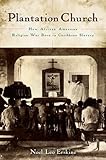
Noel Leo Erskine. Plantation Church: How African American Religion Was Born in Caribbean Slavery. Oxford: Oxford University Press. x + 216 pp. $26.95 (paper), ISBN 978-0-19-536913-7; $105.00 (cloth), ISBN 978-0-19-536914-4.
Reviewed by Stephanie Bilinsky (Arizona State University)
Published on H-Afro-Am (April, 2016)
Commissioned by Richard M. Mares (Michigan State University)
Religion, especially Christianity, has long been considered a formative aspect of life and freedom struggles for African-descended peoples in the Americas. In Plantation Church: How African American Religion Was Born in Caribbean Slavery, Noel Leo Erskine argues that freedom from slavery was “a byproduct of worshipping and missional communities” involved in transnational religious enterprises between the United States, Jamaica, and other Caribbean colonies and nation-states (p. 185). A professor of theology and ethics at Emory University, Erskine draws on his experience growing up and later serving as a pastor in Baptist churches in Jamaica. In addition to his insightful autobiographical anecdotes, Erskine’s personal experience and training make him keenly aware of theology and historical work produced by Caribbean and African scholars. He incorporates this into his framework for analyzing an abundance of archival sources in a way that sets this book apart from manuscripts that too often fail to engage scholarly voices outside the United States.
In Plantation Church, Erskine explores a series of interrelated questions about the relationship between the violent oppression of slavery and the formation of what he terms the “Black church” as well as the historical development of a hermeneutic based in African rather than Eurocentric worldviews. In his second chapter, Erskine highlights tropes and frameworks of “African Traditional Religions” that affected the development of black Christianities in the Americas (p. 60). This chapter serves as a basis on which Erskine builds his argument about African retentions at the heart of an African diasporic hermeneutic. Here Erskine places his research at the center of the Frazier-Herskovits debate over the extent and nature of African cultural retentions in the diaspora. Erskine traces multiple trajectories in which African-descended people chose to acculturate to European Christianity according to a Frazierian model, or adapt it through their own lens as Herskovits argued. In particular, interactions with intermediary divinities and ancestral spirits contributed to the development of new Christian practices while African views of the human as born free of sin enabled slaves to resist plantation owners’ and missionaries’ assertions that people of African descent were divinely destined to serve without complaint or thought of freedom. Moreover, Erskine examines four men who led revolts against plantation owners and European colonizers—Toussaint L’Ouveture, Gabriel Prosser, Denmark Vesey, and Nat Turner—as examples of black religio-political leadership interpreting Christianity through an African framework.
Throughout the middle of the book, Erskine highlights the historical priority of the Caribbean experience in the formation of black religious life in the Americas. Not only did Europeans, particularly the Spanish and French, bring enslaved Africans to the Caribbean well before the British colonies of North America, but by the time the majority of slaves in the United States were native-born, Europeans also continued to import African-born slaves to the Caribbean where they vastly outnumbered Europeans. This meant that memories of African cultural practices were more recent for African-descended people in the Caribbean, and Erskine sees this as central to understanding the ways in which Christianity developed in the region. By comparing these circumstances and the differing approaches to colonialism between the British, who settled full-time in North American colonies, and the Spanish, who tended to live only part-time in the Caribbean colonies, Erskine argues that black churches could become sites of resistance and liberation.
Although Erskine argues that the Caribbean deserves historical priority in the development of black Christianities, he demonstrates that Caribbean and North American black Christian communities communicated with and influenced one another frequently. Erskine’s example of the work of George Liele, a former US slave who founded the Ethiopian Baptist Church in Jamaica in the 1780s, illustrates this especially well. Through founding his church, Erskine argues, Liele “combined questions of salvation and social justice,” a critical framework in Afro-Caribbean and African American struggles for liberation (p. 177). Moreover, Liele and later leaders of black churches placed themselves “in the crucible between Africa and Jesus”—that is, in a productive space between Eurocentric Christianity and traditional African worldviews (p. 8).
Considering Erskine’s emphasis on slaves’ emotional and spiritual agency even within the confines of plantations, it is surprising that women receive little attention in this study outside of a brief ethnographic example. Erskine does address the horrors, especially rape, to which enslaved women were subject; however, in his examination of historical examples of religiopolitical leadership, he focuses solely on men. In doing so, he fails to examine women’s roles as counselors, healers, and midwives on plantations. Since healing and non-institutionalized leadership have been and continue to be major themes of black religious life in the diaspora, women merit a larger place in Erskine’s narrative. Engagement with more recent scholarship would have been one way to address this. Although Erskine employs the work of foundation figures, including W. E. B. DuBois and E. Franklin Frazier, effectively, his analysis of religious life on plantations would have been enriched by scholarship focusing on women’s roles in their communities, such as Sharla M. Fett’s Working Cures: Healing, Health, and Power on Southern Slave Plantations (2002).
Ultimately, Erskine’s underlying goal appears to be “the empowerment of the church-community” through a cohesive historical narrative of the development of African diasporic Christian practices (p. 17). Erskine emphasizes elements of “African Traditional Religions” that serve as a counterpoint to the ways in which Christian theology historically was used to denigrate people of color. For example, as opposed to a concept of original sin, Erskine points to African conceptions of the human as born sinless and whole, an understanding that he argues helped enslaved people see themselves as having “equal access to the tree of life” (p. 60).
Plantation Church is a significant contribution for theologians and students seeking to understand the development of black Christian communities. Moreover, the book is truly international in its scope, demonstrating the necessity of treating transnationalism as characteristic of religious life in the Afro-Atlantic.
If there is additional discussion of this review, you may access it through the network, at: https://networks.h-net.org/h-afro-am.
Citation:
Stephanie Bilinsky. Review of Erskine, Noel Leo, Plantation Church: How African American Religion Was Born in Caribbean Slavery.
H-Afro-Am, H-Net Reviews.
April, 2016.
URL: http://www.h-net.org/reviews/showrev.php?id=45349
 | This work is licensed under a Creative Commons Attribution-Noncommercial-No Derivative Works 3.0 United States License. |

