

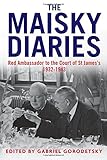
Gabriel Gorodetsky, ed. The Maisky Diaries: Red Ambassador to the Court of St James's, 1932-1943. Translated by Tatiana Sorokina and Oliver Ready. New Haven: Yale University Press, 2015. Illustrations. 632 pp. $40.00 (cloth), ISBN 978-0-300-18067-1.
Reviewed by Tony Demchak (Kansas State University)
Published on H-War (August, 2016)
Commissioned by Margaret Sankey (Air University)
The Maisky Diaries is an edited one-volume edition of the extensive diaries of Ivan Mikhailovich Lyakhovetsky (who chose the revolutionary name “Maiskii”), who served as Soviet ambassador to London from 1932 to 1943. According to the editor, Gabriel Gorodetsky, all three volumes of the original, unedited diary are forthcoming from Yale University Press, including his extensive commentary (p. xii). While readers await the publication of the full edition, the abridged version is an extremely valuable resource in its own right.[1]
Maisky’s diary is almost unique because so few Soviet officials kept standard diaries, especially important officials like ambassadors.[2] Indeed, as the editor points out, “Maisky’s diary is not the typical Soviet diary, a vehicle to ‘self-perfection,’ which was encouraged by the regime as a means of political education and transformation” (p. xiii). Rather, it is a more traditional diary of the day-to-day events and meetings that took place in Maisky’s life. It contains not only his opinions and ideas on the major diplomatic events of the day but also his personal remembrances of political and cultural figures in 1930s and 1940s London. For example, Maisky was fond of David Lloyd George (who he often affectionately termed “the old man”) and George Bernard Shaw and his wife, and even recounts meetings with H. G. Wells.
In addition to the diary itself, Gorodetsky provides an introduction and conclusion that describe the details of Maisky’s life before and after the period of the diary. Interspersed with the diary entries are explanatory notes that help fill in the gaps between entries. Every time an individual is mentioned for the first time, Gorodetsky provides a footnote listing the person’s occupation and relevance to the period. A recommendation for future editions might be to include these footnotes in an appendix as well, as sometimes Maisky goes several entries between mentioning individuals for the first and second time. Readers who are not already familiar with the cast of characters, so to speak, might get lost.
Maisky’s own writing style is approachable and easy to understand. One of the best lines in the diary occurs in a May 1939 entry, where Maisky proclaims, after a visit to Geneva, “The League of Nations smelled of carrion” (p. 195). The translators, Tatiana Sorokina and Oliver Ready, do an excellent job of translatingthe Russian prose into readable English, avoiding the trap of rendering Russian idioms too literally into English.
For a work as long and detailed as this one, there are few errors of note. One of the only obvious mistakes occurs late in the book, as Gorodetsky incorrectly attributes a name in a footnote. In a quote from Lloyd George about Poland in the period after World War I—“There wasn’t one sensible man among them!... Egged on by Clemenceau, the Poles lost all restraint and refused to listen to me or Wilson” (p. 521)—Gorodetsky identifies “Wilson” not as American President Woodrow Wilson but the secretary of British ambassador to the Soviet Union Stafford Cripps, George Masterson Wilson. At another point, he claims that the engineers in the Metro-Vickers case of 1933 were arrested in London; they were actually arrested in Moscow (p. 6). These errors are far and few between, however, and do little to affect the scholarly erudition of Gorodetsky’s overall commentary.
Readers already intimately acquainted with the details of interwar and World War II foreign policy will not find anything shocking in the pages of this book. Maisky, for example, was as surprised as anyone when the Molotov-Ribbentrop Pact was announced; Maisky had done his best to encourage closer Anglo-Soviet relations throughout the entirety of his term in office. However, the impressions of somebody so intimately involved in the events of the day are useful in their own right and profitably enrich the scholarly literature on this topic. The Maisky Diaries is an invaluable work for anybody interested in European foreign affairs from 1932 to 1943, particularly students of British or Soviet foreign policy.
Notes
[1]. A paperback version of this book is due out in August 2016, according to Yale University Press. See http://yalebooks.com/book/9780300221701/maisky-diaries for more information.
[2]. As Gorodetsky notes, a diary was also kept by Aleksandra Kollontay, the Soviet ambassador to Sweden, who only did so at the prompting of Maisky (p. xi).
If there is additional discussion of this review, you may access it through the network, at: https://networks.h-net.org/h-war.
Citation:
Tony Demchak. Review of Gorodetsky, Gabriel, ed., The Maisky Diaries: Red Ambassador to the Court of St James's, 1932-1943.
H-War, H-Net Reviews.
August, 2016.
URL: http://www.h-net.org/reviews/showrev.php?id=45320
 | This work is licensed under a Creative Commons Attribution-Noncommercial-No Derivative Works 3.0 United States License. |

