

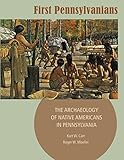
Kurt W. Carr, Roger W. Moeller. First Pennsylvanians: The Archaeology of Native Americans in Pennsylvania. University Park: Penn State University Press, 2015. Illustrations. 256 pp. $29.95 (paper), ISBN 978-0-89271-150-5.
Reviewed by April Beisaw (Vassar College)
Published on H-Pennsylvania (December, 2015)
Commissioned by Allen J. Dieterich-Ward (Shippensburg University)
Summarizing Pennsylvania’s Archaeological Past
Kurt W. Carr and Roger W. Moeller have produced what will surely be the definitive monograph on Pennsylvania’s archaeological past for decades to come. This richly illustrated work is aimed at the novice yet it could serve as a useful desk reference for professionals, especially those without easy access to the state’s archaeological grey literature. The authors begin with a summary of archaeology as a discipline and then proceed through time, from 16,500 years ago to 1750 AD, chronicling the archaeological remains of the Native American occupations in and around the state’s current borders.
The production of statewide archaeological summaries was popular in the 1950s to 1970s. For the first half of the twentieth century, the field of American archaeology sought to organize the variety of artifacts and site types that archaeologists had uncovered throughout each state. This organization of traits (for example, house form and pottery form) is known as culture history. The problem with culture history is that organizing variety does not explain the observed differences. A “New Archaeology” developed in the 1970s to 1980s to quantify and explain change as the result of such processes as the interaction of people with their environment. Now known as processual archaeology, the difference between two sites could be explained by such factors as distance to fresh water or the variety of plants available at a certain elevation. Culture is a process of adaptation. Carr and Moeller’s work is both culture history and processual archaeology.
For the first 168 of the 230 pages of this text, the record of stone tool manufacture and use is at the forefront, with site locations and plant remains as the secondary data discussed. This covers the Paleoindian period (10,000 to 16,500 years ago), the Archaic period (4,300 to 10,000 years ago), the Transitional period (2,700 to 4,300 years ago), and the Early and Middle Woodland periods (2,700 to 1,100 years ago). Pottery and architectural remains are given the most attention when discussing the Late Woodland/Late Prehistoric period (1,100 years ago to 1550 AD). The architectural and artifactual variety of the Historic period (1550 to 1750 AD) is covered in just 16 pages.
The processual approach has its own limitations. To reduce human behavior to environmental adaptation assumes that humans always make the decisions that are most optimal in terms of risk and reward. A newer archaeology developed in the 1990s and it is now known as post-processual archaeology. Under this paradigm, archaeologists look more closely at human experience, and that allows for interaction between peoples and places to be a driving force in culture change or cultural stasis. Carr and Moeller have sprinkled some post-processual archaeology throughout their monograph by ending each chapter with a fictional first-person narrative that seeks to illustrate what life may have been like for those who made the stone tools and lived at sites discussed in that chapter. What is missing is a discussion of how these narratives were constructed and what evidence was used to create them. Many accounts adhere to gender role stereotypes that a post-processual archaeology would avoid. One account, “A Middle Archaic Narrative,” includes problematic dialogue comparing two cultures: “They were very primitive” and “They have a different look, with dark skin and small noses” (p. 103). The final narrative, “An Indian in the Twenty-First Century,” begins with the disclaimer “I am not a white person writing an imaginary story about being an Indian, I am one” (p. 222). This narrative is guest authored by Robert Winters. A discussion of these narratives in the book’s introduction or in chapter 1 could have helped better situate them within the larger text.
This final narrative is also left to do the work of informing readers about today’s Native American populations. Labeling Native Americans as the “First Pennsylvanians” and ending their story at 1750 CE perpetuates the stereotype of the vanishing Indian. The epilogue summarizes the contents of the book and includes a two-page time line. Neither takes the opportunity to remind readers that Native Americans still live in the state. The time line identifies the Contact period (450 BP) with “European Materials” as its sole “Technological Highlights.” This is followed by the Modern period (200 BP) with all its cultural and technological development fields blank.
What Carr and Moeller do that makes this book invaluable is summarize the wealth of data that has been amassed through Cultural Resource Management (CRM). Since the late 1960s, certain governmental projects, such as road widening and bridge replacement, have required archaeological surveys to be conducted before ground disturbance begins. This work is regulated to state-level archaeologists and historic preservation specialists and the results of these surveys are often housed with them. Too much CRM data never gets into the publishing world of journal articles. As senior curator of archaeology at the State Museum of Pennsylvania, Carr has an understanding of Pennsylvania archaeology that cannot be rivaled by those who work elsewhere. Moeller is the chief executive officer of Archaeological Services and founding editor of the Journal of Middle Atlantic Archaeology. Interestingly the book’s meager bibliography references only twelve journal articles, with none from this journal.
First Pennsylvanians is a magnum opus for those interested in Pennsylvania’s past. Its extensive illustrations will draw in younger readers and provide comparative data for early career researchers. The thorough summary of evidence from each time period makes it a desk reference for everyone working on the archaeology of the greater Middle Atlantic and into the Northeast region. As a textbook, I would recommend this for a sophomore-level course in stone tool analysis, CRM, or even the history of archaeological thought. Within a classroom setting, the book’s weaknesses are merely fodder for discussion. Pairing First Pennsylvanians with historian Daniel K. Richter’s Native Americans' Pennsylvania (2005) would produce a more holistic understanding of the state’s Native history. Both books remind us of the need for more research into the state’s Native past and present.
If there is additional discussion of this review, you may access it through the network, at: https://networks.h-net.org/h-pennsylvania.
Citation:
April Beisaw. Review of Carr, Kurt W.; Moeller, Roger W., First Pennsylvanians: The Archaeology of Native Americans in Pennsylvania.
H-Pennsylvania, H-Net Reviews.
December, 2015.
URL: http://www.h-net.org/reviews/showrev.php?id=45114
 | This work is licensed under a Creative Commons Attribution-Noncommercial-No Derivative Works 3.0 United States License. |

