

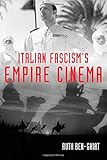
Ruth Ben-Ghiat. Italian Fascism's Empire Cinema. Bloomington: Indiana University Press, 2015. 420 pp. $35.00 (paper), ISBN 978-0-253-01559-4.
Reviewed by Erica Moretti (Mount Holyoke College)
Published on H-Italy (October, 2015)
Commissioned by Matteo Pretelli (University of Naples "L'Orientale")
Cinema and Empire
Ruth Ben-Ghiat’s Italian Fascism’s Empire Cinema is the first text to provide a comprehensive overview of empire cinema as defined and promoted by the fascist regime. It offers an in-depth analysis of feature films and documentaries produced in collaboration with or under the auspices of the interwar regime, and which have as their subject or setting the Italian colonies. Together with imperial literature and ethnography, empire cinema let Italians get acquainted with these far-away lands, depicted either as possible territories to conquer or else as already formed colonies. Largely forgotten after World War Two, these films provide an unparalleled window into the relationship between the Italian colonizer and colonized, the Italian metropole and its colonies. This cinematic genre was characterized by a close relationship between feature and documentary films, as the two styles informed each other and brought international attention to Italian film. Ben-Ghiat’s text offers a multifaceted reading of the subject, providing a rich analysis of the numerous national and international forces that shaped this cinematic genre, while providing insightful close readings of the filmic texts. It also sheds light on how these films offered a cinematic aesthetic that eventually laid the foundation for neorealism.
Among the central themes in Ben-Ghiat’s study is mobility: within Italy, and from Italy to the colonies or other foreign lands. From the nascent glamorization of travel, to fascist desires to regulate migration, to the figure of the nomad, Italian Fascism’s Empire Cinema explores the notion of mobility from a variety of perspectives. For instance, in the analysis of the Il grande appello (Mario Camerini, 1936), the author captures the regime’s ambivalent position vis-à-vis the Italian diaspora, examining in depth the protagonist’s wanderings through French colonial territories as a cypher of the regime’s attitude toward French imperialism. Here, Ben-Ghiat also analyzes the cinematic tools used by the regime to foster a sense of national belonging, such as metaphorical places used to symbolize Mussolini’s anxiety toward cosmopolitanism, successfully blending propaganda and entertainment. Empire movies do not only tackle the horizontal circulation of people and ideologies, but also vertical motion, such as aviation, through the depiction of aerial acrobatics, long-distance flights, and bombing scenes, as in the feature film Luciano Serra, Pilota (Goffedo Alessandrini, 1938). Often shot in military planes, these scenes underlined the synergy between the movie camera and the airplane, between cinema and propaganda, while also manipulating the medium to recall futurist aeropitture. Through her investigation of the notion of mobility, already at the center of other essays by the author,[1] Ben-Ghiat aptly connects to a broader historiography on the topic (i.e., nation outside the nation, Italian emigration, etc.) and implicitly contributes to the heated debate on Italy’s role in the modern Mediterranean.
Ben-Ghiat’s analysis of the category of empire cinema also sheds light on the relationship between war and cinematography. The majority of Italian empire films analyzed by the historian are war films: battle scenes are present in almost all the analyzed texts, and the directors often employed members of the military rather than professional actors. Furthermore, the armed forces were frequently involved in the direction of the films, loaning weapons and consulting on particular scenes. Due to the centrality of war as a theme, empire films developed a new visual mode that filled the spectator’s gaze with violence by fusing the shooter with the cameraman, allowing the spectator to participate in all the stages of colonial conquest. Indeed, Ben-Ghiat argues that this conflation was crucial to the regime’s maintenance of popular consent. The author’s perspective complicates the role of the film’s viewer vis-à-vis that of the camera, seen as an instrument of conquest and governance. This argument bears an uncanny resemblance to contemporary debates on media and war representation. As posed by critical theorist Judith Butler, the central issue in this debate is “the performative power of the state to orchestrate and ratify what will be called reality.” Butler calls for a necessary problematization of images of conflict (photography mainly), and for a condemnation of embedded reporting as a tool for the state that “operates on the field of perception and, more generally, the field of representability, in order to control affect, and in anticipation of the way that affect informs and galvanizes political opposition to the war.”[2] To use Butler’s words, this “forcible dramaturgy” by the state gives the viewer a biased perspective, one that dehumanizes the enemy and his suffering. Ben-Ghiat herself has rightly pointed out the current relevance of this issue in her analysis of the top-grossing war movie American Sniper (Clint Eastwood, 2014), a controversial feature that has ignited a heated debate on the representation of violence and its perpetrators—in this particular case the lone gunman so dear to the American imagination.[3]
In her analysis of this cinematic genre, issues related to race and corporality clearly occupy a significant place, as Ben-Ghiat devotes two chapters to them. In the first, the author delves into the relationship between colonizers and colonized (using Lo Squadrone Bianco [Augusto Genina, 1936] and Sentinelle di Bronzo [Romollo Marcellini, 1937]), and in the second, she explores the concept of Africa as a sensory paradise (with the help of the feature films L’Escalve Blanc [Jean-Paul Paulin, 1936] and Sotto la Croce del Sud [Guido Brignone, 1938]). In both chapters, the author examines how Italian dominance is racially and economically imposed on the populations. In doing so, she emphasizes Italian dependence on the occupied populations for governance, labor, and sexual satisfaction. Due to the small number of Italians who settled in the colonies and the lack of systematic training for those who worked or moved to the colonies, intermediaries, such as interpreters, and askari leaders were crucial to running the colonies, and, for the purpose of Ben-Ghiat’s analysis, to shooting the films. This condition of dependency permeates the films analyzed and highly influences the protagonists’ trajectories vis-à-vis the native populations. Ben-Ghiat highlights the anxiety over contact between colonized and colonizers, resulting in the sexual and moral contamination of white men and women.
In conclusion, Italian Fascism’s Empire Cinema contributes to an important rethinking of an understudied aspect of Italian history. Rarely is Italy’s colonial heritage mentioned in popular discourse, and when Italians do acknowledge their colonial past, it is frequently with the faulty belief that it was a comparatively mild form of imperialism conducted by italiani brava gente.[4] Ben-Ghiat is masterly in her examination of fascist endeavors to culturally dominate colonies and promote the occupation and dominance of colonial lands through cinema, showing her readers that colonialism was neither a marginal nor a mild chapter in Italy’s past. One hopes that this provocative work is only the beginning of an overdue conversation, and that future contributions will move beyond the doors of Italian archives to consult voices/sources/documents from the colonies themselves.
Notes
[1]. Ruth Ben-Ghiat, “Modernity is Just Over There: Colonialism and Italian National Identity,” Interventions: International Journal of Postcolonial Studies 8, no. 3 (2006); Ruth Ben-Ghiat and Stephania Malia Hom, eds., Italian Mobilities (London and New York: Routledge, 2015).
[2]. Judith Butler, “Torture and the Ethics of Photography,” Environment and Planning D: Society and Space 25 (2007): 952, 953.
[3]. Ruth Ben-Ghiat, “American Sniper, The Perfect Hero for Our Time,” CNN, February 22, 2015, http://www.cnn.com/2015/02/09/opinion/ben-ghiat-american-sniper-hero/, accessed on August 2, 2015.
[4]. Angelo Del Boca, Italiani, brava gente? (Vicenza: Neri Pozza, 2005).
If there is additional discussion of this review, you may access it through the network, at: https://networks.h-net.org/h-italy.
Citation:
Erica Moretti. Review of Ben-Ghiat, Ruth, Italian Fascism's Empire Cinema.
H-Italy, H-Net Reviews.
October, 2015.
URL: http://www.h-net.org/reviews/showrev.php?id=45111
 | This work is licensed under a Creative Commons Attribution-Noncommercial-No Derivative Works 3.0 United States License. |

