

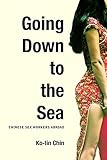
Ko-lin Chin. Going Down to the Sea: Chinese Sex Workers Abroad. Chiang Mai: Silkworm Books, 2014. x + 175 pp. $25.00 (paper), ISBN 978-616215077-7.
Reviewed by Sandy Chang (University of Texas)
Published on H-Asia (February, 2016)
Commissioned by Sumit Guha (The University of Texas at Austin)
In a dimly lit KTV (karaoke establishment), “Lily,” a Chinese woman from rural Sichuan, works as a hostess, entertaining clients and occasionally selling sex. After dropping out of middle school to work in a factory in Dongguan for fifty dollars a month, Lily opted to leave China with a friend in search of more lucrative work in the commercial sex industry. Drifting between jobs in Singapore and Malaysia, she ended up a few years later in Indonesia, earning 1,500 dollars a month. According to the prevailing trafficking paradigm, Lily would be categorized as a trafficked person. Her movement within the city is carefully monitored and circumscribed; she is required to give up her passport and travel documents to be held for “safekeeping” by her employers. In her own account, however, Lily sees sex work as a transient occupation, and dreams of saving enough to buy her own house back in China. The discrepancy between Lily’s personal experiences as a migrant and the dominant trafficking paradigm that casts her as a victim raises pertinent questions regarding how sex trafficking is and should be defined.
In Going Down to the Sea: Chinese Sex Workers Abroad, Ko-lin Chin explores these contentious debates by offering a first-hand look at the experiences of Chinese women working in the transnational sex industry. The book features a collection of eighteen interviews with women living in Bangkok, Singapore, Kuala Lumpur, Jakarta, Hong Kong, Macau, Los Angeles, and New York. Chin uncovers the underlying motivations behind each woman’s decision to migrate overseas in order to discern “whether they were deceived or coerced” into entering the sex trade (p. 3). Each interview is replete with intricate details about the industry, from methods of recruitment to the logistics of transportation, monthly earnings to individual experiences with clients. In highlighting the human dimension of commercial sex work, the author reveals how contemporary anti-trafficking policies have affected the daily lives of the people these measures are designed to protect, often with unintended consequences.
Lily’s story is typical of many young women from rural China who sell sex overseas. With little education or technical skills, they often turn first to low-paying work in factories around Chinese coastal cities before transitioning to sex work in pursuit of economic mobility. However, as Chin demonstrates, this transition is by no means emblematic of all Chinese women involved in commercial sex. In Going Down to the Sea, for example, readers are also introduced to “Michelle,” a college graduate unsatisfied with her salary as an entry-level clerk who moves to Singapore to work as a nightclub hostess, earning 6,600 dollars a month. There is also “Na Na,” who graduated with a degree in international business law, but longed to live abroad. After spending 40,000 dollars to be smuggled to the United States, she worked odd jobs in restaurants before selling sex in a rented apartment in Los Angeles.
What emerges from these disparate narratives is that the nature of sex work and the degree of exploitation each woman experiences is variegated and country-specific, precluding simple broad generalizations about the global sex industry. For example, while Chinese women are able to travel to Macau and Hong Kong with relative ease for sex work, they are also most susceptible to “chickenheads” or pimps there. In Taiwan, sex workers most often arrive under debt bondage and engage in highly organized commercial sex involving multiple parties; in Thailand, they frequently enter the trade with the help of female relatives and neighbors. In Malaysia and Singapore, there is a hodgepodge of sex venues, ranging from sauna, KTV, food courts, and massage parlors for women to ply their trade, while in the United States, many Chinese women work independently, keeping a low profile in order to avoid attracting attention from law enforcement officials.
Despite these differences, Chin also sheds light on how international anti-trafficking campaigns and the intensification of law enforcement at local levels have sometimes rendered Chinese sex workers more vulnerable to exploitation abroad. Since the implementation of the Trafficking Victims Protection Act (TVPA) in 2000, the US government has spent hundreds of millions of dollars each year to combat and prevent human trafficking. Rescue agencies, awareness programs, and stringent prosecution laws against traffickers have also flourished in many other countries, due to growing pressures from both the United States and the United Nations. While these measures emerge from goodwill intentions to protect trafficked victims, they often exacerbate migrant women’s dependency on brokers, third-party agents, and employers. In the United States, as Going Down to the Sea shows, these measures have increased the expenses of Chinese women hoping to “try their luck” in the country, with some spending as much as 73,000 dollars to be smuggled across the border from Mexico (p. 170). Similarly, in Hong Kong, police crackdowns on commercial sex have led sex workers to retreat from the streets, soliciting their business on the Internet instead. As a consequence, they face new challenges and dangers.
The interviews presented are based on fieldwork the author conducted between 2006 and 2008 for the award-winning book Selling Sex Overseas: Chinese Women and the Realities of Prostitution and Global Sex Trafficking (2012), coauthored with James O. Finckenauer. Going Down to the Sea presents eighteen stories from the total 149 interviews with sex workers conducted for the 2012 book. In Selling Sex Overseas, Chin and Finckenauer investigate the social organization of a transnational Chinese sex industry, interviewing sex workers, sex-ring operators, government officials, and nongovernmental organizations (NGOs). Arguing that rescued trafficked victims, which many researchers have based their studies on, are an unrepresentative sample of people involved in the transnational sex trade, Chin and Finckenauer aim to provide a broader overview of the operational aspects of the industry. Their conclusions challenge core assumptions that underpin contemporary anti-trafficking policy, which frequently depict sex workers as “sex trafficked,” ignoring the agency of many women who migrate not by force nor deception, but rather by choice—even if that decision is informed by economic, social, and familial constraints.
These findings echo the burgeoning body of work that is critical of the semantic slippage between sex work, sex trafficking, prostitution, and modern-day slavery in popular anti-trafficking and abolitionist rhetoric. Kamala Kempadoo argues that the dominant trafficking paradigm is driven by moral panic and fuelled by sensationalist reports that are often unsubstantiated and nonempirical.[1] In a similar vein, in Temporarily Yours: Intimacy, Authenticity, and the Commerce of Sex (2007), Elizabeth Bernstein suggests that the majority of sex workers enter the trade not by deceit or coercion, but by their desire for supplementary income and greater social and geographic mobility. More recently, Rhacel Salazar Parreñas, in her work on Filipina hostesses in Japan (Illicit Flirtations: Labor, Migration, and Sex Trafficking [2011]), shows that none of the migrant women she studied had been coerced into prostitution. Rather, she demonstrates convincingly that it is not sex work itself that makes migrant women susceptible to exploitation, but the anti-trafficking regulations and stringent immigration laws that render them vulnerable to trafficking and abusive labor practices overseas. By reframing sex work as one of several livelihood strategies available to migrant women, these studies call on policymakers to attend more closely to migrant experiences rather than focus on top-down legal measures that paint, in one broad sweeping stroke, women in sex work as trafficked victims, stigmatized and in need of rescue.
Going Down to the Sea engages with this broader literature on sex trafficking by offering nuanced insights on the experiences of Chinese sex workers. It suffers, though, from some methodological issues. To encourage his interviewees to speak freely, the author did not use an audio recorder nor take notes during his interviews. He recollected the answers from memory after the meetings rather than documenting them verbatim. This approach would not be so concerning if it were not for the narrative style in which Chin presents the interviews. In all eighteen chapters, he provides long, seamless passages where the women recount their stories in the intimate, first-person voice. Not only is the complex process of translation glossed over, but readers are also left unable to distinguish between what was actually being articulated by the sex workers themselves and what was, in fact, Lin’s own retelling of their stories. Although Chin concedes in the prologue that his method of interview was an “imperfect approach,” his choice to present the interviewees’ answers as if they were taken word for word seems, at worst, misleading and, at best, imprecise (p. 6).
Going Down to the Sea attempts to offer narratives of Chinese sex workers “in their own words,” but ultimately, it remains unclear how much of the passages are masked by Lin’s personal voice (p. 7). These accounts, far from being unvarnished, should be read as a subjective and mediated retelling of these women’s own stories. Despite these methodological issues, these stories are poignant and informative. The book is intended for a nonacademic audience; it is written in a simple and accessible style that will appeal to the general public and readers who wish to gain more knowledge of contemporary prostitution and sex trafficking. The interviews presented here are best read alongside Chin and Finckenauer’s Selling Sex Overseas for additional context and commentary.
Note
[1]. Kamala Kempadoo, “From Moral Panic to Global Justice: Changing Perspectives on Trafficking,” in Trafficking and Prostitution Reconsidered: New Perspectives on Migration, Sex Work, and Human Rights, ed. Kamala Kempadoo with Jyoti Sanghera and Bandana Pattanaik (Boulder, CO: Paradigm Publishers, 2005), vii-xxxiv.
If there is additional discussion of this review, you may access it through the network, at: https://networks.h-net.org/h-asia.
Citation:
Sandy Chang. Review of Chin, Ko-lin, Going Down to the Sea: Chinese Sex Workers Abroad.
H-Asia, H-Net Reviews.
February, 2016.
URL: http://www.h-net.org/reviews/showrev.php?id=45098
 | This work is licensed under a Creative Commons Attribution-Noncommercial-No Derivative Works 3.0 United States License. |

