

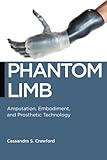
Cassandra Crawford. Phantom Limb: Amputation, Embodiment, and Prosthetic Technology. New York: New York University Press, 2014. 314 pp. $85.00 (cloth), ISBN 978-0-8147-8928-5; $26.00 (paper), ISBN 978-0-8147-6012-3.
Reviewed by Julie M. Powell (Ohio State University)
Published on H-War (December, 2015)
Commissioned by Margaret Sankey (Air University)
In Phantom Limb: Amputation, Embodiment, and Prosthetic Technology, Cassandra S. Crawford examines the embodied ghosts of amputation and the ways in which they both impact, and are impacted by, the world that they inhabit. Broadly, Crawford seeks to address questions about the transformative nature of prosthetization and, in doing so, to shed light on the nature of embodiment itself. She charts the historical trajectory of phantom limbs—how they have manifested, felt, and behaved—and phantom-prosthetic relations from mid-nineteenth century to present day. The author argues that the relationship between phantom limbs and prosthetics has “at times been pleasant accommodating, and mutually beneficial. At other times, it has been fraught with discord” (p. 24). Medical treatises and journal articles form the bulk of Crawford’s source base, which she supplements with a host of secondary-source literature on the body and science, adding a smattering of texts from the realm of disability studies, including the works of Katherine Ott, David Serlin, and Henri-Jacques Stiker.[1] Crawford is a professor of sociology and the Phantom Limb is published as part of New York University Press’s Biopolitics series. Unsurprisingly, then, Foucauldian notions of biopower undergird the largely discursive analysis. As is too often the case with such approaches, the writing tends toward the jargon-y and becomes, at times, impenetrable. Nevertheless, Phantom Limb offers much to scholars of the body, of science, and of technology.
Crawford begins her analysis with a discussion of corporeal ideology and a typology of phantom limbs, setting the preconditions for understanding the succeeding chapters. Corporeal ideology refers simply to what we know and believe, in any given time or context, about the body (p. 30). Such beliefs, as Crawford shows, have shaped not only how scientists and medical professionals have understood phantom limbs but, moreover, how amputees have experienced them. As Thomas Kuhn has argued, it is often difficult to recognize evidence outside of the hegemonic paradigm. Such norms kept ghosts in their places and understandings of their forms and functions stable until corporeal ideologies shifted, giving rise to phantom anomalies that subsequently necessitated a periodic reevaluation of the nature of the phantom limb (in Kuhnian terms, the operation of normal science).[2] Put simply, phantom limbs have moved, felt, morphed, and materialized differently, depending on prevailing notions about the body in any given time—ghosts can be historicized. Understood in 1871 as “skillful imitators …replicas of the original limb” (p. 35), a century later the “unnatural” phantom had become normalized; phantoms that manifested “out of place, as protean or as grotesquely disturbed in size and shape” had become widely recognized and accepted (p. 69).
A useful example of the impact of body ideology on embodied ghosts is the notion of phantom pain, which Crawford discusses in chapter 3. In the 1960s, phantom pain was reported at a rate of 5 to 15 percent, rising to 35 to 5o percent in the 70s, reaching its apex in the 80s and 90s with reports of phantom pain presenting in more than 80 percent of patients (p. 82). For Crawford, the rise is consonant with the normalization of pain medicine, the proliferation of pain clinics, the institutionalization of pain therapies, and a new vocabulary for pain, supplied by the widespread use of the McGill Pain Questionnaire (p. 73). While eminently believable, Crawford’s causal hypothesis is a bit thin. More context is needed. I am more than willing to accept that the availability of pain discourses made pain expressible and, as such, more detectable, more real. That said, I yearn to understand what provoked the creation of such institutions and discourses. The creation of pain as a new focus in the late twentieth century requires historicization here. Crawford is not a historian, but her project, as she has articulated it, is a historical one and her argument is all about context.
The author next tackles the conceptual shift from psychogenic to neurological understandings of phantom limbs. Crawford cites the rise of the medicalized body as the mechanism by which neuroscientists replaced psychologists and psychiatrists as the “legitimate arbiters of … diagnosis” (pp. 138-140). The shift, she argues eloquently, relocated phantoms from “the dark recesses of the disturbed or repressed mind … [to] the pink, convoluted folds of the cerebral cortex” (p. 142). The mystery of phantoms quickly eroded. Embodied ghosts became the motor of scientific discovery. Chapter five examines the production of new understandings of the relationship between the mind and body, resulting from the partnership of neuroscience and phantom limbs. Such discoveries beggar succinct summary but, as told through Crawford’s words, they are both comprehensible and endlessly fascinating.
In the final chapter, Crawford turns toward the phantom-prosthetic relationship, tracing its technological and ideological path through modern America. This is the author’s most historically grounded section, reflected in an increased reliance on secondary historical literature. That said, the use of historical contextualization is applied unevenly throughout the chapter, and in some cases (such as with the discussion of the late-twentieth-century shift to a reciprocal phantom-prosthetic relationship) causation remains frustratingly obscure (pp. 209-211). Following both the Civil War and the First World War, she contends, prosthetization “became a pivotal and productive project in the surveillance and regulation of male bodies” (p. 208). Such an assertion finds common ground with the claims of Beth Linker’s fantastic study of WWI-era rehabilitation; prosthetic rehabilitation was the precondition for military disability payouts.[3] In the case of soldiers, as late as the 50s and 60s, phantoms and the degree to which they could successfully animate a prosthetic were symptomatic of the amputee’s ability to readjust to civil life (pp. 208-209). In the 70s and 80s, though the mechanism is unclear, this changed. Phantoms and prosthetics awakened one another. As Crawford puts it, “the prosthesis was roused by the phantom, the phantom was tamed by its structure” (p. 211).
Ultimately, there is much to recommend in Phantom Limb. No doubt the author would have benefited by further engagement with the historiography on disability and bodily reconstruction but this far from invalidates the project. Such an engagement would only serve to strengthen her arguments. The use of phantoms as an ingress into ideas about the body is original and thought-provoking. The book is informative and well organized and uses tables and images to great effect. In thinking critically about where the body, technology, and medicine have been and where they are going together, Crawford’s book is a stimulating and welcome contribution to the scholarship.
Notes
[1]. Katherine Ott, David Serlin, and Stephen Mihm, Artificial Parts, Practical Lives: Modern Histories of Prosthetics (New York: New York University Press, 2002); David Serlin, Replaceable You: Engineering the Body in Postwar America (Chicago: University of Chicago Press, 2004); and Henri-Jacques Stiker, A History of Disability (Ann Arbor: University of Michigan Press, 1999).
[2]. Thomas Kuhn, The Structure of Scientific Revolutions (Chicago: University of Chicago Press, 1970).
[3]. Beth Linker, War's Waste: Rehabilitation in World War I America (Chicago: University of Chicago Press, 2011).
If there is additional discussion of this review, you may access it through the network, at: https://networks.h-net.org/h-war.
Citation:
Julie M. Powell. Review of Crawford, Cassandra, Phantom Limb: Amputation, Embodiment, and Prosthetic Technology.
H-War, H-Net Reviews.
December, 2015.
URL: http://www.h-net.org/reviews/showrev.php?id=45000
 | This work is licensed under a Creative Commons Attribution-Noncommercial-No Derivative Works 3.0 United States License. |

