

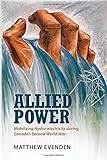
Matthew Evenden. Allied Power: Mobilizing Hydro-electricity during Canada's Second World War. Toronto: University of Toronto Press, 2015. 290 pp. $32.95 (paper), ISBN 978-1-4426-2625-6.
Reviewed by Daniel Macfarlane (Western Michigan University)
Published on H-Environment (September, 2015)
Commissioned by David T. Benac (Western Michigan University)
Hydro power seems a quintessentially Canadian conceit. And for good reason--as Matthew Evenden states in his excellent Allied Power: Mobilizing Hydro-Electricity during Canada’s Second World War, the country has historically been a hydro-electric superpower. At both the start and end of the Second World War, 98 percent of Canadian electricity came from water-spinning turbines, with Canada’s output increasing 40 percent in the six-year period over which the Second World War extended. At the close of the war, Canada was second in total hydro-power production only to the United States, and second in per capita production only to Norway.
Yet, given all that has been written about hydro-electricity in Canada (with some of the best work by Evenden himself), until now we did not have a coherent picture of one of the most intensive periods of hydro-electric development in the country’s history. The central argument of Allied Power is that wartime crisis facilitated an unprecedented expansion of state control over hydro-electric development, which boosted the country’s generating capacity for war production in order to make an important material contribution to the Allied war effort. Granted, some of the larger strokes of this argument are already known, but this is a synoptic explanation of how and why it all happened.
Indeed, the originality of this book is most apparent in its pan-Canadian approach to power development. As the author points out, studies of hydro-electricity in Canada tend to be bordered and focus on one utility or province. Similarly, in the Canadian historiography the Second World War is generally treated in discrete provincial containers with “little appreciation for how federal wartime power policy operated and with what wider effects”; in contrast, Allied Power “seeks to situate the Canadian wartime power outlook at several intersecting jurisdictional scale, at once provincial, national, and international” (p. 8). This reflects the fact that, prior to 1939, hydro power was chiefly under provincial jurisdiction; but during the conflict, the federal government centralized power over power, so to speak, which would have lasting consequences.
Interrogating the changing role of the state vis-à-vis hydro power, Evenden demonstrates that wartime mobilization resulted in the federal government taking on a more activist role. In addition to detailing the evolution of this process, one of the most important findings is the identification of path dependencies regarding the Canadian state’s development of hydro resources--the war established a range of roles, policies, and goals that continued after 1945. For example, the major developments of the postwar period, such as the St. Lawrence Seaway and Power Project, were generally deferred wartime projects.
Chapters 3 and 4 look primarily at Ontario and Quebec (Niagara, St. Lawrence, Ottawa, Saguenay system, Beauharnois, etc.); chapters 6 and 7 take up Alberta and British Columbia (primarily Lake Minnewanka, Kootenay, and the Fraser). One could say this book represents both a return to familiar ground, and an eastward progression, for Evenden: his first book was about the Fraser River in British Columbia, his second (co-authored with H. V. Nelles and Christopher Armstrong) was on Alberta’s Bow River, and in this volume the central Canadian provinces have a central role since Ontario and Quebec benefited most from the regionalized effects of wartime power development.
In breaking new ground while covering some old ground in new ways, Evenden also fills in gaps in Canada’s mid-twentieth-century hydro history. Many of the hydro projects featured in Allied Power have been previously studied in isolation (some by Evenden himself), but this book synthesizes them while adding some original findings. Detail is provided on a range of underexplored topics: Herbert Symington deserves a full biography; the Ogoki and Long Lac diversions into the Lake Superior basin might make a good dissertation topic; and the Ottawa River power developments are rife enough for a lengthy exploration by a scholar interested in transborder river projects.
An impressive feature of this book is the balancing of demand-side and supply-side. Two chapters deal with thematic topics such as conservation and the federal establishment of a power controller. While a number of chapters illuminate the increased production of electricity, the chapter on conservation homes in on attempts to reduce the usage of electricity, and its attendant social and cultural effects. Evenden follows the current down the line, for the organization and construction of electrical distribution systems that cut across the country are given far more than perfunctory treatment. Much of the hydro-electricity generated during the conflagration went towards aluminum production, which Evenden does a strong job of covering.
Allied Power shows how environmental history can be integrated with other historical fields, for this is equally a work of political economy, energy, political/diplomatic, economic/capitalism, and state-building history. The author glides smoothly between diverse areas such as federalism, Canadian-American-British relations, and engineering reports. Given that Evenden deals not only with production, but distribution and consumption, he connects with the literature on electricity by the likes of Thomas Hughes and David Nye, although historians of technology and STS scholars might have wished the author had pressed his findings a bit further. Nonetheless, this book could be considered a contribution to envirotech history, an emerging field that blends technology and environment (http://www.envirotechweb.org), and it obviously fits within scholarship that explores the links between war and environmental history (http://www.environmentandwar.com).
Eminently readable, engaging, and well supported with ample maps and images, this book will be useful not only for scholars of the Canadian home front and wartime mobilization, but also for those looking at other countries in the context of resource development during the Second World War. Evenden points out that damming a river was equally destructive in peacetime as during war; at the same time, as this book itself reveals so clearly, war led to a voracious increase in the scale and intensity of natural-resource consumption, with many projects or endeavours undertaken that might not have occurred otherwise, which in turn entrenched resource-consumption patterns that would continue after the war.
If there is additional discussion of this review, you may access it through the network, at: https://networks.h-net.org/h-environment.
Citation:
Daniel Macfarlane. Review of Evenden, Matthew, Allied Power: Mobilizing Hydro-electricity during Canada's Second World War.
H-Environment, H-Net Reviews.
September, 2015.
URL: http://www.h-net.org/reviews/showrev.php?id=44911
 | This work is licensed under a Creative Commons Attribution-Noncommercial-No Derivative Works 3.0 United States License. |

