

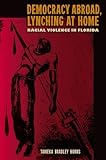
Tameka B. Hobbs. Democracy Abroad, Lynching at Home: Racial Violence in Florida. Gainseville: University Press of Florida, 2015. 288 pp. $74.95 (cloth), ISBN 978-0-8130-6104-7.
Reviewed by Brandon T. Jett (University of Florida)
Published on H-Law (February, 2016)
Commissioned by Michael J. Pfeifer (John Jay College of Criminal Justice, City University of New York)
Lynchings in Florida in the 1940s
Lynchings occurred with frightening frequency throughout the late nineteenth and early twentieth centuries as white mobs ranging in size from a few individuals to thousands of onlookers tortured, shot, hung, and burned thousands of African Americans for challenging their subordinate status throughout the United States. By most accounts, lynching essentially ceased or at the very least significantly declined by the 1930s; however Tameka Bradley Hobbs demonstrates that in North Florida lynchings continued well into the mid-1940s. By documenting the lynchings of Arthur C. Williams, Cellos Harrison, Willie James Howard, and Jesse James Payne, the author illustrates the longevity of lynchings in Florida, argues that World War II and the emerging Cold War shaped the response to these lynchings, and most interestingly, demonstrates how the narratives and memories of these events continue to affect black communities in these regions.
As previous scholars have demonstrated, Floridians lynched black Americans with as much frequency as many of their counterparts in neighboring states, but Hobbs stresses that lynchings continued in Florida much longer than almost everywhere else in the country.[1] Despite the persistence, the nature of lynching had changed. Florida lynch mobs in 1940s looked different than the spectacle lynchings of the turn of the century. According to Hobbs, “the extralegal murders of Williams, Harrison, Howard, and Payne confirm trends about the decline and change in extralegal violence during the mid-twentieth century” (p. 201). Each of the lynchings was carried out in the middle of the night by secretive and small assemblages of local whites. While lynching in the 1940s looked much different from mob violence at the turn of the century, the results remained the same. African Americans who challenged white supremacy or violated southern customs of etiquette were denied due process and died at the hands of white lynch mobs.
Democracy Abroad, Lynching at Home is not so much a study of the causes of lynching in 1940s Florida, but is instead more concerned with the reactions, both local and national, that each lynching garnered. By placing her study in an international context, Hobbs contributes to the emerging trend within the historiography that seeks to understand lynching and mob violence in relation to global trends.[2] “The new international aims of the U.S. government,” Hobbs claims, “dramatically impacted the ability of vigilantes in the South to continue to abuse and subjugate African Americans with impunity. The nation, and the world, was watching, and these realities demanded change if America was to claim the mantle of the world’s greatest democracy” (p. 4). Following America’s entrance into World War II, lynching proved a startling contradiction as the government attempted to portray itself as the defender of democracy while southern whites denied that right to African Americans at home. After each of these lynchings, local whites continued to support the actions of the mobs, but it was the public outrage from places around the country and threats of federal investigations of these vigilante actions that Hobbs believes is most significant. Following the lynching of Jesse James Payne in 1945, for instance, agents from the Department of Justice and the FBI investigated the circumstances surrounding the abduction of Payne from local authorities. Although the investigation closed and no one faced prosecution, federal intervention, Hobbs contends, “sent a clear message that the federal government would involve itself in the fight to stamp out lynching violence” (p. 173). Due to the change in national perception of lynchings and the federal government’s newfound interest in thwarting mob violence, lynchings in Florida came to an end.
While Hobbs’s contention regarding the change in national perception of lynching is well supported, the impact of those broader changes on local and state officials needs to be better explicated. Although people across the country denounced the lynching of Jesse James Payne in 1945 and the federal government opened an investigation into the lynching, Governor Millard F. Caldwell did not remove local law enforcement officials from office and even refused to acknowledge that Payne had been lynched. As Hobbs writes,, “all of the news articles, telegrams, phone calls, and other expressions of outrage and appeals for justice came to naught” (p. 174). The federal investigation never brought charges against anyone, local law enforcement officials remained in their positions of power, and, according to a contemporary observation in the Tampa Tribune, Governor Caldwell “enjoys today much higher esteem, confidence, and respect from the people of Florida than he did in the early days of his administration” (p. 186). While the decline of lynching and the change in national perception of the America’s role in the world were clearly related, in each of the case studies examined by Hobbs no members of the lynch mobs or local officials faced punishment; outside of one failed investigation in 1945, the federal government did little to combat mob violence; and the families of the victims received no form of compensation. While the language used to discuss and combat lynching may have changed due to the United States’ new role in international politics, for black and white residents of these rural counties in North Florida, what changed?
Hobbs is at her most compelling when discussing the ways African American communities in North Florida continue to grapple with the lynchings she examined. Despite reports in the white press and in local legal proceedings, Hobbs suggests that African Americans maintained and circulated their own interpretation of the lynchings, often crafting a narrative that maintained the innocence of the black victim. She states, “Despite attempts to suppress discussions of [lynchings] in the African American community, blacks kept these stories alive, sharing and retelling the tale in churches, in living rooms, and in schools, on front porches, and in the fields” (p. 150). While far from adequate justice for the atrocities these victims faced, black narratives allowed the African American community to “exercise control over, and extract cultural value from, the memory of instances of white brutality” (p. 218). She also speaks to the continuing fear and suspicion that permeate black communities that witnessed a lynching. Hobbs located relatives of lynching victims and conducted interviews with some of them, while others remained uninterested in conjuring up these past family tragedies. Her impressive efforts in documenting the effect of racial violence on black families and communities into the late twentieth and early twenty-first centuries emphasizes the “long-lasting climate of fear” that white violence perpetuated (p. 219). To better understand many African Americans’ distrust and suspicion of the American criminal justice system, Hobbs correctly asserts that we must understand how lynchings and other forms of racial violence contributed to this view. If, as Hobbs asserts, “more attention to the long-term psychological and social effects of lynching, racial violence, and unequal protection under the law in the United States is necessary,” then her book is an excellent example of how historians can contribute to this understanding (p. 220).
In all, Democracy Abroad, Lynching at Home is an important contribution to the field of legal history. While previous scholars have suggested that extralegal justice gave way to formal and institutionalized methods of due process by the 1930s, Hobbs reminds readers that this transformation was not ubiquitous.[3] In North Florida, adherents to extralegal violence, or “rough justice,” held sway over the operation of the local criminal justice system well into the 1940s, as small mobs continued to lynch African Americans, white residents refused to condemn the actions of vigilantes, and local law enforcement proved unwilling or unable to stop them. Hobbs’s most important contribution, however, rests in her examination of the short- and long-term effects of lynchings on black communities, and how World War II fundamentally shaped many Americans’ and the federal government’s response to lynchings. In all, Democracy Abroad, Lynching at Home is a welcome and valuable contribution to the growing field of lynching and mob violence studies.
Notes
[1]. Robert P. Ingalls, Urban Vigilantes in the New South: Tampa, 1882-1936 (Gainesville: University Press of Florida, 1993); Paul Ortiz, Emancipation Betrayed: The Hidden History of Black Organizing and White Violence from Reconstruction to the Bloody Election of 1920 (Berkeley: University of California Press, 2005); Walter T. Howard, Lynchings: Extralegal Violence in Florida during the 1930s (Selinsgrove, PA: Susquehanna University Press, 1995); Margaret Vandiver, Lethal Punishment: Lynchings and Legal Executions in the South (New Brunswick, NJ: Rutgers University Press, 2005); James R. McGovern, Anatomy of a Lynching: The Killing of Claude Neal (Baton Rouge: Louisiana State University Press, 1982); Stewart E. Tolnay and E. M. Beck, A Festival of Violence: An Analysis of Southern Lynchings, 1882-1930 (Urbana: University of Illinois Press, 1995).
[2]. William D. Carrigan and Christopher Waldrep, eds., Swift to Wrath: Lynching in Global Historical Perspective (Charlottesville: University of Virginia Press, 2013).
[3]. Michael J. Pfeifer, Rough Justice: Lynching and American Society, 1874-1947 (Urbana: University of Illinois Press, 2004); Elizabeth Dale, Criminal Justice in the United States, 1789-1939 (New York: Cambridge University Press, 2001).
If there is additional discussion of this review, you may access it through the network, at: https://networks.h-net.org/h-law.
Citation:
Brandon T. Jett. Review of Hobbs, Tameka B., Democracy Abroad, Lynching at Home: Racial Violence in Florida.
H-Law, H-Net Reviews.
February, 2016.
URL: http://www.h-net.org/reviews/showrev.php?id=44841
 | This work is licensed under a Creative Commons Attribution-Noncommercial-No Derivative Works 3.0 United States License. |

