

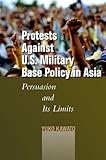
Yuko Kawato. Protests against U.S. Military Base Policy in Asia: Persuasion and Its Limits in Base Politics. Studies in Asian Security Series. Stanford: Stanford University Press, 2015. 248 pp. $45.00 (cloth), ISBN 978-0-8047-9416-9.
Reviewed by Jun Suk Hyun (University of Georgia)
Published on H-War (December, 2016)
Commissioned by Margaret Sankey (Air University)
Yuko Kawato’s Protests against U.S. Military Base Policy in Asia examines how anti-US base protests have influenced base politics in Asia. Kawato centers her study on twelve anti-base protests after World War II: three in the Philippines between 1964 and 1991, four in Okinawa between 1945 and 2010, and five in South Korea between 2000 and 2007. After analyzing these protests, the author reaches four general conclusions. First, protesters typically failed to persuade policymakers. Second, following rarely successful persuasion, “domestic institutional arrangements” turned out critical to the revision of established policies (p. 5). Third, even when protesters failed to persuade policymakers, their mobilization of large protests sometimes brought limited change to base policy by generating incentives for compromise. Finally, policymakers at times offered symbolic concessions when they needed to “generate a norm-abiding image, to save face for a failed attempt to change base policy, and to facilitate the implementation of an existing policy” (pp. 174-175).
When protesters called for change of base policy in each case, according to Kawato, they argued that existing policy was violating important norms or “widely shared principles” (p. 4). She calls these proposals, based on norms or proper behavior, “normative arguments.” The author explains that normative arguments change base policy through two processes. First, policymakers may find protesters’ arguments persuasive when normative arguments are not at odds with policymakers’ knowledge and beliefs and when protest leaders are also credible. Second, when persuasion fails, normative arguments can still mobilize large protests, thus creating incentives for policymakers to change base policy.
Kawato believes that her analysis based on “normative arguments” sheds light on unexplored areas of base politics. She finds that neither regime type nor security consensus, which previous studies have stressed in the change of base policy, is sufficient to explain why policymakers respond differently to protesters’ “normative arguments.” Focusing on “normative arguments,” Kawato argues, her study sorts out “a broader set of base policies” in “greater specificity than the earlier models,” according to a different extent of policy change in each case (p. 31). In this context, norms become subjective, depending on policymakers’ preexisting beliefs. Separation of persuasion and compromise also helps specify the different ways and the extent to which norms shape policy outcomes. Within a theoretical frame of international relations, Kawato argues, both constructivist and rational choice perspectives are useful to specify the “range of base-policy outcomes” in her study of base politics. While persuasion is a “constructivist micro-mechanism for learning,” compromise is a “rational mechanism based on cost/benefit calculations.” By specifying when “each perspective is more appropriate to explain the policy outcome,” Kawato’s study responds to the “recent trend” of “moving away from choosing either rational choice or constructivism” and looks into the “scope conditions of the two perspectives (p. 35).
With protesters’ normative arguments and credibility at hand, Kawato describes in five chapters how each protest has changed or brought compromise to base policy. Chapter 1 covers Okinawan protests against US land expropriation in the 1950s and against US military bases in the island prior to reversion (1972). The first case coerced policymakers to make symbolic concessions, and the second case ended in limited policy change through compromise. Chapter 2 discusses the other two Okinawan protests in the recent two decades. The first case, which took place in the mid-1990s, called for a revision of a Status of Forces Agreement (SOFA) and a reduction of bases and prompted a limited policy change through compromise. In the second case of 2010, regarding the relocation of the Futenma base, Kawato argues, protesters’ “normative arguments” succeeded in persuading Yukio Hatoyama, the Japanese prime minister. Due to bureaucratic resistance, however, Hatoyama failed to relocate the Futenma facility out of the island.
Chapter 3 highlights five base-policy disputes in South Korea after the 2000s. In 2001, the United States and South Korea agreed to revise criminal custody procedures of a SOFA in a limited way. The United States offered some symbolic concession to protesters’ demand of new environmental policy (2001) and criminal jurisdiction procedures (2002-3). Between 2006 and 2007, South Korea and the United States agreed on land expropriation and expanded US basement against large protests. Finally, local protests against prostitution did not influence the United States forces Korea (USFK), but the joint pressures from the US Congress and the Department of Defense (2002) eventually led to USFK’s renewed fight against prostitution.
In chapters 4 and 5, Kawato illustrates how US bases in the Philippines were removed after decades of local protests. During the 1960s and 1970s, protesters’ normative arguments against the Military Bases Agreement (MBA) did not persuade Philippine presidents. For example, the protest of 1964-65 led to a limited policy change through compromise. During the 1979 protest, policymakers offered symbolic concessions. After 1987, however, domestic institutions, including the Philippine Constitution and other legislation, bestowed on the Philippine Senate the central authority in base politics. Normative arguments against US military presence successfully persuaded the Senate and led to the final closure of US bases in the Philippines.
In this comprehensive study of anti-US base protests in Asia, Kawato offers brilliant insights into the key elements of successful protests against largely recalcitrant and reluctant policymakers. Nevertheless, there are still some points that the study should have better clarified in order to avoid confusion. In particular, the author’s recognition of the United States as a key actor in base politics is highly agreeable, but the proper role of the United States vis-à-vis domestic policymakers and protesters in each case needs more speculation. For instance, during the US governance of Okinawa, there was little consensus among top US policymakers regarding the wisdom of ongoing US rule on the island. Even before residents in Okinawa and Japan joined in nationwide protests against US occupation, many Americans, including Dwight Eisenhower, John Foster Dulles, Edwin Reischauer, and U. Alexis Johnson, expressed their eagerness to end the military’s rule there and work toward an improved US-Japan relationship. Apart from the military’s preoccupation with US military effectiveness, many American politicians and diplomats seemed ready to offer a compromise solution. In another case, the details of domestic institutional arrangements in the Philippines after 1987 overshadow the role of the United States during and after the 1992 “revolt,” which may be an important topic to some readers.
At the same time, the divers cases in time and place make it more challenging than usual to assume a common perception of “security” on either side of policymaker or protester. The Cold War geopolitics had long placed South Korea closer to Taiwan and (former) South Vietnam in the vicinity of China proper. Faced with immediate threats from the north, South Koreans in general had to put much more weight on security questions than Okinawans, the Japanese, or the Filipinos. Further, a reversal of base politics recently in South Korea and the Philippines, both of which reaffirmed their devotion to security ties with the United States, is also inconsistent with the observation that “protests over the years” have contributed to the “evolution of state behavior in the direction of normative prescription” (p. 185).
On balance, Kawato’s study expands readers’ understanding of how complexity surrounding security perception reshapes base politics in different situations. Kawato concludes that protesters challenge policymakers to “skillfully balance the various requirements to ensure security for all, in its fullest sense” (p. 186). To others, however, such a view might be an oversight of the vitality of security, placing overall security questions in potential jeopardy. In The Clash: U.S.-Japanese Relations throughout History (1997), Walter Lafeber describes how Washington feared that the Okinawan protests in 1995 might trigger a reassessment of “their entire security policy.” According to “one Pentagon official,” security is “a lot like oxygen,” which people barely notice. Once they begin to lose it, however, there would be “nothing else” they think about.[1] Both views might help explain what changes the direction of base politics from time to time. To readers who are interested in this question, Kawato’s Protests against U.S. Military Base Policy in Asia is a great source for inspiration.
Note
[1]. Walter Lafeber, The Clash: U.S.-Japanese Relations Through History (New York: W. W. Norton, 1997), 395.
If there is additional discussion of this review, you may access it through the network, at: https://networks.h-net.org/h-war.
Citation:
Jun Suk Hyun. Review of Kawato, Yuko, Protests against U.S. Military Base Policy in Asia: Persuasion and Its Limits in Base Politics.
H-War, H-Net Reviews.
December, 2016.
URL: http://www.h-net.org/reviews/showrev.php?id=44278
 | This work is licensed under a Creative Commons Attribution-Noncommercial-No Derivative Works 3.0 United States License. |

