

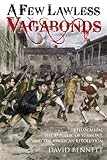
David Bennett. A Few Lawless Vagabonds: Ethan Allen, the Republic of Vermont, and the American Revolution. Havertown: Casemate, 2014. 520 pp. $32.95 (cloth), ISBN 978-1-61200-240-8.
Reviewed by Michael Verney (University of New Hampshire)
Published on H-War (November, 2015)
Commissioned by Margaret Sankey (Air University)
David Bennett’s book examines the complex drama of Revolutionary-era Vermont through the career of its primary defender, Ethan Allen, and to a lesser extent, through Allen’s brothers Heman and Ira. Bennett’s tale focuses on the Allens’ and Vermont’s troubled relationship with New York, New Hampshire, Massachusetts, the British in Canada, the King-in-Council, and the Continental Congress. The primary issue in these disputes was the legal status of the New Hampshire Grants. These were deeds of land sold by New Hampshire Governor Benning Wentworth in the 1740s and 1750s that New York, which was granted authority over much of present-day Vermont by the Crown in 1764, refused to honor. Enraged by the high-handedness of Yorker officials, Allen joined with like-minded Vermonters and formed the Green Mountain Boys in 1770 to protect the grantees from ejection by force of arms. Bennett claims that Allen’s famous seizure of Fort Ticonderoga in the name of “‘the great Jehovah and the Continental Congress,’” rather than being a patriotic move, was in fact a means of undercutting Yorker dominion over the New Hampshire Grants by hamstringing their royal supporters (p. 67). The author argues that Allen was not an ideological revolutionary or even a devout antiroyalist, but was instead animated by a fierce jealousy of Vermont’s independence, which Vermonters declared against New York in 1777 while Allen was in British captivity.
Bennett portrays Allen and his brothers as protean Vermont nationalists who strove to preserve the legitimacy of the New Hampshire Grants and increase the region’s prosperity. When the Continental Congress refused their repeated requests for recognition and membership, the Allens began seeing closer ties with British Canada as a viable alternative path to their cherished goals of independence and economic success. Accordingly, they signed a truce with the British in October 1780 and then began secret negotiations for the reunion of Vermont with the British Empire. The diplomatic cover for these sensitive talks—called the Haldimand Negotiations after the primary British agent, the Swiss-born Sir Frederick Haldimand—was the exchange of prisoners. Previous scholars, such as Michael Bellesiles (Revolutionary Outlaws: Ethan Allen and the Struggle for Independence on the Early American Frontier [1993]) and Willard Sterne Randall (Ethan Allen, His Life and Times [2011]), have doubted the sincerity of the Allens’ interest in reunion with the British Empire, portraying the Vermonters’ talks with Haldimand as a charade that would buy time and scare the Continental Congress into accepting its application for membership. In contrast, Bennett contends that the Allens were earnest in their attempts at reannexation. To dissuade Vermont from joining the Continental Congress, Haldimand offered the Allens promises that he had no authority to honor. Despite both parties’ sincerity, the Haldimand Negotiations went nowhere. The ratification of the Constitution of 1787 eliminated Vermont’s hopes for an economic free-trade treaty with Canada. Vermont would remain aloof from the United States until New York and New Hampshire abandoned their claims over Vermont’s territory, prompting the montane republic’s admission to the Union in 1791.
Bennett’s book takes aim at the romanticized vision of Allen as a backwoods democrat and one of the great patriotic founders of the United States. This vision has captured the imagination of generations of scholars who have refused to believe that the Haldimand Negotiations were serious and who have assumed that Allen had a revolutionary, democratic, and republican agenda. In contrast, Bennett argues that Allen was a Vermont partisan who cherished his adopted republic’s rights but also an oligarch who pursued an anti-democratic and secret agenda during the Haldimand Negotiations. Bennett contends that Allen’s “reputation as a Robin Hood is largely undeserved,” noting that his “ruling passions [did not] include justice for the peasants and yeomanry of Vermont” (p. 226). In Bennett’s telling, Allen’s struggle was a limited revolution against New York, a contest not to be equated with the Founding Fathers’ fight for continental independence or a democratic concern for the common man. As the author observes, George Washington and the Continental Congress were suspicious of Vermont republicans and time and again refused their entreaties for membership in the Union. At one point, Washington and the Congress even contemplated invading the wayward republic. Against all odds, the Allen brothers and their allies managed to evade the many threats to Vermont’s subjugation, and Bennett presents Allen as the founding father and chief defender (though perhaps not an egalitarian or democratic one) of an independent Vermont.
A Few Lawless Vagabonds is stimulating and provocative. Yet it also raises important questions about the motivations that drove Allen’s legendary energy. Bennett drops hints throughout the book that Allen’s commitment to Vermont may have had personal economic motives. Allen first purchased lands along the Onion River in northern Vermont in 1773 and then dramatically expanded those holdings in 1778. Since these properties had freshwater access to the Saint Lawrence River through Lake Champlain and the Richelieu River, they were well situated to carry on a prosperous trade with British Canada. This is especially so since New York blocked a southern export route via the Hudson River. Yet in asking if Allen’s efforts to effect a truce and trade agreement with Britain sprung from “an all-consuming economic motive,” Bennett answers that it “seem[ed] unlikely” and that Allen had no wish to “accumulate wealth to live in regal splendor” (pp. 224-225).
Why, then, did Allen risk his life in fighting for Vermont’s independence or his reputation during the Haldimand Negotiations, which Bennett observes would have been seen as treachery by other Vermonters? In an intriguing chapter on Allen’s political philosophy, Bennett concludes that he had no particular revolutionary ideology and that Allen’s greatest political influence was Thomas Hobbes. Allen found parallels with the experience of the New Hampshire Grants in Hobbes’s theory that peoples who did not enjoy political protection were thrown into a state of nature. Overall, Bennett describes Allen as bright, restless, and spontaneous. His politicization was an “accident” of history in which the New Hampshire grantees found Allen in need of employment and a new direction (p. 30). Given his roving character, Bennett expresses surprise at Allen’s lifelong opposition to New York’s claims over Vermont.
Allen’s single-minded dedication to Vermont leads us to consider his nationalism in particular and the meaning of nationalism in general. Bennett describes Allen as a “Vermont nationalist,” but he does not unpack this insightful concept (pp. 13, 222). Nationalism suggests a romantic attachment to a land and its people and culture. Did Allen reveal any of these romantic tendencies in his writings or actions? Since we cannot ascribe Allen’s motives to economic concerns or lofty ideological values, is it possible that some emotional attachment is the key to unlocking Allen’s Revolutionary-era activities? Bennett observes that Allen had hunted in the New Hampshire Grants in the late 1760s and that many members of Allen’s family migrated to Vermont from Connecticut and western Massachusetts during the 1760s and early 1770s. Perhaps these personal and familial activities formed attachments deep enough to be termed “nationalistic.” Bennett’s claim of the Allens’ parochial nationalism is especially challenging if we accept his thesis that the brothers’ efforts to reunite Vermont with Britain were honest ones. Scholars tend to think of nationalists as striving for independence and home rule, but Bennett suggests that nationalists might see annexation by a larger power as being in the nation’s best interest. Yet Bennett also claims that had the real substance of the Haldimand Negotiations been uncovered, the Allens would have turned into Benedict Arnolds, “burned their boats and committed themselves unequivocally to the British cause” (p. 210). Though A Few Lawless Vagabonds makes a compelling case for the dismantling of romantic renderings of Allen, the origins and depth of his nationalistic sacrifices for Vermont remains intriguingly opaque.
In sum, A Few Lawless Vagabonds has much to praise. Bennett’s command of the primary-source material from archives in Ontario and Vermont is impressive. His methodology of extracting goals from actions rather than assuming Allen’s place as a hallowed Paul Revere-like figure is also laudable. Military historians will take an interest in his chapters on the seizure of Fort Ticonderoga and of John Burgoyne’s southerly thrust in 1777, which Bennett calls “sheer folly” (p. 13). His analysis of the Haldimand Negotiations is the most exhaustive and compelling to date. While the impulses directing Allen and his brothers might have used more excavation, Bennett does an excellent job highlighting the fierce competition between colonies and states for land and resources. The author reminds us that British North America and the Confederation-era United States were composed of mini-settler empires that were frequently at odds with each other. His book illuminates the strength of David C. Hendrickson’s argument in Peace Pact: The Lost World of the American Founding (2003) that the Constitution of 1787 was a “peace pact” between rival states on the verge of civil war. By focusing on Ethan Allen, his brothers, and their allies, enemies, and potential friends, Bennett resurrects a Revolutionary-era world fraught with myriad hopes, aspirations, political philosophies, and intriguing possibilities.
If there is additional discussion of this review, you may access it through the network, at: https://networks.h-net.org/h-war.
Citation:
Michael Verney. Review of Bennett, David, A Few Lawless Vagabonds: Ethan Allen, the Republic of Vermont, and the American Revolution.
H-War, H-Net Reviews.
November, 2015.
URL: http://www.h-net.org/reviews/showrev.php?id=44245
 | This work is licensed under a Creative Commons Attribution-Noncommercial-No Derivative Works 3.0 United States License. |

