

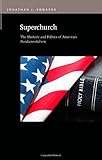
Jonathan J. Edwards. Superchurch: The Rhetoric and Politics of American Fundamentalism. East Lansing: Michigan State University Press, 2015. 265 pp. $44.95 (paper), ISBN 978-1-61186-159-4.
Reviewed by John Young (University of Alabama)
Published on H-AmRel (October, 2015)
Commissioned by Bobby L. Smiley (Vanderbilt University)
As recent scholarship has shown, Christian Fundamentalism has affected seemingly every aspect of modern American society in some form or fashion. Prominent ministers associated with the movement have taken their place in the public square, preaching and prophesying, often quite loudly, about any number of political and social concerns. Although the omnipresence of Fundamentalism has bred contempt in many circles, it has not always engendered equivalent levels of familiarity and understanding. Fundamentalism’s internal logic has proven difficult for outsiders to unravel, leaving important questions about the movement--questions like “What exactly are they fighting, and what are they fighting for?” (p. ix)--partially or wholly unanswered. Jonathan J. Edwards’s Superchurch: The Rhetoric and Politics of American Fundamentalism helps clear up much of this confusion, using an array of case studies to demonstrate the cruciality of churches, “both as symbolic elements within religious discourse and as the physical spaces within which such discourse often occurs” (p. xi), to Christian Fundamentalism.
Christian Fundamentalism, Edwards contends, can best be understood as a “church movement” (p. ix). This label does not mean that Fundamentalism is contained within a single congregation or denomination. Rather, the term signifies that Christian Fundamentalism’s political concerns ultimately revolve around the “survival and status of the Fundamentalist church” (p. x). The church, not the government, remains the “center of the Fundamentalist political landscape” (p. x), and individual Fundamentalists themselves are expected to be active participants in local “Bible-believing” congregations. These congregations can be powerful demonstrations of the movement’s numerical, technological, and organizational capacity. Yet contradictorily, they are also reminders of Christian Fundamentalism’s somewhat marginal status and self-conception as a persecuted minority in an increasingly godless world. Still, as Edwards notes, the church, “though embattled, offers the only earthly hope for protection and rescue from a culture and a world that has abandoned God” (p. xi). By returning the church to the center of discussion about Christian Fundamentalism, scholars and other observers will be able to speak more accurately about this highly significant force in recent American history.
Edwards begins with a brief discussion regarding the concepts of “public” and “counterpublic,” arguing that they can help us better understand Christian Fundamentalism by illustrating the tensions in the relationship between the movement and the modern secular state. “The notion that religious perspectives can be disconnected from modern politics continues to shape our academic and practical discussions” (p. 7), he writes, and this belief has provided necessary protections for religious and other minority groups. Yet it has also sidelined those groups who either cannot or will not believe they ought not to separate their “private” religious convictions from their “public” decision-making. These counterpublics, with their competing conceptions of which matters are private and which are not, define themselves in opposition to a perceived hostile public. Christian Fundamentalisms’ use of counterpublic speech, despite its potential for inciting violence and other antisocial behaviors, usefully “disrupts deliberative self-assurances and the ease with which democratic publics assert their tolerance, civility, and inclusivity” (p. 16).
Chapter 2 delves into Charles Grandison Finney’s 1834-35 Lectures on Revivals of Religion, given at New York City’s Chatham Street Chapel, to determine how it came to be that “fundamental truth coexists with, and to some degree operates within, pluralism” (p. xii) in the present day. Finney, the most well-known northern revivalist of his era, helped create a proto-Fundamentalist mindset by linking revivalist demands for individual repentance with more community-minded “jeremiadic” pleas--in his case, for the abolition of slavery--providing a distinctly spiritual impetus for social reform. Next, in chapter 3, Edwards traces the development of the Fundamentalist counterpublic identity which has determined the substance of the movement’s political activism and rhetoric. Early Fundamentalist newspapers and sermons, he observes, frequently argued that a worldwide confederation of political and religious “liberals” threatened the fundamentals of true biblical faith. The supposed existence and potency of this “modernist” oppressor, the public against which a Fundamentalist counterpublic came to define itself, led to the creation of Fundamentalist fellowships (which, ironically, were themselves quite modern in their quest to provide communal meaning in a pluralistic society.)
Another significant internal tension within Christian Fundamentalism is the struggle between the desire for separation and the need for public speech. Believers are “called upon to … embrace, as far as possible, the exclusive company of the faithful” (p. xiv), yet Fundamentalism’s revivalist heritage keeps it engaged with the broader world in hopes of transforming it. These competing discourses have shaped the movement’s public face profoundly. In chapter 4, Edwards examines 1970s and 1980s “Rapture” films to show how apocalyptic narratives “encourage public action by articulating a central role for the church in world events” (p. xv). Analyzing a 1971 sermon from Moral Majority leader Jerry Falwell, Edwards contends in chapter 5 that fears about the inherent dangers of powerful institutions gradually gave way to support for Fundamentalist networking and political organization, even though this ecumenical impulse contested the ideal of local-church freedom. Lastly, Edwards argues that recent evangelical leaders, like Bill Hybels of Willow Creek Community Church, have “adopted methods of aggressive church growth while largely abandoning apocalyptic dichotomies and appropriating more public norms of speech” (pp. xvi-xvii).
Even though Superchurch is chiefly a work of rhetorical criticism, historians will find much to like about it as well. Edwards interweaves thorough examinations of cultural sources, including newspapers, sermons, and films, into a clear historical narrative that provides a compelling account of the development of modern-day Christian Fundamentalist rhetoric. Most useful about Superchurch, however, is its author’s insistence that we take seriously the claims of Fundamentalists about themselves. This insistence does not mean that we should accept such claims at face value, or even that we should agree with them at all. (Edwards himself finds Fundamentalist assertions of marginalization spurious, and questions whether the movement legitimately constitutes a counterpublic or whether it merely coopts counterpublic rhetoric.) Yet for good or for ill, Fundamentalist speech is here to stay. In the end, perhaps the best-case scenario is that we can learn from it and “more effectively communicate and live with one another in the midst of both civil and uncivil demands” (p. 184). Superchurch is unquestionably an important step in that direction.
If there is additional discussion of this review, you may access it through the network, at: https://networks.h-net.org/h-amrel.
Citation:
John Young. Review of Edwards, Jonathan J., Superchurch: The Rhetoric and Politics of American Fundamentalism.
H-AmRel, H-Net Reviews.
October, 2015.
URL: http://www.h-net.org/reviews/showrev.php?id=44166
 | This work is licensed under a Creative Commons Attribution-Noncommercial-No Derivative Works 3.0 United States License. |

