

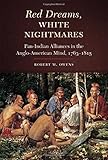
Robert M. Owens. Red Dreams, White Nightmares: Pan-Indian Alliances in the Anglo-American Mind, 1763-1815. Norman: University of Oklahoma Press, 2015. 320 pp. $32.95 (cloth), ISBN 978-0-8061-4646-1.
Reviewed by Benjamin T. Resnick-Day (Rutgers University)
Published on H-AmIndian (October, 2015)
Commissioned by F. Evan Nooe (University of South Carolina Lancaster)
Revolutionary Dreams, Existential Fears, and Pan-Indian Alliances
In Red Dreams, White Nightmares Robert M. Owens explores the Anglo-American existential fear of a general pan-Indian war from the late colonial period through the period of the early republic (1763-1815). Particularly,Owens examines the fear that such a war might be supported by the intervention of a foreign European power and a simultaneous black slave insurrection. These fears were based loosely on a realistic appraisal of pan-Indian capabilities and intentions, and partly on what Owens, following Gordon Wood ("The Paranoid Style: Causality and Deceit in the Eighteenth Century," 1982), characterizes as "European and colonial consciousness in the eighteenth century [that] tended toward an abiding belief in conspiracies" derived from an Enlightenment mentality (p. 6). Pervasive fear of a general Indian conspiracy took root after Pontiac’s rebellion in 1763, when Indians along the British frontier suddenly launched a massive coordinated effort to destroy forts and settlements on Indian lands, after rumors warning of its impending explosion had been ignored by British commanders. The sudden, unexpected, and devastating nature of the war, coupled with the fatal error of ignoring the warning signs of such an eruption, gave credence to many future rumors of an impending “general Indian war,” whether true or false. From that point, fear of a similar conspiracy guided British, and subsequently American Indian policy. Policymakers voiced their nightmare that an even broader conspiracy than that of Pontiac's rebellion might unite the populous tribes south of the Ohio River with those tribes of the Ohio River Valley and the Great Lakes, where there was a precedent for militant confederation. The American Revolution crystallized the association of the British invasion, slave rebellion, and pan-Indian uprising, and fear of this combination.
Images of gruesome atrocities committed by Indians fed an American sense of victimhood and self-defense even as the nation violently expanded onto Indian lands, killing and dispossessing native people as it did so. Indeed, Owens encourages us to understand the very reality of pan-Indianism, and of the terrors of Indian mode of warfare, humanizing “Indian hating” and Indian haters, and in the process understanding the role that fear played in justifying violent expansion and dispossession of native people in terms of “defense” (building heavily on the work of Peter Silver's 2008 Our Savage Neighbors: How Indian War Transformed Early America). British commanders, for their part, continued to fear pan-Indianism in spite of their efforts to control it and to direct it against the United States, even as Americans persisted in the mistaken belief that the British were the masterminds of pan-Indian warfare against them. However, Anglo-American unity within the new United States and the expansion of that new nation came at the expense of the parallel dream of pan-Indianism. Pan-Indianism suffered from mistiming, never quite bringing the pan-Indian threat to fruition concurrently with a sincere British war effort against the United States and a major slave rebellion. Missed opportunities and near-misses abound in this narrative. While pan-Indianism had its greatest chances of success in the 1790s, Owens argues, it served as a bogeyman in the American imagination well past even the War of 1812, justifying both fears of Indians and their violent dispossession, while memory of pan-Indian uprisings likewise remained a motivating hope for native leaders, such as Blackhawk, in continued violent resistance past the point at which hopes for a general alliance were realistic.
Owens gleans evidence from newspapers and the communications of British and American generals, politicians, and Indian agents, drawing from a broad base of British and North American archives to build his narrative. He builds on the historiography of the role that “Indian hating” and the fear of Indians played in a developing white identity, and (relatedly) in American nation-building, particularly the work of Peter Silver, cited above, and Patrick Griffin's 2007 work American Leviathan: Empire, Nation and the Revolutionary Frontier. Owens relies on the insights of a historiography of Nativist pan-Indianism grounded in the work of Gregory Evans Dowd's 1992 work A Spirited Resistance: The North American Indian Struggle for Unity, 1745-1815 to understand the independent agency of Indians in creating the pan-Indian movement. Owens follows this scholarship in rejecting the idea that their beliefs were merely reactive or traditional, or were manipulated and controlled by the British or other European powers.
Owens’s particular contribution is made in tackling a previously underexplored phenomenon over multiple generations, revealing the persistence and continuity of reactive American fears of pan-Indianism, demonstrating American readiness to believe rumors of imminent pan-Indian warfare and the role of fears of pan-Indianism in motivating American actions towards Indians and their potential European allies. Over an eighty-year period, American policymakers and commanders attempted to placate Indians, even to the point of restraining settler murders of Indians and risking the wrath of the states, and to sow divisions among and between Indian nations to prevent their confederation. Alternatively, US policymakers at times confronted the threat by launching aggressive preemptive strikes, such as the assault on the pan-Indian capital of Prophetstown in 1811, or by committing aggression against Spanish or British territory and persons that might serve to support pan-Indian war efforts. Whichever strategy the United States took, confronting and preventing this potential nightmare scenario guided American military and foreign policy towards Indians, and their real (or potential/imagined) European allies, throughout its infancy. The widespread perception of catastrophic threat, which has been touched on previously by other scholars, is comprehensively foregrounded and compellingly narrated by Owens. Accordingly, Owens’s material and themes are rich enough to be of interest to scholars beyond those focusing on colonial, early republican, or Native American history, since potential connections are manifold. For example, his work will resonate for scholars interested in the role that narratives of victimization, insecurity, and urgent threat play in justifying genocide in a settler-colonial context and beyond. (For example, there is a remarkable resonance between the dynamics in “Red Dreams” and the theory of genocide in Abdelwahhab El-Affendi's recent 2015 work, Narratives of Insecurity and the Logic of Mass Atrocities).
There are weaknesses here as well. Though his writing is generally compelling and easy to follow, Owens has a consistent narrative habit of passing judgment on the actions of American politicians or military men as “wise” or “foolish.” Perhaps this is meant to be more of a military history than I took it to be, making such judgments relevant to the work of the book. Still, these judgments do not always appear to be concretely tied to his overall argument about fear of pan-Indian conspiracy, so that it is not clear why the reader should be invested in evaluating the wisdom or foolishness of the decisions of particular commanders or politicians.
Furthermore, though I assume that this is primarily meant to be a work in the genre of Native American history and the history of white perceptions of Native Americans, Owens might have better integrated treatment of Anglo-American fears of slave rebellion, which makes frequent entrance into this narrative as a subordinate but associated concern.
Finally, this book is on the lighter side in terms of theory, dispensing with it by brief reference to the work of others, which admittedly may leave some readers unsatisfied while leaving others relieved. Specifically, this book leaves undertheorized and underexplored the issue of how fears of pan-Indianism were passed on through the generations, beyond a general understanding that such fears were transmitted through media such as books and newspapers and bedtime stories. Relatedly, a fuller exploration of his chosen topic might have given the psychological theory of fear and its transmission a more thorough and serious treatment, rather than the cursory and general observations on the topic he makes in the introduction. (He points out, for example, that fear induces hypervigilance, fight or flight responses, and a “limited consideration of alternatives,” for instance, and discusses the idea that people can inherit fears modeled by their parents in a general sort of way, pp. 5-6.) Owens’s work is, after all, essentially a history of fear, and thus would be relevant to historians of emotions, who have here and there also been early Americanists (see for example Nicole Eustace's 2012 1812: War and the Passions of Patriotism or her 2008 work Passion is the Gale: Emotion, Power, and the Coming of the American Revolution). Overall, Red Dreams is a very good, well-researched narrative survey of the persistence of fears of pan-Indian warfare in the Anglo-American world that will be quite useful to anyone interested in this and related topics for some time to come.
If there is additional discussion of this review, you may access it through the network, at: https://networks.h-net.org/h-amindian.
Citation:
Benjamin T. Resnick-Day. Review of Owens, Robert M., Red Dreams, White Nightmares: Pan-Indian Alliances in the Anglo-American Mind, 1763-1815.
H-AmIndian, H-Net Reviews.
October, 2015.
URL: http://www.h-net.org/reviews/showrev.php?id=44152
 | This work is licensed under a Creative Commons Attribution-Noncommercial-No Derivative Works 3.0 United States License. |

