



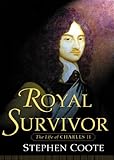
Stephen Coote. Royal Survivor: The Life of Charles II. New York: St. Martin's Press, 2000. xiii + 396 pp. $27.95 (cloth), ISBN 978-0-312-22687-9.
Reviewed by Andrew Barclay (History of Parliament Trust)
Published on H-Albion (August, 2000)
Oh no, not another biography of Charles II! How one's heart sank when this first appeared in the bookshops. Library shelves are already well-stocked with modern biographies of the "Merry Monarch." Over the past thirty years biographers as various as Maurice Ashley, Christopher Falkus, Lady Antonia Fraser, Tony Palmer, David Lunn, Richard Ollard, J.R. Jones, Ronald Hutton and John Miller have all tackled him.[1] Those by Hutton and Miller were substantial scholarly treatments, while Fraser's work (still in print) is widely thought to be a modern classic among popular royal biographies. Is there room for another?
There can be no doubt that it is Fraser's work that Coote is seeking to supersede. This is a popular biography by a writer who is not a specialist in the period and which is based on no original research. It was a fascination with the personality, not any broader historical agenda, which attracted him to the subject (pp. xi-xiii). What he has produced is very much "the life" rather than "the reign." Events before 1660 get as much attention as those after, with Charles's arrival in London in May 1660 marking the exact halfway point in the narrative. This is an emphasis which can easily be justified. Charles's story does divide itself into two halves of roughly equal length separated by the life-changing events of 1660. No one would dispute that his experiences in the 1640s and the 1650s were formative.
Yet the first half of the story works here only because it is one which cannot fail to interest. The loss of his father and the extended humiliations of exile are a biographer's dream. The escape from Worcester naturally forms a chase narrative and, in truth, can amount to little else. As usual, it receives extended coverage. Other events are recounted with no new insight. The vast spectacle of the Civil War is treated almost as an incidental backdrop to Charles's adolescence. It is all just one anecdote after another.
The standard of analysis does not improve once the story gets beyond the king's return to England. Predictably, we learn far more about Charles's mistresses than we do about his ministers. Coote's grasp of the subtleties of Restoration politics is, in any case, rather shaky, with the result that speculation on Charles's motives is rarely more than simplistic. The diplomatic context is a particular weakness. Whatever one may think about the secret clauses of the Treaty of Dover, a topic on which there is still plenty of scope for disagreement, it has never before been suggested that they were an attempt by Charles to "blackmail" Louis XIV. Could Charles really have believed that Louis, as the Most Christian King, would be "obliged to come to his support for the honour and security of Catholic Europe" (p. 239)? Not even James II fell for that one. All the big questions about the reign, including the ongoing debate about the nature of the 'Restoration crisis', seem to have passed Coote by.
This book has all the faults found in historical potboilers written from a narrow range of printed sources. Pepys and Evelyn, those godsends for the popular biographer, have been used only through abridgments, and, although Clarendon's History was consulted, the more relevant Continuation was not. Quotations are almost always culled from other secondary works. Most other statements are unsupported by any form of citation. Even as a string of unreliable anecdotes the narrative can disappoint. Why bother retelling the story about the Countess of Castlemaine castrating the corpse of Bishop Braybrooke (p. 251) without the punch line about "bishoprics"? That Coote adopts a critical view of his sources only as his subject's life is ebbing away is doubly unfortunate. The famous dying words about taking "a most unconscionable time dying" are not, as he supposes, one of Macaulay's inventions (pp. 352, 371). If only he had bothered checking, the footnote provided by Macaulay would have led him to a printed eyewitness source recording remarks exactly to that effect.[2] Macaulay knew what footnotes were for.
The advice regarding biographies of Charles II remains the same. Those requiring academic scholarship should read both Hutton and Miller, comparing and contrasting as they do so. (I perhaps ought to confess that I think Hutton has a freshness which Miller, for once, lacked). Those who just want a good read should try Fraser. It may have its faults, its enduring popularity is difficult to explain, but it remains the book on seventeenth-century British history which the man or woman in the street is most likely to have read.
Notes
[1]. Maurice Ashley, Charles II: the man and the statesman (London: Weidenfeld and Nicholson, 1971, reprinted St. Albans, Panther, 1973); Christopher Falkus, Charles II (London, 1972); Antonia Fraser, King Charles II (London: Weidenfeld and Nicholson, 1979, numerous reissues), printed in U.S. as Royal Charles; Tony Palmer, Charles II: portrait of an age (London: Cassell, 1979); David Lunn, Charles II (Glasgow: Blackie, 1979); Richard Ollard, The image of the king: Charles I and Charles II (London: Hodder and Stoughton, 1979, reprinted London: Pimlico, 1993); J. R. Jones, Charles II: royal politician (London: Allen & Unwin, 1987); Ronald Hutton, Charles the Second: King of England, Scotland, and Ireland (Oxford: Clarendon, 1989); John Miller, Charles II (London: Weidenfeld and Nicholson, 1991).
[2]. Letters of Philip, second Earl of Chesterfield (London, 1829), p. 279. Macaulay, following Chesterfield, reports Charles's remarks only as indirect speech.
Copyright (c) 2000 by H-Net, all rights reserved. This work may be copied for non-profit educational use if proper credit is given to the author and the list. For other permission, please contact H-Net@h-net.msu.edu.
If there is additional discussion of this review, you may access it through the network, at: https://networks.h-net.org/h-albion.
Citation:
Andrew Barclay. Review of Coote, Stephen, Royal Survivor: The Life of Charles II.
H-Albion, H-Net Reviews.
August, 2000.
URL: http://www.h-net.org/reviews/showrev.php?id=4411
Copyright © 2000 by H-Net, all rights reserved. H-Net permits the redistribution and reprinting of this work for nonprofit, educational purposes, with full and accurate attribution to the author, web location, date of publication, originating list, and H-Net: Humanities & Social Sciences Online. For any other proposed use, contact the Reviews editorial staff at hbooks@mail.h-net.org.

