

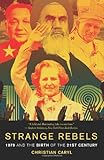
Christian Caryl. Strange Rebels: 1979 and the Birth of the 21st Century. New York: Basic Books, 2013. 407 pp. $38.99 (cloth), ISBN 978-0-465-01838-3; $17.99 (paper), ISBN 978-0-465-06567-7.
Reviewed by Javan D. Frazier (Middle Georgia State College)
Published on H-War (August, 2016)
Commissioned by Margaret Sankey (Air University)
In Strange Rebels, Christian Caryl argues that 1979 was a pivotal moment in world history, especially for China, Poland, Great Britain, Iran, and Afghanistan. Events that started in that year, he contends, still affect these societies and others worldwide. Caryl goes so far as to state that the twenty-first century started in 1979 and was heralded by four unlikely rebels: Margaret Thatcher, Deng Xiaopoing, Pope John Paul II, and Ayatollah Ruhollah Khomeini. The author labels these leaders as rebels because the ideas they advocated challenged many of the conventional norms of their cultures. Through persistence, persuasion, and, for some, harsh methods, these rebels significantly changed not only their nations but many others as well.
The organization of the book makes it difficult to get as much out of the work as I believe is there. The first chapter, “Malaise,” provides the context for major events occurring in the 1970s and briefly introduces the four rebels and the situation in Afghanistan. Though Caryl does not focus on any particular rebel in the case of Afghanistan, he notes that Khomeini and the Islamic Revolution profoundly influenced this nation particularly after the Soviet invasion of 1979. Subsequent chapters somewhat haphazardly alternate their focus on one of the four rebels or events in Afghanistan, making it difficult to follow each topic and rebel. Caryl alternates between Deng, Afghanistan, Khomeini, Thatcher, John Paul II, Khomeini, Afghanistan, Khomeini, Deng, etc. For example, chapter 5 discusses Thatcher but Caryl does not come back to her narrative until chapter 12. He discusses the events leading to Pope John Paul II’s accession to office in chapter 6 but does not pick up the narrative of the pontiff’s life again until chapter 15.
The author occasionally attempts to find commonalities between the rebels. For example, Caryl argues that the forces of religion caused major changes in Poland, Iran, Afghanistan, and other areas of the Middle East, and that the pope and and the ayatollah influenced these changes. He notes that the force of economics, particularly capitalist, marketplace-driven economics, propelled Thatcher and Deng to initiate reform that led to economic prosperity for many. Yet Caryl only rarely presents personal common bonds among the four; perhaps this is because there are so few. The book would have been stronger if he had woven the struggles, the rise to power, and the policies these four initiated to show their similarities.
Caryl has an extensive background as a journalist and the book flows well. Yet it is difficult to explain what this book is. The monograph includes parts that are biographical that reveal information about the rebels’ lives both before and after they entered public life. The work includes historical analysis on the rebels and events of the 1970s and beyond. The monograph reads as a work of biography, history, and journalism, and because of this it is difficult to deduce where the author was going in his writing.
The book is thorough in the amount of information it contains regarding the events surrounding the four rebels. The chapters on Afghanistan and Khomeini are particularly packed with dates, names, and events. Yet these chapters are so dense that it sometimes is difficult to keep all of the relevant dates, names, and events clear. It is difficult to decipher when events occurred, who was involved, and where they happened.
Caryl has provided an interesting and persuasive argument regarding the importance of 1979 and the influence of the four rebels. Though most scholars recognize the importance of these leaders, Caryl depicts them from a new and interesting perspective. He also demonstrates how important the 1970s were in world history and just how powerful an influence religion continued to have for some in the twentieth century and into the twenty-first. For college instructors, this book could be used in a world history class as a bridge from twentieth-century issues to twenty-first-century issues and challenges.
If there is additional discussion of this review, you may access it through the network, at: https://networks.h-net.org/h-war.
Citation:
Javan D. Frazier. Review of Caryl, Christian, Strange Rebels: 1979 and the Birth of the 21st Century.
H-War, H-Net Reviews.
August, 2016.
URL: http://www.h-net.org/reviews/showrev.php?id=43985
 | This work is licensed under a Creative Commons Attribution-Noncommercial-No Derivative Works 3.0 United States License. |

