

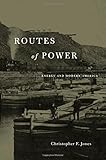
Christopher F. Jones. Routes of Power: Energy and Modern America. Cambridge: Harvard University Press, 2014. 320 pp. $39.95 (cloth), ISBN 978-0-674-72889-9.
Reviewed by Brian Leech (Augustana College)
Published on H-Environment (October, 2015)
Commissioned by David T. Benac (Western Michigan University)
At first glance, Routes of Power: Energy and Modern America is smaller in scope than the title implies. It is smaller because the book primarily traces the development of energy transportation infrastructure in the mid-Atlantic United States, providing a detailed portrait of coal canals, oil pipelines, and electric transmission wires. Author Christopher F. Jones convincingly argues that the building of each new type of infrastructure, not the simple discovery of new power sources, made energy more abundant and increasingly cheap, hence embedding fossil fuels and energy-intensive practices into mid-Atlantic life. Yet Jones’s ambitious book is in some ways bigger than the mid-Atlantic and his professed 1820 to 1930s period, as he seeks to uncover broader patterns behind energy transitions, while even suggesting ways to move toward a more sustainable future at the book’s end. Jones therefore deftly balances the particular and general in a book that will likely have a big impact on the quickly growing subfield of energy history.
Jones opens his book by considering canals built primarily to transport Pennsylvania coal to mid-Atlantic cities. He immediately makes a case for examining infrastructure, showing that financial investments in the transport of coal actually exceeded the amount spent on coal mining itself. Certainly much has been previously written on canals, but no one has shown just how involved canal companies were in creating new markets for anthracite. Jones then turns to oil, telling both some familiar stories, like one involving Standard Oil’s domination of railroad oil transport, and many unfamiliar ones, like that of teamsters sabotaging the first oil gathering pipeline or that of “Benson’s Folly,” America’s first long-distance oil pipeline, which many initially decried as foolish. Finally, the author discusses the transmission lines that mixed power from dams on the Susquehanna River with electricity from mineral energy. Unlike in the cases of coal and oil, neither the transmission lines nor the dams were the first of their kind, but their story does provide the reader with an understanding of how interconnected electric utilities reshaped urban life. By this point in Jones’s tale—the 1920s and 1930s—the mineral energy regime had almost entirely replaced the organic one.
The corporations that developed transportation networks promoted new applications for coal, oil, and electricity, convincing factory owners and residential customers that everyone now needed a new way to make light, heat, and power. The speed and reduced cost made possible by infrastructure meant that, at least at first, supply drove demand. In time, though, transportation infrastructure encouraged a set of “positive feedback loops,” in which financial investments, transportation company actions, and customers’ newfound demands each encouraged prolific energy use (p. 8). Transportation infrastructure and its synergistic loops therefore created “landscapes of intensification,” in Jones’s terminology. To create such landscapes, transport infrastructure connected the hinterland’s energy supplies with cities, leading to “unequal geographies” (p. 233); urban populations and industries benefited, while coal communities, oil towns, and dam sites suffered. Transport technologies therefore hid the negative effects of each new energy source from urban consumers.
Jones effectively weaves the above argument throughout the book, allowing him to come to some convincing conclusions. One particularly persuasive claim is that canals and railroads provide greater benefits to an entire region, especially extractive boom towns, than one-way, single-product technologies like oil pipelines. Even after people stop extracting Albertan oil sands, for instance, railroads can be reused for a new economic purpose, whereas pipelines cannot. Even if his focus lies on ambitious private entrepreneurs, Jones also suggests that public actors greatly shaped energy transportation.
One other notable element of this book is that Jones shows great comfort in finding and using quantitative evidence. This ease allows him to make fairly reasonable assessments of the impact each energy shift had on urban consumers. Jones does not spend as much time on how transportation technologies affected the other end of the energy production process, which is certainly a topic worthy of additional projects. Indeed, one good reason to pick up this book is that Jones provides a template for future research. Historians might be inspired by this book to more deeply compare either the environmental impacts made by or the hard labor involved in each type of energy transport—both are topics that Jones touches on in tantalizing but short discussions. Perhaps more important, this book’s conclusions suggest ways that historians can engage with activists and policymakers, all of whom need to be persuaded to look closely at both the “roots” and the “routes” of America’s energy addiction (p. 2).
If there is additional discussion of this review, you may access it through the network, at: https://networks.h-net.org/h-environment.
Citation:
Brian Leech. Review of Jones, Christopher F., Routes of Power: Energy and Modern America.
H-Environment, H-Net Reviews.
October, 2015.
URL: http://www.h-net.org/reviews/showrev.php?id=43943
 | This work is licensed under a Creative Commons Attribution-Noncommercial-No Derivative Works 3.0 United States License. |

