

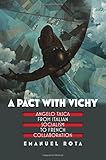
Emanuel Rota. A Pact with Vichy: Angelo Tasca from Italian Socialism to French Collaboration. New York: Fordham University Press, 2013. xii + 217 pp. $45.00 (cloth), ISBN 978-0-8232-4564-2.
Reviewed by Ernest Ialongo (Hostos Community College, The City University of New York)
Published on H-Italy (June, 2015)
Commissioned by Niamh Cullen (University of Southampton)
A Pact with Vichy: Angelo Tasca from Italian Socialism to French Collaboration
Emanuel Rota has written an intellectual biography of Angelo Tasca that seeks to tell the whole story, from Tasca’s beginnings in Turin socialism through to his collaboration with the Vichy regime. This has not been satisfactorily done, according to Rota, as previous scholars have limited their analyses within national boundaries. Italian scholars have focused on the early years of Tasca’s life as they relate to the Italian Socialist Party (PSI) and the Communist Party of Italy (PCI), and such scholars have downplayed the foundational role Tasca played in the Italian Left because of his expulsion from the PCI in 1929 and subsequent transformation into an anticommunist. Alternately, French scholars focus on Tasca’s time in France after 1929, especially his activities for the Vichy regime. Rota will do it all.
Of course, he pays due homage to Alexander De Grand’s fine biography of Tasca, In Stalin's Shadow: Angelo Tasca and the Crisis of the Left in Italy and France, 1910-1945 (1986), but distinguishes his work from its predecessor. He recognizes that De Grand focused on the transnational nature of Tasca’s life, but argues that his own biography places more emphasis on Tasca’s intellectual development. Moreover, Rota argues he was able to contextualize Tasca’s involvement with Vichy “without accepting Tasca’s self-exculpatory explanation, as De Grand has partially done” (p. 7).
In narrating Tasca’s early years, Rota’s seeks to abandon the “retrospective teleology” that historians have used to marginalize his subject in the history of Italian socialism (p. 10). To that end, he emphasizes how influential Tasca was in bringing both Antonio Gramsci and Palmiro Togliatti into the PSI, and that Tasca, like Gramsci, believed that the workers would only become revolutionary when they developed a working-class consciousness through their own autonomous culture. It was this shared view of Marxism that led Tasca, Gramsci, and Togliatti to found L’ordine nuovo and form the PCI. In the new PCI Tasca resolutely placed himself on the right. He refused to abandon the trade unions or the reformist socialists, hoping they could all work together toward their common goals, and he strongly argued for a broad alliance to combat fascism. Tasca refused to believe that fascism, democracy, and social democracy were to be equally combated as products of the capitalist system. It was these rightist views, in addition to what Rota believes was Togliatti’s unscrupulous actions, which eventually led to Tasca’s expulsion from the PCI. Rota argues that Togliatti purposefully sent Tasca to Moscow--just when Stalin had turned against rightist communists--in order to eliminate him from the PCI leadership.
After his expulsion from the PCI, Tasca continued to call for a coalition to resist fascism, and eventually made his way back to socialism. He joined the PSI in 1934, began writing for Le populaire, the paper of the French Socialist Party (SFIO), and became a French citizen so as to participate in France’s politics. The socialists recognized the growing domestic and international fascist threat and were willing to work with like-minded parties to resist it. Consequently, Tasca became a fervent supporter of Léon Blum’s Popular Front government.
However, though now technically a socialist, Tasca was increasingly having doubts about Marxism, and would eventually abandon it altogether by the end of the decade. He lost all faith in communism, as the Communist Party of France (PCF) had no real interest in defeating fascism. Their antagonism to the socialists precluded them from offering any ministerial support to Blum’s government. Moreover, the militant nationalism of the fascists was triumphing over internationalism. Finally, capitalism was not crumbling, and the class structure was not resolving itself into a struggle of the proletariat and the bourgeoisie. Therefore, Tasca began to envision a more national form of socialism, a movement that provided an economic and social vision that could appeal to all classes within France and hold back fascism. According to Rota, from 1935 to 1938 “the need to support the French Popular Front enhanced Tasca’s ideological transformation from a cosmopolitan revolutionary to a French citizen whose commitment was to the French government more than to international revolution” (p. 87).
With the failure of the Popular Front in 1938, however, Tasca’s primary means of promoting democracy and resisting fascism came apart. The SFIO was now hopelessly divided between a war and a peace faction. Moreover, Tasca’s hopes for the Franco-Soviet alliance against Germany were dashed by the Nazi-Soviet Non-Aggression Pact. From this point forward he fully committed to working with anyone who was willing to rally the French against the fascists. This mobilization, he concluded, had to be done from the top down by a group of elites, not the proletariat or the broader masses, and, according to Rota, Tasca felt that “such a unity … could also be worth the sacrifice of some political freedom--the ‘unessential’ part--because the alternative was to lose the battle with totalitarianism and all liberty with it” (p. 101). Thus, on the eve of war Tasca had come around to the belief that the only way to preserve democracy in France was to adopt an elite-driven, nationalist-inspired, potentially antidemocratic policy that was dangerously close to the very policies of the totalitarian states he was determined to resist.
This, of course, in Rota’s telling, would explain Tasca’s collaboration with the Vichy regime. In his penultimate chapter Rota details Tasca’s work for Vichy, and discounts his claim that he simultaneously aided the Resistance. After France’s defeat, Tasca wanted to transform France into a “national socialist” state that he felt Germany, Italy, and even the Soviet Union had become. He hoped to infuse some form of French pluralism into the mix, but ultimately his goal was to ape the successful totalitarian regimes in order to strengthen and liberate France. To this end, he was instrumental in having the socialist deputies vote for the constitutional powers conferred on Marshal Pétain, championed the regime in his writings for the collaborationist paper L’effort, and worked with everyone, including fascists, to rebuild France. He helped develop Vichy’s youth movement, he worked as the director of the Research Bureau under the secretary-general for propaganda (which worked against the communist Resistance), and silently accepted the regime’s anti-Semitic policies.
After the war, Tasca relentlessly attacked the French communists for weakening the nation in the thirties and for supporting the Nazi-Soviet pact, which all led to France’s defeat. He argued that Pétain’s actions were justified in the face of this defeat, and that he should be judged according to his intentions to help France, not by the actions themselves. Rota believes Tasca was indirectly making the case that his own actions were similarly justified, and has harsh words for such sentiments. In the concluding lines of his book, he writes, “the political context in which [Tasca] moved changed him much more than he was able to change the context itself, and he was left only with the conviction of the morality of his own political aspirations. This conviction was not enough for his contemporaries, and it is certainly still not enough for us. His attempt to use history to rehabilitate himself failed because the difficulties of the French context after the invasion did not prevent other people from making different choices” (p. 170).
It is curious Rota did not express such judgment earlier. The early chapters are in fact a patient analysis of Tasca’s intellectual evolution with nary an ill word for his political decisions--until he got to Vichy. Certainly, Rota is clear that his goal is not to read all of Tasca’s life from the perspective of his time under Vichy. Yet, the very success of this book is that it can make a very clear, and, as Rota says, “coherent” connection between decisions made by Tasca in the 1920s and those made in the 1940s (p. 4)--a connection rooted in an uncomplicated antifascism, and no tortuous teleology was required to make this point. It would have been useful if Rota had more clearly emphasized the critical turning points in Tasca’s thinking on the road to Vichy.
Another useful addition to this book would have been a more broad international focus. Rota writes that “contrary to De Grand, whose essential focus remains on Tasca’s relations with the Italian political world, I have emphasized Tasca’s relations with the international world of intellectuals who were trying to reform socialism during the interwar period” (p. 6). De Grand, in fact, does cover Tasca’s relations with both the French and the Italian Left. More to the point, Rota’s exclusive focus on the French has some limitations. For instance, Rota notes that after the PCF refused to offer ministers for Blum’s government “it did not take too long for Tasca to translate his practical anticommunism into a more theoretical position” (p. 84). De Grand’s study, however, is able to show just how long it took for Tasca to become a full-fledged anticommunist because of his overriding goal to resist fascism. He argues that Tasca supported unity of action between the PSI and the PCI through the Spanish Civil War as the only means available for fighting fascism. It also helped preserve the Franco-Soviet alliance against Germany. Similarly, Rota’s focus on the French obscures the influence of the Nazi-Soviet pact on Tasca. He notes that the pact sundered relations between the SFIO and the PCF, in which Tasca had an indirect role. But, De Grand shows us that in the PSI the leader Pietro Nenni still wanted to hold on to the alliance with the communists. It was Tasca who forced the issue, demanded an end to the alliance, and dramatically took over the leadership of the PSI on this very issue by December 1939.
Finally, I cannot agree with Rota’s contention that De Grand was more accepting of “Tasca’s self-exculpatory explanation” of his activities under Vichy (p. 7). This is not a fair characterization of De Grand’s analysis. Certainly, in De Grand’s chapter titled “Tasca’s Vichy Gamble,” he notes in a few places that Tasca’s activities for Vichy were “understandable.” By 1940, De Grand argues, Tasca considered himself a Frenchman, and, as such, he did not abandon his nation when it was defeated. He, like many others, including many socialists, remained in France seeking to help save it from complete collapse. However, De Grand also clearly points out that Tasca was heavily compromised by his work. The paper he wrote for, L’effort, loyally supported the regime and carried articles that were increasingly pro-Nazi. Also, although De Grand believes Tasca’s work for the Resistance was genuine, he has a viable explanation as to how Tasca could actively work for both Vichy and the Resistance, namely anticommunism. Tasca aided the noncommunist Resistance to help free France from the Nazis, but he also worked with Vichy against the communist Resistance because he did not want the PCF legitimating itself with its resistance activities and then parlaying that experience into real political power after the war. De Grand is hardly accepting of this reasoning. He explains it, calls it “morally ambiguous,” and points out that such questionable decision making did not seem to bother Tasca, though, we are led to believe, it should have (p. 167).
Of course, these issues are relatively minor compared to what Rota has achieved. It is a solid work of intellectual history that minutely details the various influences on Tasca’s thinking, especially in France, and certainly shows how Tasca the socialist eventually became Tasca the Vichyite. I recommend that one read Rota and De Grand back to back, however, as these two volumes complement each other very well. Where Rota provides the deep analysis, De Grand offers the broader context of such analysis. Students of Tasca, and of the Italian Left more generally, are well served by Rota’s volume.
If there is additional discussion of this review, you may access it through the network, at: https://networks.h-net.org/h-italy.
Citation:
Ernest Ialongo. Review of Rota, Emanuel, A Pact with Vichy: Angelo Tasca from Italian Socialism to French Collaboration.
H-Italy, H-Net Reviews.
June, 2015.
URL: http://www.h-net.org/reviews/showrev.php?id=43932
 | This work is licensed under a Creative Commons Attribution-Noncommercial-No Derivative Works 3.0 United States License. |

