

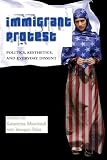
Katarzyna Marciniak, Imogen Tyler, eds. Immigrant Protest: Politics, Aesthetics, and Everyday Dissent. Praxis: Theory in Action Series. Albany: State University of New York Press, 2014. Illustrations. 320 pp. $90.00 (cloth), ISBN 978-1-4384-5311-8; $34.95 (paper), ISBN 978-1-4384-5310-1.
Reviewed by Emily Mitchell-Eaton (Syracuse University)
Published on H-Citizenship (January, 2016)
Commissioned by Sean H. Wang (Max Planck Institute for the History of Science and Syracuse University)
At the close of a year in which almost four thousand migrants have died in the Mediterranean Sea, brought to their death by the aggressively anti-immigrant deterrence policies of the European Union (EU) known as Fortress Europe, Immigrant Protest: Politics, Aesthetics, and Everyday Dissent is an absolutely crucial text. The first collection of its kind, Immigrant Protest brings together essays on an incredibly diverse set of immigrant protest strategies in an equally diverse set of contexts. It showcases a range of multi-media artistic political interventions, spanning from film critique and performance to installation art and pedagogical strategies, from both European and North American contexts.
This edited collection on immigrant protest and politics is fantastically transborder and transnational in the best sense: its transnationalism materializes through embracing a politics of difference—some of those differences being created vis-à-vis borders and the nation-state—rather than an erasure of those differences. The book’s orientation is centered on the agency of the migrants who lead these movements, those same migrants whose visions are driving these projects. The collection thus grounds itself in the work and vision of “migrants as subjects who matter” (p. 8). In particular, the chapters draw on narratives from undocumented and “irregular” migrants (the term “irregular” being somewhat of a misnomer given that such “irregular” migrants, in their supposedly exceptional status, have increasingly become the rule rather than the exception). These chapters also challenge notions of citizenship and “legality”—concepts that are always racialized, gendered, and classed—in order to reveal how such categorizations have produced exceptional and excluded subjects over time.
The collection is divided into two well-curated sections, the first dedicated explicitly to visual representation and performance, and the second broadly concerned with more conventional, or street-based, forms of protest. In the first section, “The Aesthetic Performance of Immigrant Protest,” the authors play with the tension between the seeming borderless-ness of art and new media technology and the “obsessive tightening of the border” (Alex Rivera, p. 84), which together form the interstitial space of many immigrant protests. For some of the authors, and for the artists whose work they examine, the space of the border takes on its most intimate meaning at the space of the body. In “Dare to Wear—A Mosque!,” for example, author and artist Azra Akšamija explores the concept of a “wearable Mosque,” in which the mosque is converted into an article of clothing, thus serving as a mobile space of prayer but also a space of everyday being, particularly necessary for those in contexts in which Orientalism and anti-Islam sentiments make such everyday being difficult.
The book’s first section also engages with the role of emotion in protest and resistance. The authors draw on a vast range of energies and emotions: rage, fear, anxiety, desire, and hope, among others. All of these are emotions of resistance, the authors remind us. Katarzyna Marciniak, for example, explores the political uses of im/migrant rage, which is counterposed with the simmering, persistent anxieties about immigration and race that characterize public discourse in both North America and Europe. Together, these pieces reveal the political potency of anger, an emotion that is often directed at immigrants by the media and by politicians, but that is unsanctioned and even criminalized when expressed by immigrants themselves, particularly when they direct their rage toward the oppressive systems imposed upon them. Here, Imogen Tyler reminds us of bell hooks’s important observation that “‘the rage of the oppressed is never the same as the rage of the privileged’” (p. 13). Such analytical engagements with emotion are vital, particularly in a moment when xenophobia has taken on a fever pitch in countries of the Global North, generating emotive currents that flow through political discourse.
The second section of the book, “In the Field: Acts of Immigrant Protest,” brings readers to the streets and other public sites of contestation. Here, we are introduced to asylum-seeker protests in Glasgow, the Hawara checkpoint near Nablus, and the clinics and welfare offices of Malmö, Sweden. Each of these case studies offers a glimpse into a distinct political and social context, revealing the effects of each particular nation-state on the daily lives of im/migrants, and the ways in which immigrant protest coalesces in response to, or in defiance of, national policies. In this section in particular, the authors attend to questions of place, space, and scale. In the book’s afterword, Tyler and Marciniak examine the “compulsory dispersal” of asylum seekers in detention centers throughout Europe; in another chapter, collectively authored by the Anti-Raids Campaign Coalition, the members describe their interventions in the spaces of immigrant raids and street stops to disseminate migrant “bust-cards” to advocates. In these richly detailed studies, the reader is reminded that the lived border is everywhere, materializing in traffic stops, maternity clinic visits, classrooms, and checkpoints. What emerges is an engaging exploration of these different border zones and scales of (un)belonging, following filmmaker Alex Rivera’s point that “every inch of the nation has become also its border” (p. 89).
By resisting the logic of “illegality,” and revealing the restrictions of narrowly defined or formal citizenship—such as that employed by the “host” governments—these chapters also force open a space for a more expansive, lived sense of citizenship. Through broader, lived definitions of citizenship, the authors, artists, and activists showcased here push for something more than the “right to have rights,” or the right to merely exist.[1] They conceptualize citizenship as belonging in a community; citizenship as engagement with art and aesthetics; a citizenship of liberation through resistance; and a citizenship that plays out in the commons, a commons defined more broadly than the nation-state. This is “citizenship from below” (Alexandra Zavos, p. 233).
Another central thread connecting the book’s chapters is the theme of (in)visibility: for whom is visibility empowering, even crucial to survival, and for whom is it life threatening? Collectively, these works challenge the xenophobic, anti-immigrant, fear-mongering representations of immigrants that saturate the media in the Global North—although not exclusively there—presenting instead a dynamic and diverse range of self-representations of migrant subjectivities. But the works in this collection also go beyond a resistance to oppressive policies, policing, and racism. Collectively, they imagine a resistance through playfulness, satire, and engagement with the absurd, a resistance that ridicules the violent (il)logic of border policing and indefinite detention. Simon Faulker, for example, refers to engagements with the absurdity of border policing as “the political struggle over the sensible” (p. 159). In the afterword, Tyler and Marciniak offer one poignant illustration of this dark comedy: Lamia, a migrant woman who is detained for working as a cleaner without a legal work permit, finds herself seeking employment—out of economic necessity—as a cleaner inside the detention facility that imprisons her. In this anecdote and many others, the authors expose the absurdist capitalist logics at work when dependence on im/migrant labor operates through im/migrant criminalization.
Much to its merit, this collection is decidedly feminist in its orientation. Several of the authors adopt explicitly feminist theoretical frameworks, while others, like Lena Simic, play with tropes like the “immigrant wife” and the “good mother” to reveal how women migrants are differently affected by experiences of immigration. In her writing on the Courts of Women, Marguerite Waller incorporates feminist analyses of the nation-state and nationalism, as well as an important critique of dominant human rights discourses, a critique that many transnational and Third World feminists have been mounting for decades now.[2] This feminist grounding lends Immigrant Protest a theoretically nuanced attention to the gendered dimensions of migrant identities, vulnerability, and agency.
As several thousand refugees arrive each day to Europe’s shores from Syria, Afghanistan, Somalia, and other countries, and as the United States continues to spend several billion dollars annually on the fortification, militarization, and surveillance of its land and sea borders, this collection offers a necessary intervention for scholars, activists, and artists working on issues of immigration. Readers on either side of the Atlantic will hear familiar echoes of the shared context of austerity, virulent xenophobia, border militarization, and racial profiling. This book serves less as a comparative analysis of immigration to Europe and North America and more as an exposition of the larger structuring forces of globalization and militarization that have come to shape immigrant experiences everywhere, though with varied place-based effects.
With its unique focus on immigrant protest, art, performance, and activism, Immigrant Protest brings together modes of protest and resistance that are too often examined separately. For those familiar with Rachel Ida Buff’s Immigrant Rights in the Shadows of Citizenship (2008), Tyler and Marciniak’s book will provide a timely update on social movements oriented around immigrant rights. This collection makes clear that no-border scholarship is absolutely vital in the contemporary context, in which the deadly effects of borders are increasingly evident. I highly recommend this book for anyone seeking a better understanding of how diverse immigrant rights movements can resist the violence of borders and create spaces for transborder and no-border alliances. Is it possible to construct a different kind of commons or “imagined community” within, or beyond, or despite the militarized, bordered nation-state?[3] This collection urges us to try.
Notes
[1]. Hannah Arendt, The Origins of Totalitarianism (Cleveland and New York: Meridian Books, 1958).
[2]. Inderpal Grewal, “‘Women’s Rights as Human Rights’: Feminist Practices, Global Feminism, and Human Rights Regimes in Transnationality,” Citizenship Studies, no. 3 (1999): 337-354; and Chandra Talpade Mohanty, “Under Western Eyes: Feminist Scholarship and Colonial Discourses,” Feminist Review (1988): 61-88.
[3]. Benedict Anderson, Imagined Communities (London and New York: Verso, 1991).
If there is additional discussion of this review, you may access it through the network, at: https://networks.h-net.org/h-citizenship.
Citation:
Emily Mitchell-Eaton. Review of Marciniak, Katarzyna; Tyler, Imogen, eds., Immigrant Protest: Politics, Aesthetics, and Everyday Dissent.
H-Citizenship, H-Net Reviews.
January, 2016.
URL: http://www.h-net.org/reviews/showrev.php?id=43738
 | This work is licensed under a Creative Commons Attribution-Noncommercial-No Derivative Works 3.0 United States License. |

