

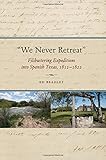
Ed Bradley. "We Never Retreat": Filibustering Expeditions into Spanish Texas, 1812-1822. College Station: Texas A&M University Press, 2015. 344 pp. $47.00 (cloth), ISBN 978-1-62349-257-1.
Reviewed by Matthew K. Saionz (University of Florida)
Published on H-War (July, 2015)
Commissioned by Margaret Sankey (Air University)
The filibusters that originated in the early nineteenth-century United States continue to simultaneously fascinate and mystify historians of the period. Privately organized and funded, filibusters essentially amounted to military expeditions led by rather sketchy figures intent on acquiring foreign lands through some combination of manipulation and force. Between the American Revolution and the Civil War, such expeditions occurred with apparent regularity and formed primarily in slave states along the Gulf Coast. The basic patterns of filibusters are well documented, but important questions remain regarding their motivations, their connections to state officials, and their overall significance. In “We Never Retreat,” Ed Bradley aims to make some sense of this phenomenon with a close examination of the filibusters into Spanish Texas during the 1810s. They key to understanding these expeditions, Bradley argues, is the context in which they developed. Indeed, Bradley illustrates how Spain’s political turmoil, mounting tensions between Spain and the United States, and an increasingly expansionist United States all set the stage for the Texas-bound filibusters of the early nineteenth century. But what actually drove the filibusterers was a muddled combination of republican idealism and the “material incentives” that awaited them with their anticipated success (p. 229).
Appropriately, Bradley begins his discussion of explicit Anglo-American interest in Texas with Philip Nolan, the notorious borderlands horse thief. Along with equally ill-reputed US Senior Officer James Wilkinson, Nolan jockeyed for commercial privileges in the Texas-Louisiana borderlands by carefully navigating the political miscommunications among (and likely colluding with) Spanish officials in the late 1790s. Bradley argues that, while ultimately caught and killed, Nolan indicated to Spanish officials not only that economic opportunities drew Anglo-Americans to Spain’s northern territories but also that they should expect similar ploys in the future. Those predictions began to materialize following the Louisiana Purchase in 1803, when uncertainty regarding the Texas-Louisiana border led to a handful of violent clashes that were calmed only by the tenuous creation of a “Neutral Ground” in 1806 (p. 19). However, boundary tensions between Spain and the United States erupted amidst the West Florida Controversy and the onset of the War of 1812 and the struggle for Mexican independence.
As Bradley observes, the “golden age” of the Texas filibuster coincided with this geopolitical maelstrom in the 1810s. During this tumultuous decade, a few rogue Mexican insurgents and particularly ambitious Anglo-Americans organized several filibusters into Spanish Texas with the stated intent of “liberating” its residents from the “tyranny” of Spanish rule and aiding the independence movement. Bradley explores the first of these, the 1812-13 Magee-Gutiérrez expedition, detailing its internal strife, its disastrous end, and the concern it raised among Spanish officials. Pondering the ambiguity of US foreign policy at the time, Bradley judiciously suggests that Madison’s aggression in Florida, the unwillingness of US authorities to prevent the expedition, and the placement of questionable US agents in the borderlands collectively indicate that Spanish officials were “quite justified in their suspicion of administration involvement” (p. 105). Meanwhile, as the Magee-Gutiérrez filibuster fizzled, others were already hatching plans for more expeditions. John H. Robinson, a doctor and veteran of the Zebulon Pike expedition, and José Álvarez de Toledo, an exiled Cuban revolutionary, each lobbied US politicians and wealthy benefactors for support throughout 1814 and 1815. However, in addition to meeting resistance from both suspicious Mexican revolutionaries and vigilant royalist forces, neither of them was able to garner the resources necessary for a successful incursion into Texas. The next few years saw numerous Anglo-Americans venture into Texas and other Spanish lands, and in 1818 General Andrew Jackson occupied Florida in pursuit of Seminoles (and likely runaway slaves). War between Spain and the United States seemed probable until diplomats settled on the Transcontinental Treaty in 1819, which awarded the Floridas to the United States in exchange for the relinquishing of claims to Texas. Disgusted over the “abandonment” of Texas, James Long (a failed surgeon) and like-minded men organized a filibuster in Natchez, Mississippi, in the summer of 1819. They quickly took Nacogdoches, established the “Republic of Texas,” and distributed “choice land” and commercial opportunities among the participants (pp. 172-173). Unsurprisingly, royalist forces arrived to scatter Long and his undersupplied supporters. Long returned for a final attempt in December 1820, but soldiers of newly independent Mexico captured him the following year.
In the closing chapter, Bradley offers his final thoughts on two lingering questions: the extent to which the US government involved itself with the filibusters, and the motivations of the filibusterers. In the first case, he brilliantly articulates the sly position of “neutrality” maintained by the Madison and Monroe administrations in their negotiations with Spain: they officially neither condoned nor condemned the Texas filibusters. However, we can read between the lines to gather that federal officials more or less tolerated such activity. Not only did US officials appoint agents who supported expansionist measures to important posts in the Texas-Louisiana borderlands, but the Madison and Monroe administrations also pursued the acquisition of West and East Florida through persistent diplomacy and force. In sum, the US government’s relaxed stance on the Texas filibusters “must be considered in the context of consistently acrimonious relations between the United States and Spain during the same period” (p. 228). In this sense, Bradley teaches us that the filibusters into Spanish Texas signaled the emergence of an expansionist United States that openly threatened the imperial holdings of Spain, Great Britain, and others.
On the question of motivation, Bradley proposes two very different answers. On the one hand, he acknowledges that material incentives likely drew most of the participants to Texas. On the other hand, he attributes to some of the members a desire to uphold republican ideals and liberate Texas from what was perceived as a European oppressor. Bradley struggles to reconcile these two motives throughout the book, intertwining his thoughts on the matter into his narrative of each key expedition. Yet perhaps they are best considered as complementary forces: republican duty and brotherhood justified their primary goal of material gain in the form of land, commerce, and silver. After all, one must consider how a James Long (himself a failed surgeon) or a John Robinson could possibly recruit several hundred nameless volunteers for expeditions with very little chance of a successful outcome. The rank-in-file members, if not the leaders, of the filibusters were likely in dire financial straits, adrift in a risky cotton economy unkind to those unable to secure sizeable tracts of land and slaves. As Bradley briefly mentions, the 1810s were difficult economic times for many in the United States, and the Panic of 1819 and ensuing depression exposed many to the dangers of speculative capitalism (pp. 177-178). For the petty laborers, fallen professionals, hopeful planters, fearful debtors, seasoned criminals, and romantic entrepreneurs who attached themselves to these filibusters, Texas potentially promised material rewards that had otherwise been unattainable in the United States.
In fact, the great strength of “We Never Retreat” is that it provides a glimpse into the driving forces of early nineteenth-century US expansion. Commercial interests and material opportunities propelled Anglo-Americans in growing numbers to distant lands across North America. But that fact should not discredit either the importance of “Manifest Destiny” ideology or the related rhetoric of republicanism that pervaded the Texas filibusters. Bradley superbly taps into this vital cultural vein of Anglo-American with his lively discussions of how US newspapers covered the rise and fall of each filibuster into Spanish Texas. The press in Missouri, Louisiana, and even Washington, DC, extolled the filibusters for their republican virtue and the “benefits” they could bring to Texan inhabitants even as it reluctantly pondered the possibility that, at heart, they were feeble attempts at land grabs. Material interests might have fueled expansion, but the well-entrenched cultural belief in Anglo-American righteousness sustained it. Thus, while Bradley remains skeptical of wedding them to Manifest Destiny, the early Texas filibusters were certainly a revealing chapter in the larger story of nineteenth-century US expansion, a drama that contained just as many failures as triumphs.
Finally, although Bradley sheds considerable light on this relatively understudied topic of early US history, he could have offered a more complete understanding of the filibusters and their implications by consulting more Spanish-language sources in both the United States and Mexico. Instead, much of the information we learn about Spanish officials or tejanos comes from the accounts of Anglo-American filibusterers and their letters to US correspondents. Importantly, such evidence might provide insight into what appears to have been a divided Texas, as large groups of tejanos eagerly joined the incoming filibusters, namely the Magee-Gutiérrez expedition. In other words, this is also a borderlands story about Spanish officials who, in addition to staving off filibusters, navigated both the outbreak of war in Mexico and increasingly disgruntled tejanos.
On the whole, “We Never Retreat” is a significant work that both US and borderlands historians will find valuable. Using an impressive array of documents and employing skillful analysis throughout, Bradley successfully rescues these expeditions from obscurity and explores their place amidst the turbulent geopolitical changes of early nineteenth-century North America.
If there is additional discussion of this review, you may access it through the network, at: https://networks.h-net.org/h-war.
Citation:
Matthew K. Saionz. Review of Bradley, Ed, "We Never Retreat": Filibustering Expeditions into Spanish Texas, 1812-1822.
H-War, H-Net Reviews.
July, 2015.
URL: http://www.h-net.org/reviews/showrev.php?id=43669
 | This work is licensed under a Creative Commons Attribution-Noncommercial-No Derivative Works 3.0 United States License. |

