

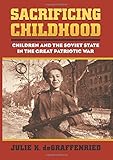
Julie K. deGraffenried. Sacrificing Childhood: Children and the Soviet State in the Great Patriotic War. Modern War Studies Series. Lawrence: University Press of Kansas, 2014. xiv + 248 pp. $34.95 (cloth), ISBN 978-0-7006-2002-9.
Reviewed by James Vaughn (University of Montana)
Published on H-War (November, 2015)
Commissioned by Margaret Sankey (Air University)
Julie K. deGraffenried's Sacrificing Childhood conjoins discussions within Soviet history about such "lofty" topics as mythos (as seen through the invaluable, if chaotic work of Richard Stites), officialdom, and individual suffering with a poignant consideration for the fate of the humble child during World War II. She argues that Soviet children became full participants in the mobilization for war with Germany, being used physically by the state as fighters and workers and psychologically in propagandistic portrayals. Before the war, Soviet mythos defined ideal childhood as a carefree existence. However, during the war children were encouraged to act like adults, debasing older notions of innocence. State media encouraged them to do their part, to be strong Soviet citizens in their contribution to the war effort. DeGraffenried argues that their key contribution lay in the performance of agricultural labor, and that through this function they played a vital role in generating Soviet victory. Children responded to state pressures by integrating "official mythology with personal experiences in an attempt to find meaning in a wartime childhood" (p. 103). DeGraffenried also explores how the state generated a masculine face for the childhood war effort over time through its portrayals of strong boys leading the charge against Fascism. While deGraffenried engages historical subfields dealing with gender, war, and oppressed groups, she also incorporates the history of memory into her discussion. She argues that the plight of children during the war, as exemplified through the Soviet experience, generated movements across the world that aimed to protect children. New statues commemorating the victorious child were erected across the Soviet Union after the war's end.
While deGraffenried provides a context for fascinating dialogue about an understudied and important portion of Soviet history, her argument goes too far in its indictment of the Soviet state as a perpetrator of inflicting suffering upon its young populace. She states that "the experience of children during the war was largely the result of a state that subordinated its needs—and its prewar definition of childhood—to the goal of winning the war" (pp. 5-6). While she does admit that the Axis certainly inflicted their own horrors on children during the war and acted as aggressors in the fight against the Soviet Union, her value judgment in this case fails to recognize that, from the perspective of the Soviet Union, the alternative to complete mobilization of all members of its populace for war entailed utter extermination at the hands of a powerful enemy bent on destroying the Slavic race in the name of lebensraum.
DeGraffenried's decisive use of such sources as children's memoirs, diaries, official reports about children, and Soviet children's press releases rightfully avoids rampant postmodern conclusions regarding the tenor of children's psychological incontinence resulting from the all-pervasive depredations of the Soviet monolith. In fact, she states that "the 'state' was not a monolithic actor but the many individuals and institutions that acted with varying public and private interests" included a diverse spectrum of people rather than a consistent application of policy (p. 3). However, her consideration would benefit from a Foucauldian understanding of power relationships that exist between systems and bodies. Such an understanding could be especially poignant when discussing child fighters. While deGraffenried does well in avoiding ideological stances that once pervaded Soviet studies, epitomized in the classic work The Bolsheviks Come to Power (1976) by Alexander Rabinowitch, her book would have also benefited from a study of the ideological groundwork that underlay the unifying drive and inherent mind-set that characterized Soviet thought and purpose. The published works of Vladimir Lenin or History and Class Consciousness (1968) by Georg Lukacs provide valuable insight into the underpinnings of the modern Marxist dialectic.
DeGraffenried's work offers an interesting, strictly monographic read into the role played by children during the Soviet Union's Great Patriotic War. She clearly lays out her main arguments and provides fascinating context for the interplay between child and state, although her writing does not always maintain consistent lucidity. Her book is worth reading whether one wishes to gain a deeper understanding regarding the Soviet perspective of World War II in general, historical issues surrounding Soviet children specifically, or even the origins of modern global children's rights movements.
If there is additional discussion of this review, you may access it through the network, at: https://networks.h-net.org/h-war.
Citation:
James Vaughn. Review of deGraffenried, Julie K., Sacrificing Childhood: Children and the Soviet State in the Great Patriotic War.
H-War, H-Net Reviews.
November, 2015.
URL: http://www.h-net.org/reviews/showrev.php?id=43658
 | This work is licensed under a Creative Commons Attribution-Noncommercial-No Derivative Works 3.0 United States License. |

