

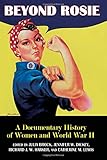
Julia Brock, Jennifer W. Dickey, Richard J. W. Harker, and Catherine M. Lewis, eds. Beyond Rosie: A Documentary History of Women and World War II. Fayetteville: University Of Arkansas Press, 2015. 245 pp. $22.95 (paper), ISBN 978-1-55728-670-3; $59.95 (cloth), ISBN 978-1-55728-669-7.
Reviewed by Kenneth Surles (University of Oregon)
Published on H-War (August, 2015)
Commissioned by Margaret Sankey (Air University)
Beyond Rosie: A Documentary History of Women and World War II is a collection of primary source documents detailing the experiences and contributions of American women during World War II. The documentary collection is a companion volume to a 2012 traveling exhibition from the Museum of History and Holocaust Education. The primary documents, which include photographs, official reports, editorials, executive orders, radio broadcast scripts, letters, and oral histories, demonstrate how women challenged traditional gender roles and stereotypes through their participation in the war at home and abroad. They also underscore women’s diverse motivations for serving, from patriotism to the opportunity to learn new skills and gain financial independence. The book’s major contribution to the field of women’s history is that it is the first of its kind to compile into a single volume a range of primary sources that cover various social, cultural, political, and economic perspectives on women’s participation in World War II.
The book is organized into five chapters that explore a specific arena in which women contributed to the war. The editors have prepared an introductory paragraph at the beginning of each chapter and brief headnotes before each document to provide readers with context for interpretation. The first chapter documents how the mobilization of women into industrial factories and agricultural sectors challenged gender stereotypes. Government officials and private industries depicted wartime jobs as fashionable and glamorous in an attempt to strike a balance between prevailing notions of femininity and the need for female workers. Chapter 2 details the experiences of women who found employment in white-collar professions, such as law, journalism, clerical work, and medicine. These jobs required women to prove not only that they were capable of traditionally male skills and knowledge but also that they could work in dangerous combat zones. A letter from a male officer of the Army Air Forces shows that women played an instrumental role in covering the war on the frontlines as reporters and photographers. Both chapters reinforce the notion that growth in women’s employment opportunities went hand in hand with an expanding federal government. Despite these new opportunities, however, women continued to face considerable discrimination especially in regard to equal pay, promotion, and acceptance by male coworkers and supervisors.
Chapter 3 traces women’s service in military auxiliary units, such as the Women’s Army Auxiliary Corps (WAACs) and Navy Women’s Reserve (WAVES). In addition to highlighting women’s contributions to the war effort, this chapter reveals the significant obstacles women faced in retaining their jobs once the war came to an end. Despite President Harry S. Truman’s order in 1948 to allow women to continue to serve full time in the armed forces during peacetime, supervisors, as well as prevailing cultural norms, often forced women out of their positions to make room for returning servicemen. Several documents, including surveys conducted by the National Women Veterans Foundation, show that patriotism was a primary factor motivating women’s decisions to join reserve units. Women’s letters and memoirs also reveal that their service generated intense feelings of pride and self-worth.
The collection shifts focus in chapter 4 to women’s domestic labor on the home front. The documents illustrate ways that women excelled in their management of wartime rations and food shortages, and the cultivation of victory gardens. Women found creative ways to feed, clothe, and care for their families in the absence of husbands and fathers. The documents reinforce the notion that despite the changes wrought by World War II, women still had the burden to ensure a prosperous and secure home for returning servicemen.
Chapter 5, the most original in scope, documents the secret war waged by the government including its use of women as spies and saboteurs and the internment of 120,000 Japanese Americans. As the editors point out, American women had a unique advantage “because they were considered less obvious than men and could often pass undetected through enemy lines” (p. xxix). Women could also use their sexuality to manipulate the enemy and extract important secrets. Thousands of women also worked as cryptographers to cipher codes for the United States Navy. The selection of documents on Japanese internment highlights both negative consequences of internment, such as the denial of due process, and Japanese American women’s perseverance while separated from loved ones.
The editors’ selection of oral histories throughout each chapter is a major strength of the collection. These histories give readers an intimate account of women’s day-to-day experiences during the war. An oral history conducted with a lesbian working for WAVES highlights the difficulty women had hiding their sexual orientation while serving in military auxiliary units. Lesbians were compelled to deny, suppress, or hide their sexuality, which created an environment of suspicion in which few people could be trusted. Additionally, an oral history excerpt of Clare Marie Morrison Crane from the American Folklife Center reveals a distinct shift on the home front from rationing, community victory gardens, and reliance on extended family ties during the war to the reconstruction of a new home life built on nuclear families and consumption during the postwar years.
The editors make a concerted effort to include the voices of women of color and they also note the widespread racial and class discrimination during the war. However, the collection places more emphasis on the experiences of white middle-class women at the detriment of women of color. Rather than underscoring their unique experiences, the documents often portray women of color as participating in the war in ways strikingly similar to white women. For instance, readers are left wondering how poor women of color navigated rationing and food shortages differently than white middle-class women. Despite this one shortfall, Beyond Rosie is an essential resource for historians of modern America and, in particular, women’s history. In addition to noting some of the oft-overlooked contributions women made to the war, the collection is an accessible way for teachers to introduce upper-level high school and undergraduate students to the practice of working with primary source documents.
If there is additional discussion of this review, you may access it through the network, at: https://networks.h-net.org/h-war.
Citation:
Kenneth Surles. Review of Brock, Julia, Jennifer W. Dickey, Richard J. W. Harker, and Catherine M. Lewis, eds., Beyond Rosie: A Documentary History of Women and World War II.
H-War, H-Net Reviews.
August, 2015.
URL: http://www.h-net.org/reviews/showrev.php?id=43633
 | This work is licensed under a Creative Commons Attribution-Noncommercial-No Derivative Works 3.0 United States License. |

