

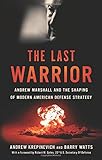
Andrew F. Krepinevich, Barry D. Watts. The Last Warrior: Andrew Marshall and the Shaping of Modern American Defense Strategy. New York: Basic Books, 2015. 337 pp. $29.99 (cloth), ISBN 978-0-465-03000-2.
Reviewed by Nicholas Sambaluk (Purdue University and the United States Military Academy)
Published on H-War (April, 2016)
Commissioned by Margaret Sankey (Air University)
One of the more obscure, but paradoxically also one of the more influential, figures in the Cold War was Andrew Marshall, a RAND analyst whose construction and leadership of the Office of Net Assessment would come to shape US security decision making. Marshall’s thinking, or at least extrapolations of his analysis, paved the way for bold expectations about revolutions in military affairs with respect to precision guidance in munitions. Andrew Krepinevich and Barry D. Watts aim to shed light on this important figure and his role in national security planning. The authors use the book title to proclaim Marshall “the last warrior,” since he was one of the last surviving lead figures in influencing US Cold War activity.
From the very outset of the work, the authors explain that their objective is to provide the “intellectual history” of Marshall, rather than his biography (p. xiii). Perhaps inevitably, however, retracing the intellectual development of a person intersects with significant life events, and for that reason the text offers biographical information, including Marshall’s heart condition that “precluded him from military service when the United States entered World War II,” as well as his wartime education in between long hours in defense plants (pp. 8-9). The early sections provide context about Marshall’s thinking, and the origins of net assessment itself first appear on page 73. From childhood onward, the authors find, Marshall demonstrated “an intense curiosity, combined with a love of reading,” which laid a strong foundation for intellectual capacity (p. 3). One of the enduring lessons that Marshall derived from his largely self-propelled studies was that popular visions of reality are frequently inaccurate.
A key tenet of his outlook, one that Marshall leveraged in his work throughout the Cold War, was a zeal for interrogating commonly held “wisdom” whenever it seemed founded on questionable information. One example was when Marshall sided with Secretary of Defense James Schlesinger rather than National Security Advisor Henry Kissinger during the 1970s, when the latter thought in less bullish terms about the US strategic position. Marshall believed that understanding Soviet capacity, and in particular being alert to shortcomings in its capacity, was an important element in developing more accurate revisions of estimated Soviet strength. This included considering the impact of culture and ideology on an adversary’s strategy, as well as reasoned deductions about economic efficiency. The authors note the enduring validity of Marshall’s thinking, beyond the Cold War era: “the fact that the Chinese have embraced Marshall’s definition of the [Revolution in Military Affairs] does not mean that Chinese views ... are a mirror image of US views” (p. 241).
Marshall’s influence grew during the tenures of defense secretaries Schlesinger and his successors Donald Rumsfeld and Harold Brown. Initially, Marshall had encountered institutional resistance to his information gathering, and his own vague descriptions of what “net assessment” meant had triggered resistance (p. 109). The process hit its stride when using historical baselines to develop measurement tools like the “Weighted Effectiveness Indices/Weighted Unit Values” to assess Warsaw Pact force’s practical combat power. Later contracted histories sought to develop a more complete understanding of the processes by which military innovation emerge. Marshall’s enduring impact had much to do with the “gentle guidance” he provided to “a cadre of individuals who understood enough about net assessment to appreciate its value” and then could utilize its methods in their own defense analysis (p. 177). In the wake of the 1991 Gulf War, Marshall worked to underline the importance of “develop[ing] appropriate operational concepts” that effectively used new technologies like precision guidance (p. 211).
Marshall, the authors emphasize, “thought it far better to concentrate on asking the right questions and leave the prescriptions to others” (p. 250). The emphasis on asking probing and valid questions is indeed one of the cornerstones of strong analysis. The book sometimes slips into a habit akin to prescription, however. Marshall is presented as a sagacious visionary, so much so that the authors apparently felt it necessary to take pains not to imply that he had single-handedly prognosticated the end of the Cold War. Sentences like “Marshall, as usual, was looking further ahead than most everyone else” (p. 238), however, reinforce the theme that Marshall was a singularly gifted individual.
At several points in the latter part of the book, Marshall is joined in the spotlight by the book’s coauthor, Krepinevich. Since both of the work’s authors served under Marshall for several years, it is in some sense understandable that aspects of their own work would become relevant to the scope of an intellectual biography of their boss. The somewhat reverential terminology makes the identification of Krepinevich in third person a bit awkward at times. The book celebrates Marshall’s influence during the Cold War, and quickly explains that Marshall’s influence was “overtaken” by wars in Afghanistan and Iraq (p. 235), thus dissociating his legacy from those national security frustrations.
As with many intellectual and institutional actors, Marshall’s impact casts a long shadow, continuing from the Cold War into the present period. This impact both adds to the relevance of such a study and complicates the historical task of conducting it. Nonetheless, The Last Warrior serves to help address an important space in the literature, regarding the role of Marshall in the US assessment of security challenges and opportunities.
If there is additional discussion of this review, you may access it through the network, at: https://networks.h-net.org/h-war.
Citation:
Nicholas Sambaluk. Review of Krepinevich, Andrew F.; Watts, Barry D., The Last Warrior: Andrew Marshall and the Shaping of Modern American Defense Strategy.
H-War, H-Net Reviews.
April, 2016.
URL: http://www.h-net.org/reviews/showrev.php?id=43620
 | This work is licensed under a Creative Commons Attribution-Noncommercial-No Derivative Works 3.0 United States License. |

