

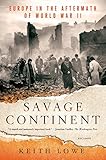
Keith Lowe. Savage Continent: Europe in the Aftermath of World War II. New York: Picador, 2013. xx + 460 pp. + 16 pp. of plates. $20.00 (paper), ISBN 978-1-250-03356-7.
Reviewed by Mark Montesclaros (U.S. Army Command and General Staff College, Fort Gordon Satellite Campus)
Published on H-War (December, 2015)
Commissioned by Margaret Sankey (Air University)
European Horror Story
The seventieth anniversary of VE Day this past spring may bring to mind visions of victory, peace, and new beginnings. Keith Lowe provides a stark contrast to this image in a harrowing yet well-crafted book that shows an alternate view to an overly optimistic characterization of VE Day, particularly as seen from the West. Indeed, the title Savage Continent refers to Europe in the aftermath of the Second World War, not during its conduct.
Reminiscent of recent works such as Timothy Snyder’s excellent Bloodlands: Europe Between Hitler and Stalin (2012) and the opening chapters of Tony Judt’s comprehensive Postwar: A History of Europe Since 1945 (2006), Lowe adopts a broad, continent-wide scope to describe the chaos and instability within Europe between the years 1945 and 1949. His primary contention is that for most of Europe, the war did not end with Germany’s surrender in May 1945. Many of the destructive forces at work continued long after the war, some relevant even seventy years later. This is evidenced by the author’s continued reference to decades-old issues which “remain controversial to this day” or are “still politically sensitive.” Thus, the portrait of postwar Europe painted by Lowe remains critical to any modern-day understanding of the continent.
Lowe organizes his attempt “to describe chaos” (p. xvii) along four broad themes, each given its own section of the book. “The Legacy of War” concentrates on the physical as well as psychological impacts of the war across the continent, and is a difficult yet engrossing read. It leads to the second section, “Vengeance,” in which victims of all manner and type seek justice or retribution against their tormentors—primarily the Nazi regime, its constituents and collaborators, as well as ordinary German citizens who were targeted both inside and outside the Reich’s borders. Vengeance is one of the author’s recurring themes, and has repercussions that echo in the Europe of today. The final sections are entitled “Ethnic Cleansing” and “Civil War.” The former deals with the multiple expulsions of whole populations that occurred within the continent both during and after the war, while the latter details the more localized internal conflicts that took place within the greater context of World War II. Many of these “wars within wars” were ugly, brutal affairs that mirrored the ferocity, if not the scale, of the broader world war.
While it is beyond the scope of this review to catalog all of the horrors discussed by Lowe, suffice it to say that he offers a grim depictionof European devastation that includes damage to cities and infrastructure, loss of life, population displacement, famine, moral depravity, and violence. The author spares no details in his stark descriptions of postwar Europe, and some of them—the horrendous number of rapes committed by soldiers of all armies; civilian casualties and collateral damage; violence to women and children; and atrocities of all types and motivations—are particularly tragic and difficult to imagine. Lowe does this in a manner which is inclusive, never trivializing such horrors as the Holocaust while effectively covering perhaps lesser-known events of chaos and violence which pale in comparison. However difficult to digest, Lowe’s description paints a gritty, realistic portrait of life in Europe in the immediate postwar period.
Savage Continent has some obvious strengths. The author is very effective in contrasting western and eastern Europe, where the death and devastation were orders of magnitude greater, based on the underlying conditions and particular ferocity of the combat in the East. To this end, Lowe makes particularly good use of a number of eastern European sources, previously untapped, that add depth to his narrative, providing a perspective from countries such as Romania, Poland, the Baltics, and the former Czechoslovakia. Additionally, vignettes from both eastern and western Europe put a human face on the litany of statistics referred to in the work, which can be difficult to contextualize. Lowe effectively incorporates these personal stories, resulting in a more holistic and readable narrative.
Another strength is balance. The author assigns blame wherever it is deserved, and does not shy away from Allied contributions to postwar chaos, including the physical destruction caused by Allied bombing campaigns, particularly on civilian targets with little military value, and Allied treatment of German prisoners of war. He also admirably takes on the sensitive issue of the manipulation of statistics for political purposes; indeed, Lowe spends a great deal of time trying to demystify the many claims associated with “national myths” proffered by European participants following the end of the conflict, in order to advance particular narratives of either heroism or victimhood. The author does his best to provide an objective view of such statistics (e.g., total numbers of atrocity victims or displaced persons), acknowledging the range of claims while generally relying on less-biased official sources. In doing so, Lowe adds depth and realism to his work.
In its totality, Savage Continent is valuable because it compels one to see WWII in a different light. The Allied-Axis struggle is in some cases merely one layer of context through which to view the grim conflicts in Europe due to ethnic, cultural, or ideological tensions—whose roots preceded the war and whose effects in some cases continued long after it. Indeed, as previously mentioned, the number of issues which Lowe considers relevant to Europe today are many and deep-rooted. Meticulously researched and well documented, Lowe provides a detailed portrait that is vibrant, relevant, and necessary. In the author’s own words, “Forgetting is not an option” (p. 376). Savage Continent is a harrowing yet necessary journey towards a greater understanding of modern-day Europe, and makes a significant contribution to scholarship devoted to the continent during the postwar period.
If there is additional discussion of this review, you may access it through the network, at: https://networks.h-net.org/h-war.
Citation:
Mark Montesclaros. Review of Lowe, Keith, Savage Continent: Europe in the Aftermath of World War II.
H-War, H-Net Reviews.
December, 2015.
URL: http://www.h-net.org/reviews/showrev.php?id=43602
 | This work is licensed under a Creative Commons Attribution-Noncommercial-No Derivative Works 3.0 United States License. |

